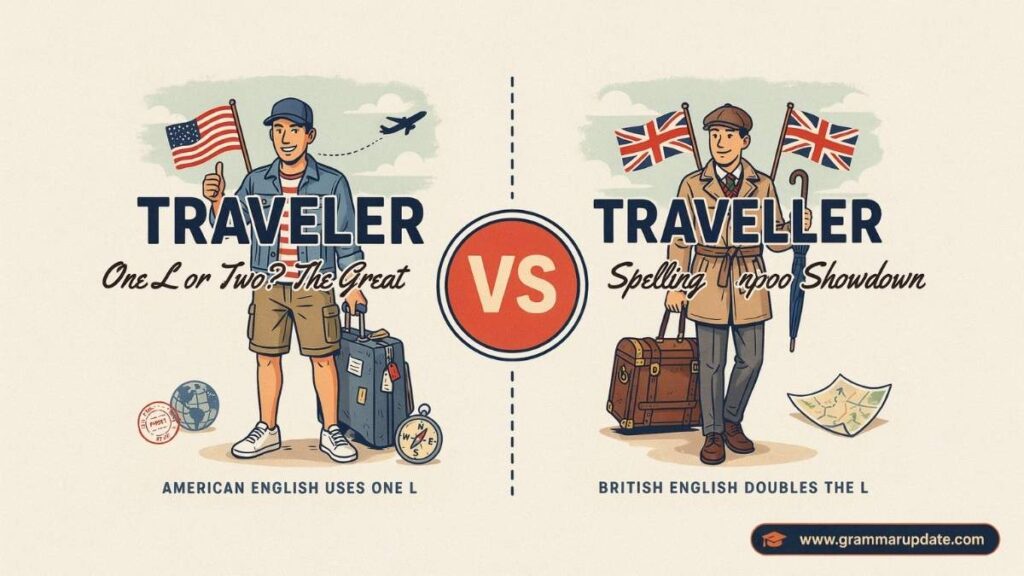
If you have ever paused mid-sentence wondering whether it’s traveler vs traveller, you’re not alone and no, your keyboard isn’t broken. English often creates confusion through regional spelling differences that look more complicated than they are. Both words appear different, yet they mean exactly the same thing: a person who moves from place to place. The confusion comes from American and British English developing separate spelling systems over time. “Traveler” is the simplified American form, while “traveller” is the traditional British spelling. In this guide, you’ll clearly understand why both exist, when to use each one, and how to avoid common spelling mistakes with confidence.
Traveler vs Traveller What’s the Difference?
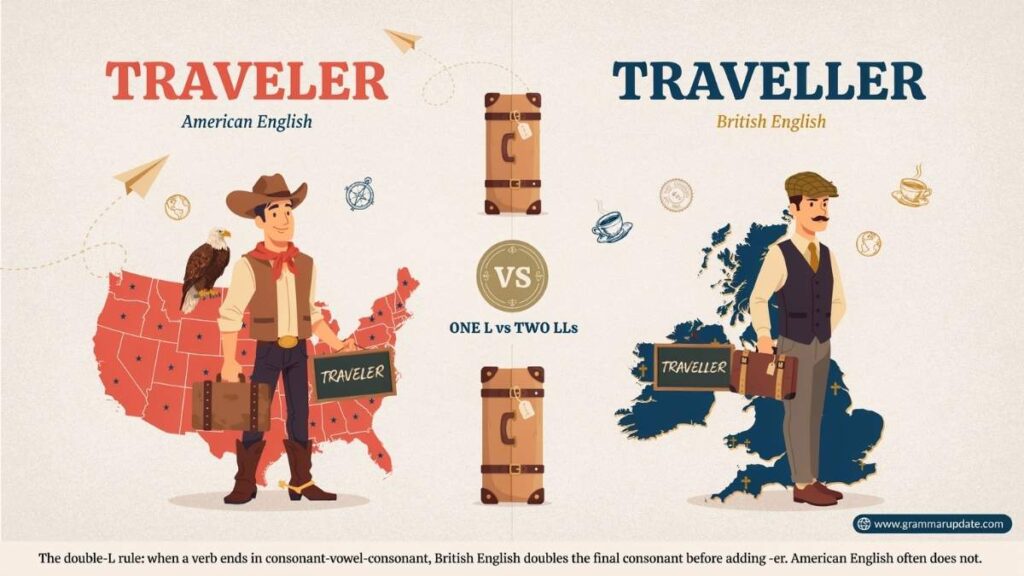
If you’ve ever paused while writing and wondered whether it should be traveler or traveller, you’re facing one of the most common spelling questions in English. The good news is simple: both are correct. The confusion comes from regional spelling systems, not grammar rules.
Traveler and traveller mean exactly the same thing. The only difference is spelling style based on American and British English.
- Traveler → American English
- Traveller → British English and most Commonwealth countries
There is no difference in meaning, pronunciation, or grammar only spelling variation shaped by regional language conventions.
Learn the difference between tricky more English words
Worshipped vs Worshiped Difference and Usage
Traveler Meaning and Definition
The traveler definition is broad and flexible, which is why the word is used so often in everyday English.
A traveler is a person who moves from one place to another, either locally or internationally, for work, leisure, study, or necessity.
Traveler meaning in English (real usage)
A traveler may include:
- Tourists exploring new destinations
- Business professionals flying for work
- Students studying abroad
- Digital nomads working remotely
- Backpackers exploring multiple countries
Key idea
A traveler is defined by movement, not purpose. Whether someone travels for pleasure or obligation, they still fall under the same category.
Traveller Meaning and Definition
The traveller definition is exactly the same as traveler.
A traveller is someone who travels from place to place.
There is:
- No change in meaning
- No change in grammar
- No change in usage
The only difference is regional spelling tradition, not language function.
Learn the difference between tricky more English words
Reining vs Reigning Which Is Difference?
Traveler vs Traveller Side-by-Side Comparison
| Feature | Traveler | Traveller |
|---|---|---|
| Meaning | Person who travels | Person who travels |
| Pronunciation | Same | Same |
| English Type | American English | British English |
| Spelling Style | Simplified (one “l”) | Traditional (double “l”) |
| Usage Regions | USA, global tech/media | UK, Commonwealth countries |
| Grammar Role | Noun | Noun |
Key insight
This difference is not grammatical. It is an orthographic variation (spelling system difference).
Why Americans Use “Traveler”
The traveler spelling in American English comes from a broader spelling reform movement.
Historical background
In the 19th century, Noah Webster pushed for simplified American spelling to:
- Reduce unnecessary letters
- Standardize pronunciation-based spelling
- Differentiate American English from British English
Resulting simplifications
- traveller → traveler
- cancelled → canceled
- modelling → modeling
- labelled → labeled
Modern impact
Today, American spelling dominates:
- global business communication
- technology platforms
- academic publishing in the US
- international media content
This is why “traveler” appears more frequently online worldwide.
Learn the difference between tricky more English words
Counselor vs Councilor Which is the Difference and Usage?
Why Brits Use “Traveller”
The traveller spelling in British English follows traditional spelling conventions.
Core rule: double consonants
British English often doubles consonants when adding suffixes:
- travel → traveller
- cancel → cancelled
- model → modelled
Why this exists
This pattern reflects older English spelling systems tied to pronunciation and historical usage.
Modern usage reality
Even in the UK:
- “traveller” is still standard in many institutions
- “traveler” is increasingly accepted in digital content
- style guides vary depending on publisher
So British English preserves tradition but is not completely rigid.
Traveler vs Tourist: Key Difference
A common confusion is traveler vs tourist, but they are not identical.
| Term | Meaning | Purpose |
|---|---|---|
| Traveler | Anyone who moves between places | Broad category |
| Tourist | Someone traveling for leisure | Short-term recreation |
| Business traveler | Travels for work | Professional purpose |
Simple explanation
- All tourists are travelers
- Not all travelers are tourists
A frequent traveler may travel for work or lifestyle, not tourism.
Learn the difference between tricky more English words
Granddad vs Grandad which spelling is Correct and Usage?
Traveling vs Travelling Explained
The same spelling pattern applies here.
American English
- traveling
- traveled
British English
- travelling
- travelled
Rule of consistency
If a word doubles the consonant in British English, related forms usually follow the same pattern:
- travel → traveller → travelling → travelled
Regional Spelling Preferences
United States
- traveler
- traveling
- traveled
United Kingdom
- traveller
- travelling
- travelled
Canada
- Mixed usage
- British spelling common in formal writing
- American spelling common in digital content
Australia & New Zealand
- Mostly British spelling tradition
- Increasing American influence online
Key takeaway
There is no universal spelling system only regional conventions.
Learn the difference between tricky more English words
Click vs Clique Which is Difference and usage?
Why Two Spellings Exist
The difference between traveler or traveller exists because English evolved differently across regions.
Main reasons
- American spelling reform (Webster system)
- British preservation of traditional forms
- Global expansion of English into multiple regions
- Lack of a single governing authority for English
English is a living language, not a fixed rulebook.
American vs British English Rules
| Rule Type | American English | British English |
|---|---|---|
| Double consonants | Rare | Common |
| Spelling style | Simplified | Traditional |
| Example | traveler | traveller |
| Writing tone | Efficient | Formal/traditional |
This pattern appears across hundreds of words, not just travel-related ones.
Case Study Global Content Performance
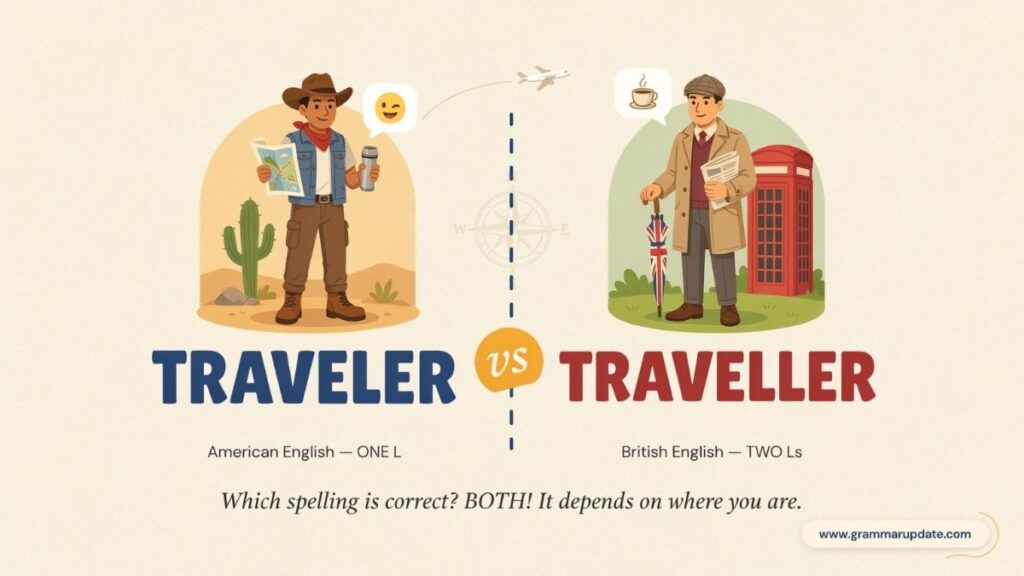
A travel blog tested two spelling versions:
- Version A: “traveler”
- Version B: “traveller”
Results
- US audience engagement: higher with “traveler”
- UK audience engagement: higher with “traveller”
- SEO performance improved when both versions were localized properly
Conclusion
Spelling choice directly affects readability and engagement depending on audience geography.
Fix common more word mistakes in English
Aswell vs As Well Which is Correct and Difference?
Traveler or Traveller in Real-World Usage
Travelers Insurance (Entity Example)
The company Travelers Insurance uses the American spelling intentionally to align with:
- US branding standards
- legal documentation consistency
- market identity
Genshin Impact Example
In Genshin Impact, the main character is officially called:
- Traveler
This reflects global branding decisions that favor simplified English for international audiences.
Common English Spelling Variations
The traveler vs traveller difference is part of a larger system:
- color / colour
- modeler / modeller
- canceled / cancelled
- labeling / labelling
These patterns fall under American and British English spelling differences, which affect thousands of words.
Learn the difference between tricky more English words
Focussed vs Focused Which Spelling Is Correct?
Common Mistakes People Make
Mixing both spellings
Incorrect:
- The traveller booked a traveler ticket.
Correct:
- The traveler booked a traveler ticket (US)
- The traveller booked a traveller ticket (UK)
Ignoring audience
Using the wrong variant for readers reduces clarity and professionalism.
Assuming one is correct
Both are correct context decides usage.
Easy Memory Trick
One “L” = America (short spelling)
Two “L” = Britain (traditional spelling)
This works because:
- American English prefers simplification
- British English preserves historical spelling
Fix common more word mistakes in English
Finaly vs Finally Differences and Usage
Practice Session traveler vs traveller
Fill in each blank with the correct form: traveler / traveller
- A frequent __________ often plans trips months in advance.
- In American English, the word is spelled __________.
- In British English, the correct spelling is __________.
- The business __________ flew to three countries in one week.
- A solo __________ enjoys exploring new cultures alone.
- The backpack __________ visited Southeast Asia.
- Canadian English often uses __________ in formal writing.
- The international __________ shared travel experiences online.
- A digital nomad is a modern __________.
- The __________ checked into a hotel after a long flight.
- Australian English prefers __________ in most publications.
- The experienced __________ knew every airport shortcut.
- A curious __________ explored hidden villages.
- The global __________ documented their journey.
- In the US, a __________ has one “l” in spelling.
- The __________ took photos of every destination.
- A professional __________ often travels for meetings.
- The __________ learned local languages during travel.
- British English uses __________ with double “l”.
- The young __________ planned a gap year abroad.
- A frequent __________ earns airline loyalty points.
- The __________ explored multiple continents in one year.
- American English prefers __________ in all documents.
- The seasoned __________ shared travel advice online.
- A modern __________ uses apps to plan trips easily.
Answers
- traveler / traveller (both acceptable depending on region)
- traveler
- traveller
- traveler / traveller
- traveler / traveller
- traveler / traveller
- traveller
- traveler / traveller
- traveler / traveller
- traveler / traveller
- traveller
- traveler / traveller
- traveler / traveller
- traveler / traveller
- traveler
- traveler / traveller
- traveler / traveller
- traveler / traveller
- traveller
- traveler / traveller
- traveler / traveller
- traveler / traveller
- traveler
- traveler / traveller
- traveler / traveller
Here’s a trusted source for clear word meanings:
FAQs
Is it spelled traveler or traveller?
Both are correct. “Traveler” is used in American English, while “traveller” is used in British, Canadian, and Australian English. The meaning is the same.
What does traveler or traveller mean?
A traveler/traveller is a person who moves from one place to another for work, study, tourism, or exploration. The meaning does not change with spelling.
How do Americans spell traveller?
Americans spell it as traveler with one “l,” following American English spelling rules.
Is traveller the UK spelling?
Yes. Traveller with two “l”s is standard in British English and commonly used across Commonwealth countries.
How is traveler spelled in Canada?
Canadian English usually prefers traveller with double “l,” although both forms may appear depending on writing style.
Is it traveling or travelling in Canada?
In Canadian English, travelling (double “l”) is more common, but usage can vary by publisher or style guide.
Does traveler have one L or two?
- Traveler = one “l” (American English)
- Traveller = two “l”s (British/Commonwealth English)
Is it correct to say traveller?
Yes. Traveller is fully correct in British English and widely accepted internationally where UK spelling is used.
Is traveller British or American English?
Traveller is British English. Traveler is American English.
Why are American and British spellings different?
The difference comes from historical language changes. American English simplified many spellings, while British English kept traditional forms.
What is the difference between a traveler and a tourist?
A tourist travels mainly for leisure and short visits, while a traveler is a broader term that includes exploration, work, and long-term travel.
What are common synonyms for traveler?
- explorer
- wanderer
- nomad
- globetrotter
- voyager
- wayfarer
What is a slang word for traveler?
- backpacker
- jet-setter
- road warrior
- globetrotter
- wanderer
- nomad
Should you say traveller or gypsy?
Use caution. The term “gypsy” is often considered offensive. Irish Travellers and Romani people are distinct cultural groups and should be referred to respectfully using correct names.
Are gypsies called travellers?
No. Romani people and Irish Travellers are different ethnic groups with separate histories and identities.
What is the meaning of the “P word” related to travellers?
The “P word” is a derogatory slur historically used against Traveller communities. It is offensive and should not be used in respectful communication.
Which spelling should you use traveler or traveller?
Use based on your audience:
- Traveler → American English
- Traveller → British, Canadian, Australian, and Commonwealth English
Best practice: choose one spelling style and use it consistently throughout your writing.
Fix common more word mistakes in English
Laser vs Lazer know the Difference
Conclusion
So, after all the spelling confusion around traveler vs traveller, one thing becomes clear English isn’t trying to mislead you; it’s just shaped by different regions and traditions. Both spellings mean exactly the same thing, and neither is more correct in meaning. The only difference lies in where and for whom you are writing.
If English had a personality, it would probably say, “I’ll drop one ‘l’ in America and keep two in Britain just to keep writers on their toes.” That’s exactly what happened over time.
The real mistake isn’t choosing traveler or traveller it’s mixing both in the same document and creating unnecessary inconsistency.
So the simple rule is this: choose your spelling based on your audience, stay consistent throughout your writing, and move on with confidence. Whether you’re a traveler or a traveller, your meaning stays clear—the journey is the same, only the spelling changes.

Jhon AJS, the creative mind behind Grammar Update, is an experienced blogger passionate about simplifying English grammar. He focuses on explaining confusing word vs word differences, grammar rules, punctuation, and sentence structure in a clear and practical way. Through easy to understand guides and examples, Jhon helps readers improve their writing and communicate with confidence. With years of blogging experience, he continues to share helpful insights that make learning grammar simple, useful, and accessible for everyone.