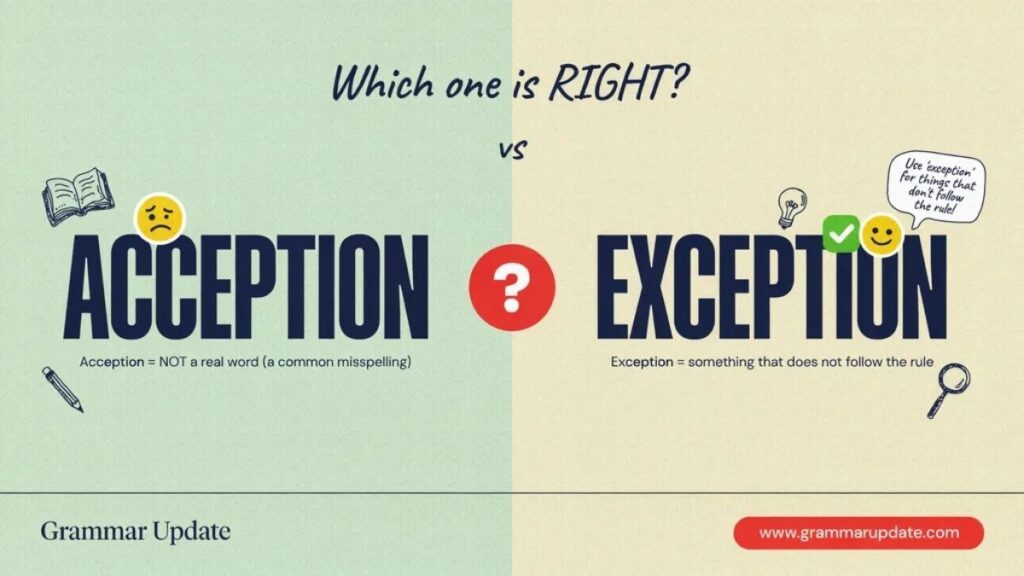
The confusion between acception vs exception is one of those classic English mistakes that even careful writers sometimes make. At first sight, both words look closely related, as if they share the same grammatical family, but only one belongs in modern English usage. “Exception” appears regularly in grammar rules, professional writing, and everyday communication, while “acception” often appears due to misunderstanding or historical overlap. This article explains the difference in a clear, simple, and slightly humorous way so you never confuse them again. You will understand what each word means, why one is correct today, and why the other is mostly considered an outdated form in modern English.
Acception vs Exception Meaning Clear and Expanded Overview
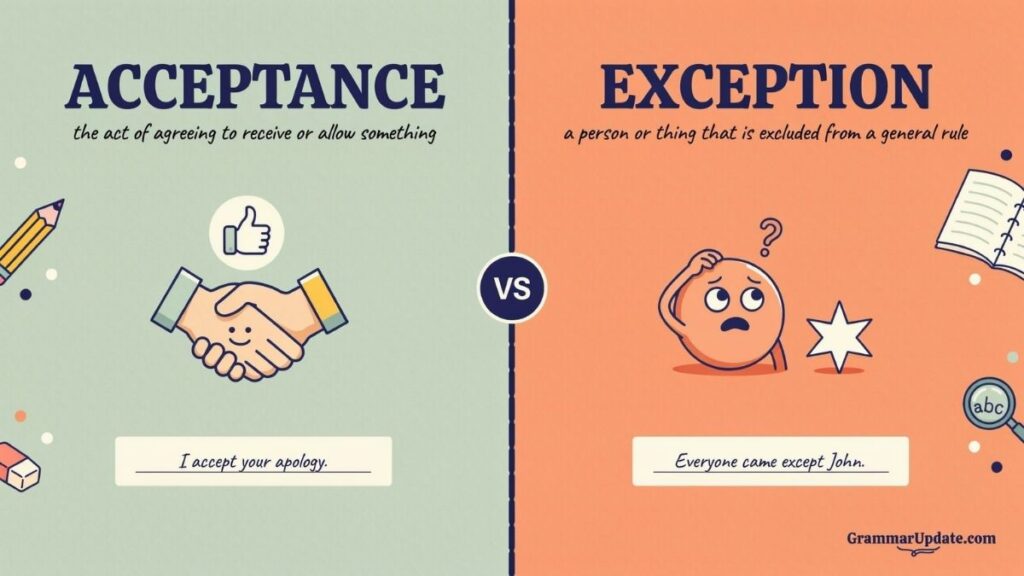
What Does Acception Mean?
The acception meaning comes from older stages of English and is closely related to the linguistic term acceptation. Historically, it referred to:
The accepted meaning, interpretation, or sense of a word.
For example, in older linguistic discussions, writers might describe how a word carried a particular “acception” in a specific context.
However, in modern English:
- Acception is extremely rare
- It is considered archaic or obsolete in most dictionaries
- It is not used in modern writing or speech
- It appears mainly in historical or linguistic discussions
Modern Dictionary View
Leading dictionaries such as the Oxford English Dictionary, Merriam-Webster, and Cambridge Dictionary either label it as obsolete or do not include it as an active modern entry. This reflects its disappearance from practical usage.
What Does Exception Mean?
The exception meaning is completely different and highly active in modern English.
Exception definition:
A person, thing, or case that is excluded from a general rule or statement.
Example:
- Everyone must attend the meeting, with no exception.
Unlike acception, exception is a core part of everyday English vocabulary and appears in legal, academic, business, and conversational contexts.
More Related Articles You May Find Helpful
Shinning vs Shining Correct Spelling and Usage
Is Acception a Word in English?
Is Acception a Real Word?
Yes, but only in a historical sense. The question “is acception a word” has a technically correct answer, but it comes with an important limitation.
- It exists in older forms of English
- It is not part of standard modern vocabulary
- It is rarely recognized outside linguistic studies
Acception Definition in Modern Context
The acception definition in historical linguistics refers to:
- The accepted sense or interpretation of a term
In modern English usage:
- It is replaced by clearer terms such as “meaning,” “interpretation,” or “usage”
- It is not used in business, education, or communication
Why Acception Disappeared
Language naturally evolves. Words disappear when they:
- Are used rarely
- Have clearer alternatives
- Lose relevance in modern communication
Over time, exception became dominant, while acception slowly faded from everyday use.
Fix common more word mistakes in English
Carrer vs Career The Correct Spelling and Difference
Acception vs Exception Deep Comparison
Core Difference Between Acception and Exception
| Feature | Acception | Exception |
|---|---|---|
| Meaning | Historical linguistic interpretation | Something excluded from a rule |
| Usage | Rare, archaic | Common, modern |
| Context | Linguistics, historical texts | Everyday English, academic, business |
| Status | Obsolete in modern English | Standard usage |
Acception vs Exception Meaning in Simple Terms
- Acception = old linguistic term for accepted meaning
- Exception = something that does not follow a rule
This is why they are not interchangeable in modern writing.
Fix common more word mistakes in English
Scarey vs Scary Learn the Correct Spelling
Why Exception Is the Standard in Modern English
Dictionary Authority and Modern Usage
Modern dictionaries consistently prioritize exception:
- Oxford English Dictionary
- Cambridge Dictionary
- Merriam-Webster Dictionary
- Collins Dictionary
All define exception as the correct, standard, and widely used term.
Why Exception Replaced Acception
Several linguistic factors contributed to this shift:
- Simplification of English vocabulary
- Standardization in education systems
- Increased need for clarity in global communication
- Preference for consistent usage across dialects
As a result, native speakers almost always use exception instead of acception in both spoken and written English.
Fix common more word mistakes in English
Stared vs Starred How to Use Each Word Correctly
Make an Exception vs Make an Acception
Correct Phrase Usage
The correct phrase is:
Make an exception
Meaning of Make an Exception
The phrase make an exception meaning refers to allowing a special case where a rule does not apply.
Example:
- The teacher decided to make an exception for the student who submitted late due to illness.
This phrase is widely used in:
- Business communication
- Academic writing
- Legal documentation
- Everyday conversation
Is “Make an Acception” Correct?
No. The phrase “make an acception” is not considered correct in modern English usage.
It may appear due to confusion, but:
- It is not standard
- It is not accepted in formal writing
- It is flagged as incorrect in grammar tools
Learn the difference between tricky more English words
Trek vs Treck Confusion and Correct Usage
Why People Confuse Acception and Exception
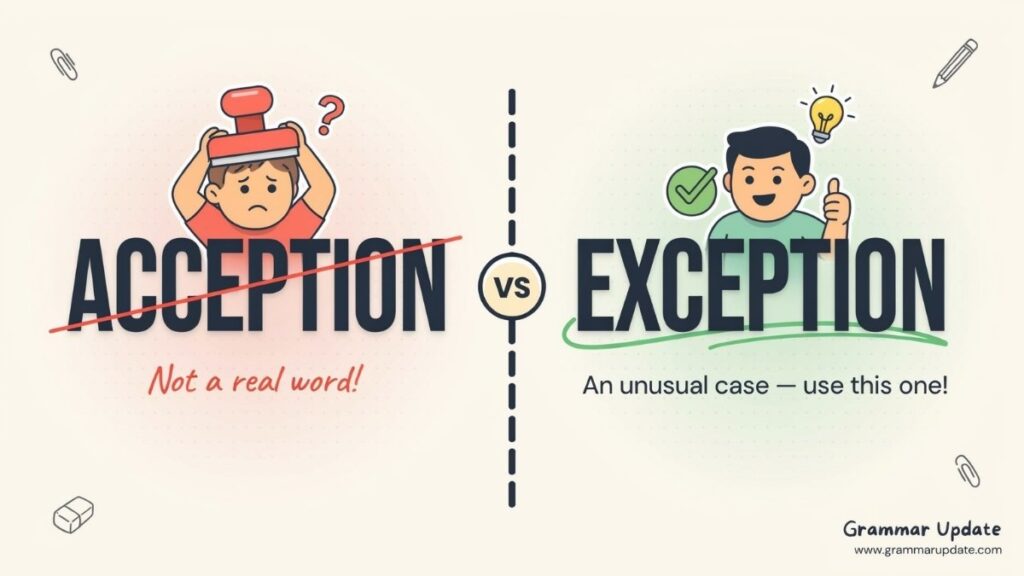
Root Cause of Confusion
The confusion arises from multiple linguistic factors:
- Similar spelling patterns
- Misinterpretation of “accept” vs “except”
- Lack of exposure to archaic vocabulary
- Overgeneralization of English word formation rules
Accept vs Except Confusion
This is one of the biggest reasons for mistakes:
- Accept = to receive or agree
- Except = to exclude
Because they sound similar, learners mistakenly assume related forms like acception and exception are interchangeable.
Learn the difference between tricky more English words
Wise vs Wize Usage and Mistakes Explained
Acception in a Sentence (Historical Usage Only)
Although rarely used today, here is an example from historical context:
- The word had a different acception in older philosophical writings.
In modern English, this would be rewritten as:
- The word had a different accepted meaning in older texts.
Exception in a Sentence (Modern Usage)
Here are clear, real-world examples:
- There is always an exception to every rule.
- No one is allowed entry without exception.
- She was granted an exception due to medical reasons.
- The policy allows no exception under any circumstances.
These examples show why exception remains essential in modern communication.
Learn the difference between tricky more English words
Connector vs Connecter Which Spelling Is Correct?
Acception vs Exception in Modern Discussions
In online discussions such as acception vs exception reddit, learners frequently ask whether acception is valid English.
The consistent response from native speakers and grammar experts is:
Exception is correct and standard. Acception is outdated and unnecessary in modern English.
Acceptation vs Acception Additional Clarification
Acceptation Meaning
The acceptation meaning refers to:
The commonly accepted meaning of a word or phrase.
This term is still used in linguistic analysis but is not common in everyday English.
Acception vs Acceptance
Another common confusion involves:
- Acceptance = approval or agreement (modern usage)
- Acception = archaic linguistic term
Only acceptance is used in modern communication.
Linguistic Perspective Why Acception Declined
From a linguistic and lexicographic standpoint:
- Word frequency determines survival
- Rare terms gradually disappear
- Communication efficiency drives language change
- Dictionaries standardize usage over time
This explains why acception is rarely used in modern English, while exception remains dominant and essential.
Learn the difference between tricky more English words
Traveler vs Traveller Which Spelling Is Correct?
Real-World Usage Comparison
Acception Usage
- Found in historical manuscripts
- Appears in linguistic research papers
- Not used in professional communication
Exception Usage
Used extensively in:
- Business communication
- Academic writing
- Legal documents
- Everyday conversation
- Media and journalism
Learn the difference between tricky more English words
Focussed vs Focused Which Spelling Is Correct?
Common Mistakes With Acception and Exception
Mistake 1: Using Acception Instead of Exception
Incorrect: Make an acception
Correct: Make an exception
Mistake 2: Confusing Acceptance and Exception
Incorrect: Acceptance to the rule
Correct: Exception to the rule
Mistake 3: Assuming Both Words Are Interchangeable
Only exception is correct in modern English.
More Related Articles You May Find Helpful
Aswell vs As Well Which is Correct and Difference?
Grammar and Vocabulary Insight
Understanding this distinction improves:
- Writing accuracy
- Professional communication
- Academic clarity
- Vocabulary precision
- Overall English fluency
Key Linguistic Rule
In modern English:
Exception is the correct and preferred term, while acception is archaic and rarely used in contemporary writing.
More Related Articles You May Find Helpful
Click vs Clique Which is Difference and usage?
Practice Session Acception vs Exception
Fill in each blank with the correct word: acception or exception
- There is always an __________ to every rule.
- The manager approved a special __________ for the deadline.
- The word carried a different __________ in older English texts.
- In modern English, __________ is the correct and standard term.
- No entry is allowed without an __________.
- The teacher made an __________ for the late submission.
- “Make an __________” is the correct phrase in modern English.
- The historical __________ of this term is rarely used today.
- Dictionaries label __________ as archaic or obsolete.
- Every system has at least one __________.
- The grammar rule allows no __________.
- The linguistic __________ of the word appears in old manuscripts.
- She received an __________ due to illness.
- The correct modern usage is __________, not acception.
- The policy includes a rare __________ for emergencies.
- The old __________ of the word differs from its modern meaning.
- You cannot use “make an __________” in formal writing.
- The only __________ to this rule is clearly stated.
- Scholars study the __________ of words in historical linguistics.
- There is no __________ to this safety regulation.
- The judge allowed an __________ in the case.
- The sentence uses an old __________ no longer common today.
- Modern grammar prefers __________ in all contexts.
- The __________ proves that rules can have flexibility.
- The rare __________ appears only in historical references.
Answers
- exception
- exception
- acception
- exception
- exception
- exception
- exception
- acception
- acception
- exception
- exception
- acception
- exception
- exception
- exception
- acception
- exception
- exception
- acception
- exception
- exception
- acception
- exception
- exception
- acception
Here’s a trusted source for clear word meanings:
FAQs
What does acception mean?
Acception is an old or rarely used term that historically referred to the accepted meaning or interpretation of a word. In modern English, it is considered obsolete and is not used in everyday communication.
What does it mean to be an exception?
To be an exception means to be excluded from a general rule or to not follow what normally applies in a given situation.
What is the difference between exception and acception?
Exception is the correct and standard modern English word meaning something excluded from a rule. Acception is an archaic term that is no longer used in modern English.
What does it mean to give an exception?
To give an exception means to allow a special case where a rule is not applied.
Is it with the exception or acception?
The correct phrase is “with the exception.” The word “acception” is not used in modern English.
What is the definition of acception?
Acception refers to a historical linguistic term meaning the accepted interpretation or sense of a word, but it is now obsolete in modern usage.
What is a better word for exception?
Depending on context, alternatives include exemption, exclusion, special case, or allowance.
What does exception mean in simple words?
An exception is something that does not follow a rule or standard pattern.
Does exceptional mean good?
Yes, exceptional usually means something very good, unusual, or of very high quality.
What are the 4 types of exception safety?
In programming, exception safety is generally classified into:
- No-throw guarantee
- Strong guarantee
- Basic guarantee
- No guarantee
What is the difference between accept and exception?
Accept means to receive or agree to something, while exception refers to something excluded from a rule.
How to define an exception?
An exception is a case that is not included under a general rule or condition.
What are examples of an exception?
Examples include:
- A student given extra time on an exam
- A rule waived for medical reasons
- A policy not applied in special circumstances
What is another word for making an exception?
Alternatives include granting an exemption, allowing a special case, or bending the rule.
What does make an acception mean?
“Make an acception” is not correct in modern English. The correct phrase is “make an exception.”
How to use exception in a sentence?
Example:
There is always an exception to every rule.
What are types of exceptions?
Types vary by context:
- Grammar exceptions
- Legal exceptions
- Programming exceptions
Does exception mean?
Yes. An exception means something that is excluded from a general rule or condition.
Is “acception” a real word?
Yes, but only in historical usage. In modern English, it is considered obsolete and rarely used.
Is it a one-time exception or acception?
The correct phrase is “one-time exception.”
Is it acception or exception to the rule?
The correct phrase is “exception to the rule.”
What is the meaning of acception?
Acception historically referred to the accepted meaning or interpretation of a word, but no longer used in modern English.
Am I the exception or acception?
The correct expression is “I am the exception.”
What is the opposite of acception?
Since “acception” is an obsolete term, it does not have a standard modern opposite. In current usage, exception is the active and correct term used in contrast with rules or general statements.
More Related Articles You May Find Helpful
Granddad vs Grandad which spelling is Correct and Usage?
Conclusion
In the debate of acception vs exception, one word clearly belongs in modern English, while the other mostly lives in historical corners of language. “Exception” takes the spotlight in grammar rules, professional writing, and everyday speech, while “acception” appears only as an outdated form that confuses more than it helps. The simple truth is this: when something breaks a rule, you always call it an exception never an “acception.” Understanding this difference removes a common English mistake and instantly improves your writing clarity, confidence, and professionalism. So next time you feel tempted to choose the fancy-sounding option, remember that correct English prefers simple precision over forgotten vocabulary.

Jhon AJS, the creative mind behind Grammar Update, is an experienced blogger passionate about simplifying English grammar. He focuses on explaining confusing word vs word differences, grammar rules, punctuation, and sentence structure in a clear and practical way. Through easy to understand guides and examples, Jhon helps readers improve their writing and communicate with confidence. With years of blogging experience, he continues to share helpful insights that make learning grammar simple, useful, and accessible for everyone.