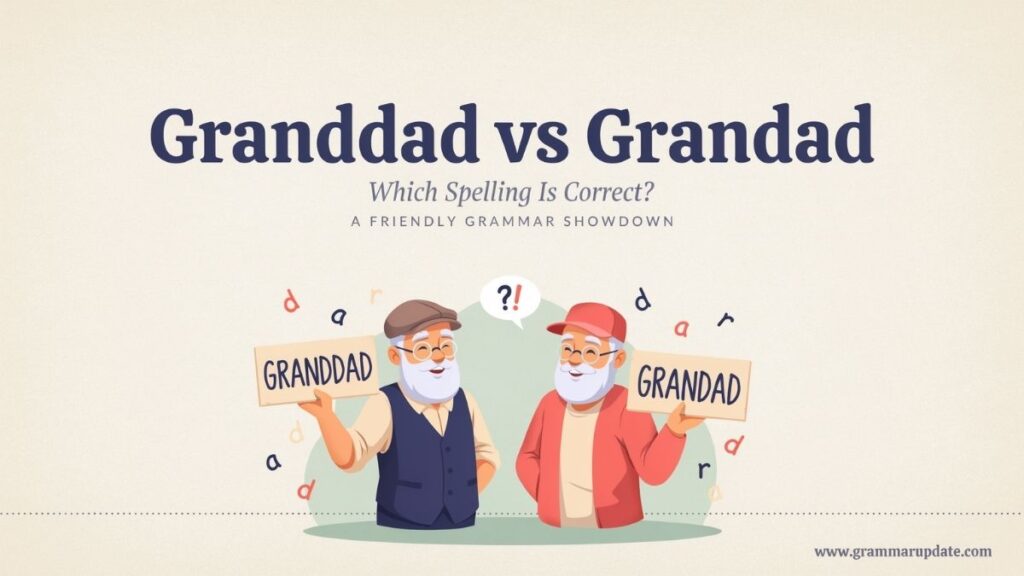
If you have ever stopped and wondered about granddad vs grandad, you’re not alone. At first glance, they can look like two different words with different meanings, which easily leads to confusion. In reality, both words mean the same thing your grandfather. The difference is not in meaning, grammar, or usage, but only in spelling style. “Granddad” uses a double “d” and feels slightly more traditional, often seen in older or more formal writing. “Grandad” uses a simpler single “d” and is more common in modern, everyday English. This small spelling difference often creates doubt, even though both forms are correct and widely accepted. In this guide, you’ll learn how to choose each one clearly and use them with confidence.
Granddad vs Grandad Quick Answer
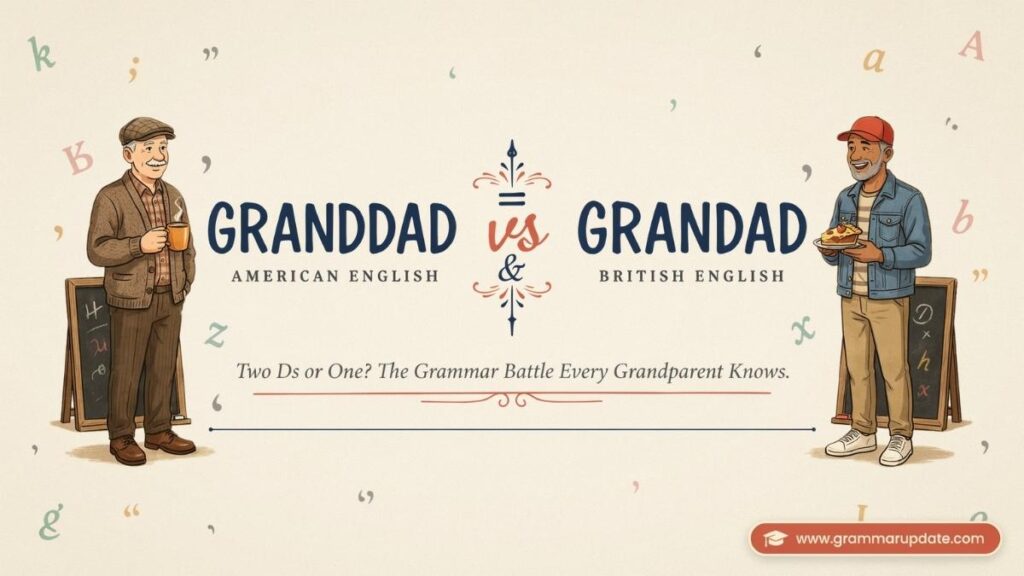
Here’s the simplest explanation:
- Granddad → Traditional spelling, slightly more formal, common in British English writing
- Grandad → Modern simplified spelling, widely used in casual and everyday English
Meaning (same for both)
An affectionate informal word for grandfather
Core takeaway:
- Same meaning
- Same pronunciation
- Same grammatical role
- Different spelling style only
So if you’re asking is it granddad or grandad, the correct answer is: both are correct depending on tone and context.
What Do Granddad and Grandad Mean?
The granddad meaning and grandad meaning are identical in English.
They refer to:
The father of your mother or father your grandfather
But beyond the dictionary definition, the word carries emotional weight in everyday use.
Learn the difference between tricky more English words
Long Term vs Long-Term Which is Correct?
Emotional meaning in real life
These words feel personal and warm. People use them to express:
- Family closeness
- Childhood memories
- Emotional attachment
- Everyday familiarity
For example:
- “My grandad used to pick me up after school.”
- “My granddad always told the best stories.”
Both are correct. The emotional tone is what subtly changes, not the meaning.
Dictionary confirmation
Leading references such as:
- Oxford English Dictionary (OED)
- Cambridge Dictionary
- Collins Dictionary
- Merriam-Webster
recognize both “granddad” and “grandad” as acceptable informal forms of grandfather.
Key fact:
Both forms are standard English, not slang or incorrect usage.
More Related Articles You May Find Helpful
Hustle vs Hussle Which is Correct Spelling and Usage?
Why Are There Two Spellings?
The difference between granddad spelling vs grandad spelling comes from natural language evolution, not grammar rules.
1. Spoken English influence
In spoken language:
- “granddad” is pronounced quickly
- the double “d” is not emphasized
It sounds like:
gran-dad
Since pronunciation is identical, spelling gradually became flexible.
2. Simplification in informal English
English often shortens familiar words:
- grandmother → grandma
- grandfather → grandpa
- father → dad
So:
granddad → grandad follows a natural pattern of simplification
3. Digital communication impact
Modern communication accelerated simplified spelling:
- shorter words are faster to type
- informal writing spreads quickly
- social media normalizes variation
This helped “grandad” become more widely used.
4. British English tradition
In British English, both forms coexist:
- Granddad → traditional, slightly formal tone
- Grandad → modern, casual tone
Neither is incorrect. They simply feel different in style.
More Related Articles You May Find Helpful
Skillset vs Skill Set Which Spelling Is Correct?
Granddad vs Grandad UK and US Usage
Regional usage helps explain the difference more clearly.
British English usage
In the UK:
- Both spellings are accepted
- “Granddad” appears more in traditional or edited writing
- “Grandad” is more common in everyday informal writing
Example:
- “Granddad came over for tea.”
- “Grandad lives nearby.”
Both are correct in British English.
American English usage
In the US:
- “Grandpa” is the dominant term
- “Granddad” is occasionally used
- “Grandad” is rarely used
US preference order:
- Grandpa
- Grandfather
- Granddad
- Grandad
So in American English, the difference is less about spelling and more about vocabulary choice.
Learn the difference between tricky more English words
Appendices vs Appendixes Which is Correct and Usage?
Granddad vs Grandad Pronunciation
Here’s where confusion becomes obvious.
Both words are pronounced exactly the same.
Phonetic form:
/ˈɡræn.dæd/
Breakdown:
- “Gran” → short vowel sound
- “dad” → same as casual “dad”
Key insight:
The spelling difference cannot be heard, only seen.
That’s why writers often struggle more than speakers.
Granddad vs Grandfather
This comparison helps clarify tone differences.
Grandfather
- Formal term
- Used in official, academic, or legal writing
- Neutral emotional tone
Example:
- “My grandfather worked in education.”
Granddad or Grandad
- Informal and affectionate
- Used in storytelling and conversation
- Emotionally warm
Example:
- “My grandad taught me how to fix my bike.”
Core difference:
| Term | Tone | Usage |
|---|---|---|
| Grandfather | Formal | Official contexts |
| Granddad / Grandad | Informal | Family and everyday speech |
Granddad Spelling vs Grandad Spelling Explained
Let’s make the choice practical and clear.
Granddad spelling
- Double “d” structure
- Traditional British English form
- Slightly more formal appearance
- Common in edited writing and print media
Example:
- “Granddad arrived early for dinner.”
Grandad spelling
- Single “d” structure
- Modern simplified form
- Common in informal and digital writing
- More conversational tone
Example:
- “Grandad makes the best Sunday roast.”
Important truth:
Both are correct. The difference is tone, not grammar.
Comparison Table Granddad vs Grandad
| Feature | Granddad | Grandad |
|---|---|---|
| Meaning | Grandfather | Grandfather |
| Spelling style | Traditional | Modern simplified |
| Tone | Slightly formal | Casual & friendly |
| Usage region | UK-heavy | UK + global informal |
| Pronunciation | Same | Same |
| Dictionary status | Accepted | Accepted |
| Writing style | Structured | Conversational |
Learn the difference between tricky more English words
Reining vs Reigning Which Is Difference?
Why English Allows Both Forms
English is a living language, not a fixed rule system.
Key reasons:
- Dictionaries document usage rather than enforce rules
- Regional dialects influence spelling habits
- Informal speech shapes written language
- Digital communication speeds up variation
This is known as linguistic variation in spelling conventions.
More Related Articles You May Find Helpful
Comment vs Coment Correct Spelling and Usage
Common Mistakes People Make
Even with clarity, confusion still appears.
1. Assuming one spelling is wrong
Incorrect beliefs:
- “Granddad is correct, grandad is wrong” ❌
- “Grandad is slang only” ❌
Both are incorrect.
2. Mixing spellings in the same text
Example:
- “My granddad came early. My grandad stayed later.”
This reduces consistency and looks unpolished.
3. Overthinking the choice
Many writers hesitate unnecessarily.
The reality:
Choose one form and stay consistent.
Learn how to use confusing more words correctly
Counselor vs Councilor Which is the Difference and Usage?
Real-Life Usage Examples
Storytelling
- “My grandad always told me stories before bed.”
Natural and conversational.
Editorial writing
- “Granddad of three received a community award.”
Slightly more formal tone.
Casual messaging
- “Visiting grandad today 👍”
Simple and modern.
Learn how to use confusing more words correctly
Nonresponsive vs Unresponsive Differences and Usage
Related Family Vocabulary
English includes many affectionate alternatives:
- Grandpa
- Granddad
- Grandad
- Grandfather
- Gramps
- Papa
- Pop-pop
Regional forms include:
- “Granda” (Scotland/Ireland)
- “Nonno” (Italian-English usage)
These belong to grandparent nickname systems in English family vocabulary.
Fix common more word mistakes in English
Sence vs Sense Which Is Correct and Usage?
Why “Granddad vs Grandad” Matters in Writing
Even though both are correct, consistency matters in:
- Academic writing
- Publishing
- SEO content
- Professional communication
Search engines understand both, but consistent usage improves clarity and readability.
Simple Memory Trick
Use this easy rule:
- Granddad = Double D = traditional tone
- Grandad = Single D = modern tone
Or simply:
More letters = more formal
Fewer letters = more casual
Fix common more word mistakes in English
Sentence vs Sentance Which Spelling Is Correct?
Practice Session Granddad vs Grandad
Complete each sentence using the correct word: granddad vs grandad or grandfather
- My __________ taught me how to ride a bicycle when I was young.
- “Grandad” and “granddad” both mean __________.
- In modern English, many people prefer writing __________ instead of granddad.
- My __________ always tells funny stories from his childhood.
- The formal word for granddad or grandad is __________.
- Both spellings, granddad and __________, are correct in English.
- I visited my __________ last weekend and we had tea together.
- The word __________ is more common in casual writing.
- Some writers prefer “granddad” because it looks more traditional than __________.
- The pronunciation of __________ and granddad is exactly the same.
- My __________ lives in a small village near the city.
- In British English, both __________ and granddad are accepted.
- The word __________ is often used in everyday conversation.
- My __________ loves telling me bedtime stories.
- “Grandfather” is a more formal term than __________ or grandad.
- The spelling __________ uses a single “d” in the middle.
- Children often feel close to their __________.
- My __________ bakes the best cookies in the family.
- Both __________ and grandad are widely understood in English.
- I call my __________ every Sunday.
- The word __________ feels slightly more traditional in writing.
- My __________ always supports me in every decision.
- “Granddad” is simply an alternative spelling of __________.
- The meaning of __________ does not change with spelling.
- I spent the holidays with my __________ and grandmother.
Answers
- granddad / grandad
- grandfather
- grandad
- granddad / grandad
- grandfather
- grandad
- granddad / grandad
- grandad
- granddad
- grandad
- granddad / grandad
- grandad
- grandad
- granddad / grandad
- grandfather
- grandad
- granddad / grandad
- granddad / grandad
- granddad / grandad
- granddad / grandad
- granddad
- granddad / grandad
- granddad
- granddad / grandad
- granddad / grandad
Here’s a trusted source for clear word meanings:
FAQs
Are there two D’s in Grandad?
No. Grandad is spelled with one “d” in the middle and one at the end. The double “d” form belongs to “granddad.”
Why is it grandad not granddad?
Because English allows spelling variation. “Grandad” is a simplified modern form, while “granddad” is the traditional spelling.
Are there two D’s in Granddaughter?
Yes. Granddaughter has a double “d” because it comes from “grand + daughter.”
Why does Grandad only have one D?
It is a shortened informal spelling that evolved over time in everyday English to make writing simpler.
How do I show my granddaughter I love her?
You can show love through:
- Spending quality time together
- Listening to her stories
- Giving encouragement
- Small thoughtful gifts
- Kind words and emotional support
What do hillbillies call their grandpa?
In informal American speech, common terms include grandpa, pawpaw, and gramps, depending on region and family tradition.
Which is correct, grandaddy or granddaddy?
Both exist, but “granddaddy” (with two d’s) is more commonly accepted in standard English usage.
Do Americans say grandad?
Yes, but it is less common in the US. Americans usually prefer “grandpa.”
What do Mexican grandmas call their granddaughters?
In Spanish-speaking families, affectionate terms like “nieta,” “mi amor,” or “cariño” are commonly used depending on region and family style.
What do I call my granddaughter’s husband?
He is commonly called your grandson-in-law.
Does granddaughter have 1 D or two D’s?
It has two d’s: granddaughter.
Is Grandad spelt with double D?
No. “Grandad” uses a single “d.” The double “d” spelling is “granddad.”
What are common misspellings of granddaughter?
Common mistakes include:
- grandauter
- granddauter
- grandaughter
- granddauther
Correct spelling is granddaughter.
Does granddad mean grandpa?
Yes. Granddad and grandpa both mean grandfather, but “grandpa” is more common in American English.
What is the grandma rule?
It is an informal idea suggesting grandparents should support and love grandchildren without replacing parents’ authority.
How often does the average grandparent see their grandchild?
Studies show many grandparents see grandchildren:
- Weekly in close families
- Monthly in moderate-distance families
- A few times a year when living far apart
What special words can I say to my granddaughter on her birthday?
You can say:
- “You make my life brighter every day.”
- “I am proud of the person you are becoming.”
- “You are my greatest joy.”
When your daughter-in-law won’t let you see your grandchildren?
This is usually a family conflict situation. Experts suggest:
- Communicating calmly
- Avoiding blame
- Seeking mediation if needed
- Focusing on the children’s well-being
What do Texans call their grandpa?
Common terms include grandpa, pawpaw, and pop-pop, depending on family tradition.
What is a hippie name for grandma?
Popular informal names include:
- Gran
- Grammy
- Nana
- Mimi
What is a cool name for a grandpa?
Some modern or affectionate names include:
- Pops
- Gramps
- Papa
- Grandad
What makes a granddad special?
A granddad is special because he often provides:
- Wisdom and life experience
- Emotional support
- Family storytelling
- Strong generational bonding
What does granddad really mean?
Granddad means the father of your mother or father. It is an informal, affectionate word for grandfather used in everyday English.
Fix common more word mistakes in English
Accross vs Across, Which Is the Correct Spelling?
Conclusion
So, in the end, granddad vs grandad isn’t a grammar battle or a serious mistake it’s just English being a little inconsistent again. Both words mean the same thing, both sound the same, and both are completely correct. The real confusion usually comes when we overthink a simple spelling choice and make it feel more complicated than it actually is.
If you ever mix them up, don’t worry. Your grandfather will understand you either way. The only real mistake is switching between both spellings in the same piece of writing, which can make your text look a bit unpolished.
So just pick one form, stay consistent, and move on with confidence. English has plenty of tricky rules, but this one is simple.

Jhon AJS, the creative mind behind Grammar Update, is an experienced blogger passionate about simplifying English grammar. He focuses on explaining confusing word vs word differences, grammar rules, punctuation, and sentence structure in a clear and practical way. Through easy to understand guides and examples, Jhon helps readers improve their writing and communicate with confidence. With years of blogging experience, he continues to share helpful insights that make learning grammar simple, useful, and accessible for everyone.