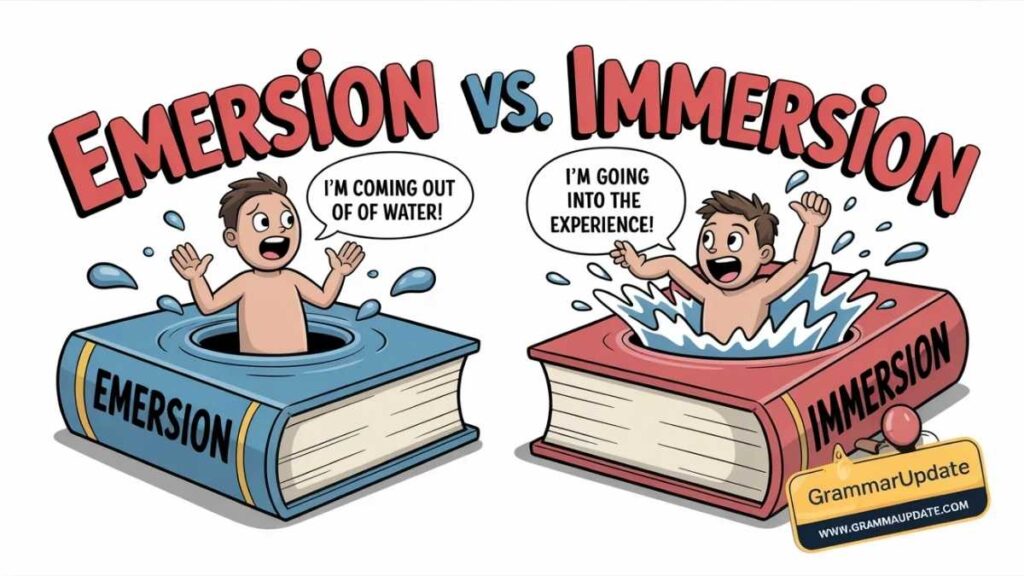
English is full of confused words that look alike but mean very different things. A perfect example is Emersion vs Immersion. At first glance, they seem almost identical. They sound nearly the same when spoken. Yet their meanings move in opposite directions. One describes diving deeply into something, while the other refers to coming back out of it. Imagine a scuba diver disappearing beneath the ocean for exploration, then rising back to the surface for air. That simple image explains the Emersion vs Immersion meaning surprisingly well. From psychology and school learning to cultural experiences and even kitchen tools like immersion blenders, these words appear in many places. If they’ve ever confused you, don’t worry you’re about to sort them out.
Emersion vs Immersion A Quick Comparison
The easiest way to understand Emersion vs Immersion is to compare them directly.
| Feature | Emersion | Immersion |
|---|---|---|
| Core Meaning | Coming out of something | Going deeply into something |
| Direction | Upward or outward | Downward or inward |
| Typical Usage | Scientific or technical contexts | Everyday language and education |
| Conceptual Idea | Transition or emergence | Deep engagement |
| Usage Frequency | Rare | Very common |
The contrast becomes clear when visualized:
- Emersion → rise to surface
- Immersion → dive deep
In other words, the relationship between these terms reflects emerging vs submerging.
Emersion Meaning, Definition and Scientific Context
To understand the difference between emersion and immersion, it helps to begin with the less common word.
Emersion Definition
The emersion meaning refers to:
The act of emerging or rising from a submerged, hidden, or covered state.
In many scientific contexts, emersion from water describes the moment something moves from beneath the surface into open air.
Examples include:
- a diver returning to the surface
- a submarine surfacing
- marine plants exposed during low tide
Simply put, emersion describes the transition from submerged to visible.
Scientific Fields Where Emersion Is Used
Although the word rarely appears in everyday conversation, it plays an important role in scientific disciplines.
Marine biology
Coastal ecosystems regularly experience emersion transitions due to tidal movements.
Example:
During low tide, coral reefs undergo emersion, exposing marine life to sunlight and air.
Many marine organisms have adapted to survive both immersion in seawater and emersion in open air.
Astronomy
In astronomy, emersion describes the moment when a celestial body becomes visible again after being hidden.
Example:
Astronomers observed the star’s emersion after it passed behind the Moon during an occultation.
Environmental science
Scientists studying coastal habitats often examine how organisms adapt to alternating periods of immersion and emersion.
Facts about tidal environments:
- Intertidal species can experience hours of emersion during low tides.
- Temperature and oxygen levels change significantly during this phase.
These environmental transitions shape entire ecosystems.
Origin and Etymology of Emersion
The word originates from Latin.
| Language | Root Word | Meaning |
|---|---|---|
| Latin | emergere | to rise out |
| Old French | emerser | to come forth |
| English | emersion | the act of emerging |
The connection to the verb emerge makes the meaning easier to remember.
Emersion in Literature and Metaphorical Use
Although originally scientific, writers sometimes use emersion in literature as a metaphor.
In creative contexts, the word may represent:
- coming out of obscurity
- leaving a challenging experience
- entering a reflective phase
Example:
After months of intense work, the research team entered a period of emersion reflection, analyzing their discoveries.
Here, emersion symbolizes transition and reflection after deep involvement.
Immersion Definition and Meaning
While emersion describes emerging, immersion describes the opposite process.
Immersion Definition
The immersion definition is:
The state of being completely submerged in a liquid or deeply involved in an experience, activity, or environment.
The concept includes two main dimensions:
- physical immersion
- psychological immersion
Both involve deep engagement and focused attention.
Physical Immersion
Historically, the word referred to submerging something in liquid.
Examples include:
- immersion baptism ceremonies
- immersion cooking techniques
- scientific experiments involving water immersion
Example sentence:
The diver’s immersion lasted several minutes before resurfacing.
Psychological Immersion
In modern language, the term appears more frequently in psychology and experience design.
Psychological immersion occurs when a person becomes fully absorbed in an activity.
Examples include:
- reading a captivating novel
- playing a story-driven video game
- participating in interactive learning
In these situations, individuals experience a fully immersed experience where outside distractions fade away.
Immersion in Technology and Digital Environments
Modern technology often focuses on creating immersive environments.
Examples include:
Virtual reality
VR technology aims to simulate environments where users feel physically present inside a digital world.
Examples:
- VR gaming platforms
- virtual training simulations
- immersive museum exhibits
These systems rely on realistic visuals, sound, and interaction to maintain immersion.
Gaming and entertainment
Video game developers frequently design immersive environments to maintain player engagement.
Key elements include:
- detailed world design
- interactive storytelling
- spatial audio
- responsive gameplay mechanics
When these elements combine successfully, players experience deep involvement in the virtual environment.
Emersion vs Immersion key Differences
Understanding the difference between emersion and immersion becomes easier when examining several core contrasts.
Direction of Experience
| Concept | Direction |
|---|---|
| Emersion | Movement outward or upward |
| Immersion | Movement inward or downward |
This contrast illustrates rise to surface vs dive deep.
Stage of Experience
Another distinction involves timing.
- Immersion occurs during an experience when engagement is strongest.
- Emersion occurs after the experience, when reflection begins.
For example:
A traveler may experience cultural immersion while living abroad. Later, they undergo emersion reflection, evaluating what they learned.
Frequency of Use
The two words differ greatly in how often they appear.
| Word | Usage Frequency |
|---|---|
| Emersion | Rare, mostly technical |
| Immersion | Very common in education and media |
Because immersion applies to many everyday experiences, it appears more often in modern language.
More Confusing Words Made Simple
Ally vs Allie Differences and Correct Usage
Emersion vs Immersion in Education
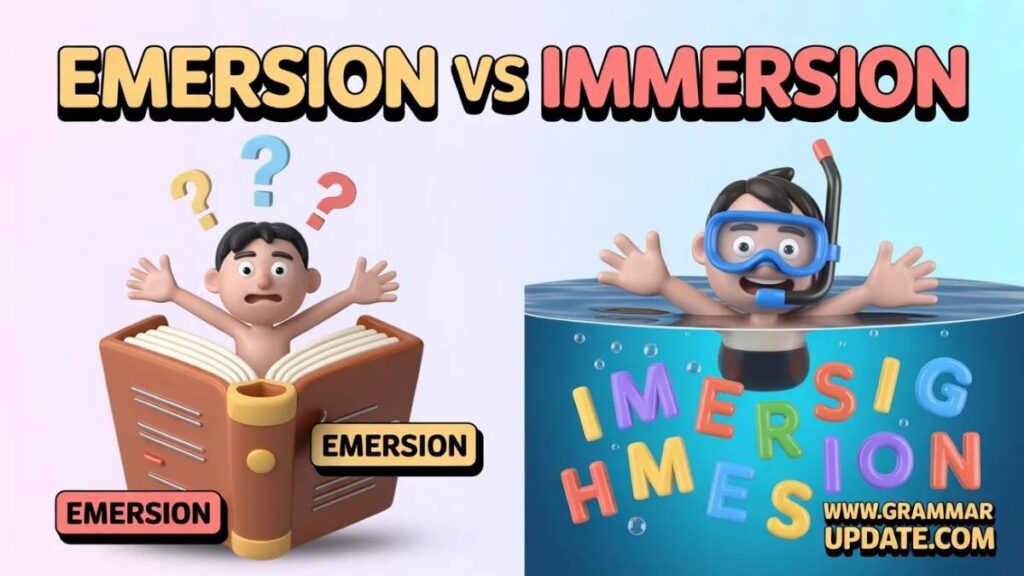
One of the most important real-world applications appears in education.
Immersion Learning Programs
Many schools use immersion learning programs to teach languages effectively.
A language immersion program places students in an environment where the target language dominates instruction.
Example classroom features:
- teachers speak only the target language
- assignments require active communication
- students practice real-world conversation
This constant exposure helps learners develop fluency quickly.
Benefits of immersive learning
Research highlights several immersive learning benefits.
| Benefit | Explanation |
|---|---|
| Faster language acquisition | Students hear and practice the language continuously |
| Improved retention | Active communication strengthens memory |
| Cultural understanding | Learners experience cultural context directly |
| Higher confidence | Students gain practical communication skills |
Because of these advantages, immersion learning programs remain popular worldwide.
Emersion vs Immersion in Language Learning
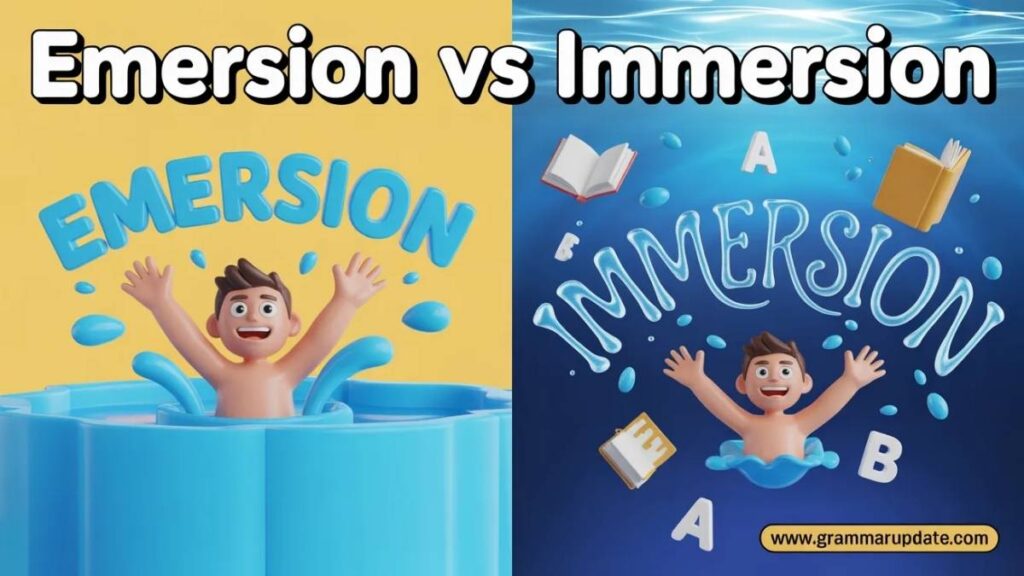
The learning process often includes two phases.
Immersion phase
Students experience:
- constant language exposure
- immersive learning techniques
- real communication practice
This stage focuses on active engagement.
Emersion phase
After leaving the immersive environment, learners begin reflecting on what they have learned.
This stage involves:
- post-experience analysis
- skill consolidation
- cultural reflection
This reflective stage resembles emersion transition.
More Confusing Words Made Simple
Manuel vs Manual When to Use Each One in Writing
Emersion vs Immersion Psychology
Psychology provides another interesting perspective.
Psychological Immersion
Psychologists describe immersion as a cognitive state of intense focus.
People in this state often experience:
- heightened concentration
- emotional engagement
- reduced awareness of external distractions
Examples include:
- athletes experiencing “flow” during competition
- readers absorbed in storytelling
- gamers engaged in complex virtual environments
These situations demonstrate deep involvement and cognitive focus.
Emersion Reflection in Psychology
After periods of deep focus, the brain enters a reflective stage.
This process involves:
- reviewing experiences
- forming insights
- integrating knowledge
Psychologists consider this stage essential for learning and personal growth through immersion.
Emersion vs Immersion Examples
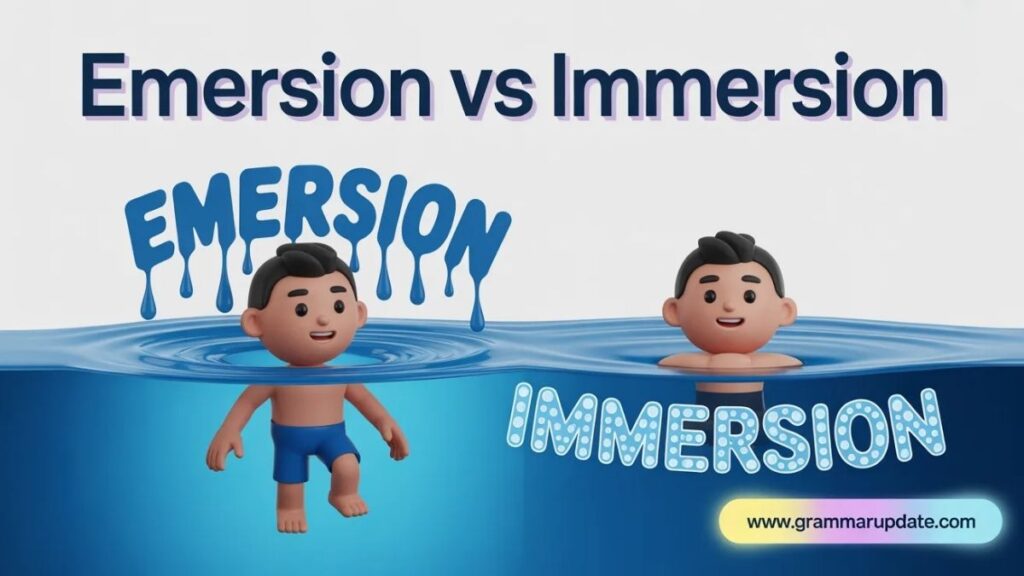
Practical examples clarify how the words function in real sentences.
Examples of Emersion
- The diver’s emersion from water occurred after the experiment ended.
- Marine plants survive alternating periods of immersion and emersion.
- After months of research, the scientist experienced intellectual emersion, reflecting on the results.
Examples of Immersion
- The school offers a Spanish language immersion program.
- Travelers seek immersion in culture when living abroad.
- Virtual reality creates highly immersive environments.
Cultural Immersion Through Travel
Travelers often pursue cultural immersion to gain deeper understanding of foreign societies.
Common immersion activities include:
- living with host families
- attending local festivals
- learning traditional cooking
- speaking the local language daily
These experiences create fully immersive cultural environments.
After returning home, travelers often experience emersion reflection, analyzing what they learned.
Common Mistakes Writers Make
Because the words sound identical, confusion occurs frequently.
Mistake: Using immersion when emersion is correct
Incorrect:
The diver’s immersion from the water surprised the observers.
Correct:
The diver’s emersion from water surprised the observers.
Mistake: Assuming the words mean the same thing
In reality, they represent opposing concepts.
- Immersion → entering deeply
- Emersion → emerging outward
Memory Trick for Emersion vs Immersion
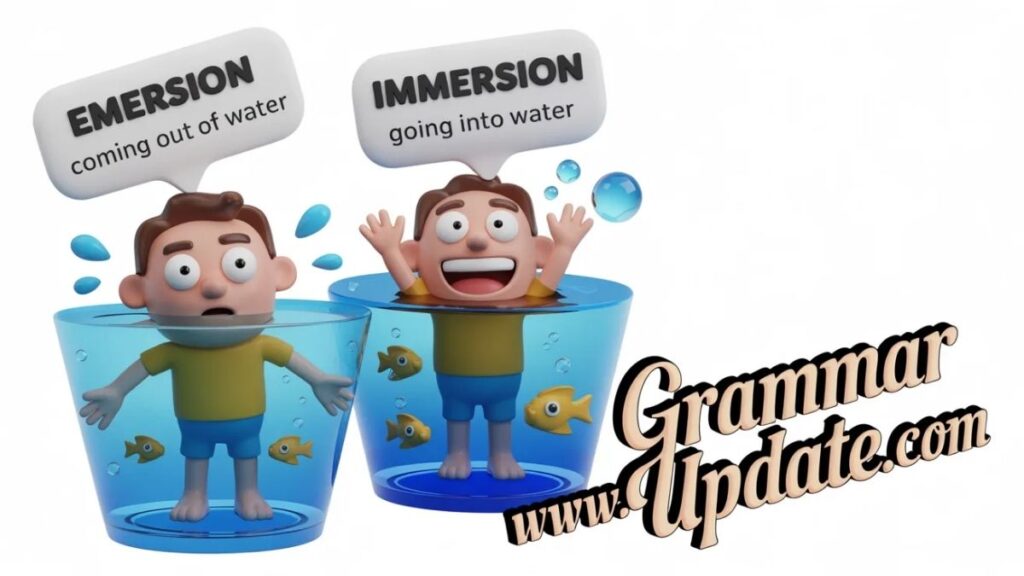
A simple strategy helps remember the difference.
| Word | Memory Tip |
|---|---|
| Emersion | E = Exit |
| Immersion | I = Into |
This quick rule prevents confusion.
Key Takeaways
Understanding Emersion vs Immersion becomes simple when you remember their core contrast.
Emersion
- emerging from water or concealment
- often used in science and astronomy
- represents transition and reflection
Immersion
- deep involvement or engagement
- widely used in education and technology
- describes immersive environments and experiences
More Confusing Words Made Simple
Tweek vs Tweak Difference and Correct Usage
Reference Cambridge Dictionary Definitions
Here’s a trusted source for clear word meanings:
FAQs
What is the emersion vs immersion meaning?
The Emersion vs immersion meaning depends on direction. Emersion meaning refers to emerging or coming out of water or a hidden state. Immersion means going deeply into something or being fully absorbed in an experience.
What is emersion vs immersion psychology?
In Emersion vs immersion psychology, immersion describes deep mental focus during an experience. Emersion refers to the reflective phase that happens after the experience ends. One involves deep engagement, while the other involves processing and reflection.
What is emersion vs immersion school learning?
In Emersion vs immersion school contexts, immersion means students learn by being surrounded by a language or subject constantly. Emersion happens when learners step out of that environment and reflect on what they learned. Schools often use language immersion programs to improve fluency.
What is emersion vs immersion blender?
An immersion blender is a handheld kitchen tool used to blend food directly in a pot or container. The term refers to the blade being immersed into the mixture. The word emersion is not used for kitchen tools.
Can you show emersion vs immersion examples?
Here are simple Emersion vs immersion examples:
- The diver’s emersion from the ocean was recorded by researchers.
- Students improved quickly through Spanish immersion classes.
These examples show emerging vs deep involvement.
What is emersion meaning?
The emersion meaning is the act of emerging from water or becoming visible after being hidden. It is commonly used in marine biology, astronomy, and scientific discussions. The word describes a transition from submerged to exposed.
What is the difference between submersion vs immersion?
In Submersion vs immersion, both involve being under a liquid. However, submersion focuses on being completely underwater, while immersion can also describe deep involvement in activities or experiences. Immersion often has broader metaphorical uses.
What are the similarities between emersion and immersion?
The similarities between emersion and immersion include their shared roots and contexts. Both words relate to water, movement, and states of experience. They are also often used in science, education, and psychology to describe transitions or levels of engagement.
Final Thoughts:
The difference between emersion and immersion may look tiny at first. After all, only one letter separates them. Yet that small change flips the meaning completely.
Immersion pulls you deep into an experience. Emersion brings you back to the surface. Simple once you picture it.
Think of a scuba diver exploring the ocean. The moment they dive under the water, that’s immersion. When they rise back up, pull off the mask, and grab a well-earned snack, that’s emersion.
English loves these little word puzzles. They look harmless until they trip you up in the middle of a sentence. The good news? You’ve solved this one. Next time someone mixes them up, you’ll know exactly which word dives in and which one comes up for air.

Jhon AJS, the creative mind behind Grammar Update, is an experienced blogger passionate about simplifying English grammar. He focuses on explaining confusing word vs word differences, grammar rules, punctuation, and sentence structure in a clear and practical way. Through easy to understand guides and examples, Jhon helps readers improve their writing and communicate with confidence. With years of blogging experience, he continues to share helpful insights that make learning grammar simple, useful, and accessible for everyone.