If you’ve ever paused mid-sentence wondering whether to write ally or Allie, you’re not alone. The ally vs Allie confusion trips up writers, students, and even seasoned editors. After all, both words sound exactly the same. Say them out loud and nobody notices a difference. Yet on the page, that tiny spelling change flips the meaning completely. One word refers to a loyal supporter or partner. The other might be your coworker Allie who just brought coffee to the meeting. Mix them up and your sentence suddenly gets awkward or unintentionally funny. So what’s the real difference between ally and Allie, and when should you use each one? Let’s clear up the confusion.
The Core Difference
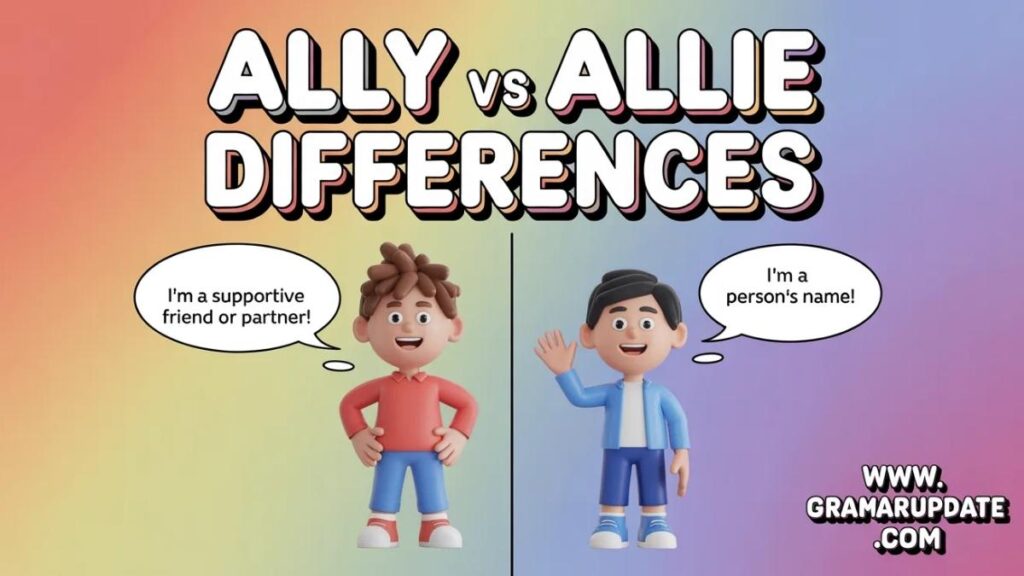
The difference between ally and Allie comes down to grammar, meaning, and capitalization.
| Word | Part of Speech | Meaning | Example |
|---|---|---|---|
| Ally | Noun / Verb | A supporter or partner working with someone toward a shared goal | Canada is a close ally of the United States. |
| Allie | Proper Noun | A personal name or nickname | Allie finished the report this morning. |
Here’s the key idea to remember.
- Ally describes a relationship of support or partnership.
- Allie identifies a person’s name.
This difference explains why the pair often causes common spelling confusion. They are homophones words that sound the same but mean different things.
A quick memory trick helps:
Ally relates to alliance.
Allie refers to a person.
Once that idea clicks, the confusion disappears.
Ally Definition, History, and Usage
The word ally appears frequently in conversations about politics, teamwork, and social relationships. Its meaning always centers on cooperation and support.
Learn how to use confusing more words correctly
Manor vs Manner Which One Is Correct?
Ally Definition
The ally definition includes two grammatical forms.
Ally as a noun
An ally (noun) means:
A supporter or partner who cooperates with another person, organization, or country to achieve a shared goal.
This meaning appears in contexts such as:
- international politics
- military cooperation
- business partnerships
- social movements
Examples:
- “Germany remains an important political ally in Europe.”
- “Every successful leader needs a reliable ally.”
- “She became a strong ally for education reform.”
These examples reflect the idea of ally as a friend or supporter.
Ally as a verb
The word also works as a verb. The ally verb meaning refers to forming a partnership.
Definition:
To join forces with someone in order to achieve a common objective.
Examples:
- “The two organizations decided to ally for environmental advocacy.”
- “Smaller companies often ally to compete with larger corporations.”
Although this usage appears less often in casual conversation, it remains perfectly correct.
Word Origins
Tracing a word’s history often reveals its deeper meaning. The ally word meaning evolved from several earlier languages.
| Language | Original Word | Meaning |
|---|---|---|
| Latin | alligare | to bind together |
| Old French | alier | to unite or connect |
| Middle English | ally | partner or supporter |
Since the 14th century, English speakers have used the word to describe cooperation and partnership. That historical background explains why modern phrases like strategic alliance and political ally feel so natural.
Learn how to use confusing more words correctly
Workday vs Work Day Which One Is Correct?
Ally in Politics Meaning

One of the most common uses appears in international relations.
A political ally refers to:
A nation that cooperates with another country for security, economic, or diplomatic reasons.
These relationships form strategic alliances that influence global politics.
Examples of modern political allies
| Country | Key Allies |
|---|---|
| United States | United Kingdom, Canada, Japan |
| France | Germany, Italy, Spain |
| Australia | United States, New Zealand |
During World War II, the nations fighting against the Axis powers became known collectively as the Allies. The term still carries strong historical significance today.
Allie Meaning
While ally describes relationships, Allie refers to a person.
Allie Definition
The Allie definition is straightforward.
Allie is a personal name commonly used as a nickname or shortened version of longer names.
Because it identifies a specific individual, it follows the rules of proper noun usage.
Examples:
- “Allie called to confirm the meeting.”
- “The report came from Allie yesterday.”
Notice how the word always begins with a capital letter.
Related Articles You May Find Helpful
Manuel vs Manual When to Use Each One in Writing
Allie Name Meaning
The Allie name meaning connects to several traditional English names.
Most commonly, Allie appears as a nickname for Allison.
Other related names include:
- Alexandra
- Alexandria
- Alice
- Alison
- Allegra
These shortened versions belong to a linguistic category known as diminutive forms of names.
Allie Nickname Meaning
In everyday language, nicknames often express familiarity or affection. The Allie nickname meaning reflects that pattern.
Examples of nickname transformations:
| Full Name | Nickname |
|---|---|
| Allison | Allie |
| Alexandra | Alex |
| Katherine | Kate |
| Benjamin | Ben |
Because of this pattern, Allie as a given name often feels friendly and informal.
Many parents even choose Allie as the official name rather than a nickname.
Popularity of the Name Allie
The name gained popularity in the United States during the late twentieth century.
According to Social Security Administration data:
| Year | Popularity Rank |
|---|---|
| 1990 | #182 |
| 2000 | #196 |
| 2010 | #250 |
| 2020 | #356 |
Although the ranking changes over time, Allie remains a recognizable and widely used name.
Fix common more word mistakes in English
Oftentimes vs Often Times Which One Is Correct?
A Direct Comparison
Seeing the words side by side makes the difference clear.
| Feature | Ally | Allie |
|---|---|---|
| Word Type | Noun / Verb | Proper noun |
| Meaning | Supporter or partner | Person’s name |
| Capitalization | Usually lowercase | Always capitalized |
| Typical Context | Politics, partnerships, activism | Personal identification |
| Example | She became a strong ally in the campaign. | Allie organized the event. |
This table highlights the ally vs Allie grammar difference.
How to Use Ally in a Sentence
Using ally in a sentence becomes easy once you understand its role as a noun or verb.
Examples as a noun
- “A supportive friend can become your strongest ally.”
- “The country relies heavily on its diplomatic allies.”
- “She acted as an ally for employees seeking fair wages.”
These examples emphasize the idea of support and partnership.
Examples as a verb
- “Two advocacy groups decided to ally during the campaign.”
- “Several companies allied to develop renewable energy technology.”
Although less common, this usage remains grammatically correct.
Ally Synonyms
Several words share similar meanings with ally.
| Synonym | Example |
|---|---|
| Partner | She became a trusted partner in the project. |
| Supporter | The candidate gained several supporters. |
| Collaborator | The scientists collaborated on research. |
| Associate | He worked closely with his associates. |
These synonyms reinforce the concept of ally relationship meaning.
How to Use Allie in a Sentence
Because Allie is a proper noun, its usage stays simple.
Examples:
- “Allie scheduled the conference call.”
- “Everyone thanked Allie for organizing the event.”
- “The design came from Allie’s creative team.”
Here, the word functions exactly like any other personal name.
Learn how to use confusing more words correctly
What Kind of vs What Kinds of, Which One Should You Use?
Ally vs Allie Examples in Sentences
Comparing sentences side by side helps clarify usage.
| Sentence | Correct Word |
|---|---|
| She became a powerful for workplace equality. | ally |
| emailed the final report yesterday. | Allie |
| The nation relied on its closest during negotiations. | allies |
| will lead the presentation tomorrow. | Allie |
These examples illustrate ally vs Allie examples in sentences.
Related Articles You May Find Helpful
Nominator vs Nominee Differences and Definition
Common Grammar Mistakes With Ally vs Allie
Because the words sound identical, writers frequently mix them up.
Several mistakes appear repeatedly.
Using “Allie” when you mean “Ally”
Incorrect:
“She is a strong Allie of the movement.”
Correct:
“She is a strong ally of the movement.”
The sentence describes a supporter, not a person’s name.
Using “Ally” as someone’s name
Incorrect:
“Ally will prepare the report.”
Correct:
“Allie will prepare the report.”
Unless the person actually spells their name “Ally,” the proper spelling remains Allie.
Learn the difference between tricky more English words
To Many vs Too Many Difference and Which is Correct?
Capitalization errors
Because Allie is a proper noun, it must be capitalized.
Incorrect:
“allie sent the message.”
Correct:
“Allie sent the message.”
Why Ally vs Allie Creates Spelling Confusion
Several factors cause this English vocabulary confusion.
Identical pronunciation
Both words share the same pronunciation:
/ˈæl.i/
That makes them homophones.
Nearly identical spelling
Only one letter separates them.
| Word | Ending |
|---|---|
| Ally | y |
| Allie | ie |
That small change causes a major shift in meaning.
Different grammatical roles
- Ally → noun or verb
- Allie → proper noun
Understanding this difference solves most ally vs Allie grammar problems.
Learn the difference between tricky more English words
Cancellation vs Cancelation Which Spelling Is Correct?
When to Use Ally vs Allie
Choosing the correct word becomes simple if you ask one question.
Are you describing a supporter or partner?
Use ally.
Example:
“A good mentor acts as an ally during difficult career decisions.”
Are you referring to someone’s name?
Use Allie.
Example:
“Allie prepared the final presentation.”
Quick reference table
| Situation | Correct Word |
|---|---|
| Supporter or collaborator | Ally |
| Strategic or political partnership | Ally |
| Person’s name | Allie |
| Nickname for Allison | Allie |
This rule answers the question when to use ally vs Allie.
Fix common more word mistakes in English
Long Term vs Long-Term Which is Correct?
Ally in Social Advocacy
In modern discussions about equality, the word ally has gained deeper meaning.
An ally in this context refers to:
Someone who supports and advocates for a community they may not belong to personally.
Examples include:
- workplace diversity supporters
- LGBTQ+ advocates
- racial justice supporters
A well-known quote captures the idea clearly:
“An ally speaks up even when it is easier to stay silent.”
This illustrates how the word extends beyond politics into friendship and support terminology.
Related Articles You May Find Helpful
Oversight vs Oversite Differences and Usage
Allie as a Cultural Name
The name Allie appears frequently in literature and film because it sounds warm and approachable.
One famous example comes from the novel and film The Notebook, where the character Allie Hamilton plays a central role.
The name continues to appear in:
- novels
- television series
- modern baby name lists
Its short length and friendly tone explain why Allie remains a popular nickname spelling.
Fix common more word mistakes in English
Skillset vs Skill Set Which Spelling Is Correct?
Tips to Remember the Ally vs Allie Spelling Difference
A few simple strategies prevent mistakes.
Think about alliances
Ally connects directly to the word alliance.
Apply the name rule
If the word refers to a person, it must be Allie.
Check the sentence context
Ask yourself:
Does this sentence describe support or someone’s name?
The answer reveals the correct spelling immediately.
Reference Cambridge Dictionary Definitions
Here’s a trusted source for clear word meanings:
Practs session Ally vs Allie
Test your understanding of ally and Allie by choosing the correct word to complete each sentence.
Fill in the Blanks
- Sarah has been my closest __________ since high school.
- Every country needs a trusted __________ during difficult times.
- __________ volunteered to organize the charity event.
- The senator thanked each international __________ for their support.
- My cousin __________ is visiting us this weekend.
- A true __________ stands by you when life gets difficult.
- __________ won first place in the spelling competition.
- The organization became a strong __________ in the fight against climate change.
- We invited __________ to dinner after the meeting.
- The two companies formed an __________ to expand their business.
- __________ loves reading mystery novels.
- Every good leader values a loyal __________.
- I met __________ at the conference yesterday.
- The neighboring nation remained an important __________ throughout the negotiations.
- __________ baked cookies for the school fundraiser.
- A dependable __________ offers support when it’s needed most.
- __________ just adopted a new puppy.
- The charity found a powerful __________ in the local community.
- Everyone congratulated __________ on her graduation.
- The military relied on each __________ during the operation.
- __________ arrived early to help decorate the hall.
- Finding a trustworthy __________ can make any challenge easier.
- __________ sent everyone a thoughtful thank-you card.
- The environmental group partnered with a new __________.
- We were happy that __________ could join us for the celebration.
Answers
| Question | Correct Answer |
|---|---|
| 1 | Allie |
| 2 | ally |
| 3 | Allie |
| 4 | ally |
| 5 | Allie |
| 6 | ally |
| 7 | Allie |
| 8 | ally |
| 9 | Allie |
| 10 | alliance (not ally or Allie) |
| 11 | Allie |
| 12 | ally |
| 13 | Allie |
| 14 | ally |
| 15 | Allie |
| 16 | ally |
| 17 | Allie |
| 18 | ally |
| 19 | Allie |
| 20 | ally |
| 21 | Allie |
| 22 | ally |
| 23 | Allie |
| 24 | ally |
| 25 | Allie |
FAQs
Is it spelled ally or Allie?
Both spellings are correct, but they mean different things. Ally is a noun or verb that refers to someone who supports another person, group, or country. Allie is a proper noun used as a first name, often as a nickname for Allison, Alexandra, Alice, or Alicia.
What is the difference between ally and Allie?
The difference is simple:
- Ally means a supporter, partner, or someone who shares a common goal.
- Allie is a person’s name.
Although they’re pronounced the same, they have different meanings and should never be used interchangeably.
What does ally mean?
An ally is someone who provides support, cooperation, or assistance. The term can describe an individual, organization, business, or country working alongside another toward a shared objective.
Who is an ally?
An ally is anyone who stands beside another person or group through support, cooperation, or advocacy. Depending on the context, an ally may be a friend, colleague, teammate, business partner, or even another nation.
Is an ally the same as a friend?
Not necessarily. A friend can be an ally, but an ally isn’t always a friend. Friendship is based on a personal relationship, while an ally is defined by support and shared goals.
What is a true ally?
A true ally offers consistent support through both words and actions. They listen, respect others, speak up when needed, and remain supportive even when it’s difficult or inconvenient.
Can a friend be an ally?
Yes. A friend becomes an ally when they actively support you, encourage you, or stand with you during challenges instead of remaining neutral.
What does ally mean in war?
In military and political contexts, an ally is a country that cooperates with another nation during a conflict or for mutual defense. Allied countries often share resources, intelligence, and military strategies.
How do you spell ally as a supporter?
The correct spelling is ally.
Example:
- She has always been my strongest ally.
How do you spell Allie as a name?
When referring to a person’s name, the correct spelling is Allie with a capital A.
Example:
- Allie won the writing competition.
What is Allie short for?
Allie is commonly used as a nickname for several names, including:
- Allison
- Alexandra
- Alice
- Alicia
- Alessandra
- Alina
Some people also use Allie as their full first name.
Is Allie a girl’s name?
Yes. Allie is most commonly used as a feminine given name, although naming traditions vary across families and cultures.
Can ally be used as a verb?
Yes. Ally functions as both a noun and a verb.
Example:
- The two organizations decided to ally to achieve a common goal.
As a verb, ally means to join forces or work together.
What are some synonyms for ally?
Depending on the context, common synonyms include:
- Partner
- Supporter
- Associate
- Collaborator
- Teammate
- Companion
Each word carries a slightly different meaning, so choose the one that best fits your sentence.
What is the opposite of ally?
The most common opposites of ally include:
- Enemy
- Opponent
- Rival
- Adversary
- Foe
The best choice depends on the context.
How do you pronounce ally?
Ally is pronounced AL-eye (/ˈæl.aɪ/).
It rhymes with words such as sky, fly, and try.
How do you pronounce Allie?
Allie is pronounced exactly the same as ally: AL-eye (/ˈæl.aɪ/).
The spelling changes, but the pronunciation does not.
Can ally refer to a person, organization, or country?
Yes. The word ally has a broad meaning. It can describe a supportive individual, a business partner, a nonprofit organization, a political group, or a nation that cooperates with another country.
Can I call someone an ally?
Yes. It’s appropriate to describe someone as an ally when they consistently support, encourage, or stand with another person, community, or cause through their actions.
How can I remember the difference between ally and Allie?
A simple memory trick is to focus on capitalization.
- Ally usually refers to a supporter or partner.
- Allie is a person’s name and begins with a capital letter when used as a proper noun.
Thinking about the context will help you choose the correct spelling every time.
Why do people confuse ally and Allie?
Ally and Allie are homophones, meaning they’re pronounced the same but spelled differently. Because they sound identical in conversation, writers sometimes choose the wrong spelling. Paying attention to the sentence’s meaning is the easiest way to avoid the mistake.
Final Thoughts
At first glance, ally vs Allie looks like a tiny spelling variation. In reality, that single letter changes everything.
- Ally means a supporter or partner in a relationship, cause, or strategic alliance.
- Allie is a person’s name, often a nickname for Allison, Alexandra, or Alice.
Mix them up and the sentence can take an unexpected turn. Imagine writing, “The country depended on Allie during the negotiations.” Suddenly one person named Allie sounds responsible for international diplomacy.
The good news? The rule is simple.
Supporter or partner → ally
Person’s name → Allie
Keep that distinction in mind and you’ll never struggle with the difference between ally and Allie again. Sometimes, in English, one little letter really does make a big difference.

Jhon AJS, the creative mind behind Grammar Update, is an experienced blogger passionate about simplifying English grammar. He focuses on explaining confusing word vs word differences, grammar rules, punctuation, and sentence structure in a clear and practical way. Through easy to understand guides and examples, Jhon helps readers improve their writing and communicate with confidence. With years of blogging experience, he continues to share helpful insights that make learning grammar simple, useful, and accessible for everyone.