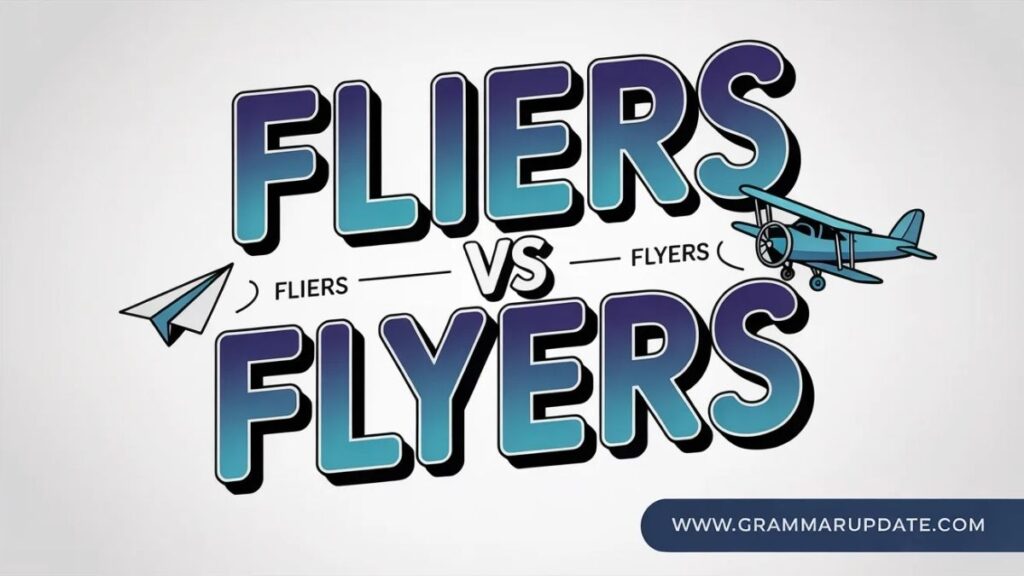
The confusion between fliers vs flyers is one of those classic English spelling problems that looks simple at first but often leads to unnecessary mistakes in real writing. Both words appear almost identical, and at a quick glance, it feels like they should be fully interchangeable. However, once you see them used in advertising, aviation, and everyday communication, the difference becomes more meaningful and much less obvious than expected. This is exactly where most writers get confused and accidentally mix contexts or meanings. In this article, you will clearly understand fliers vs flyers, how each term is correctly used, why the confusion happens so often, and how to avoid common spelling and grammar mistakes with confidence.
Fliers vs Flyers Quick Answer
In modern English, flyers is usually the preferred spelling when discussing advertisements, marketing materials, printed handouts, or promotional papers. Businesses, schools, restaurants, and event organizers overwhelmingly choose this version because readers immediately recognize it as advertising language.
The spelling fliers is more commonly associated with aviation and travel. Airlines, pilots, travel organizations, and aviation programs frequently use this spelling when referring to people who fly regularly.
Quick Examples
- The company distributed promotional flyers before the product launch.
- Frequent fliers earn airline points and travel rewards.
These examples clearly show how the preferred spelling changes according to context.
Simple Context Rule
| Context | Preferred Spelling |
|---|---|
| Advertising and marketing | Flyers |
| Aviation and travel | Fliers |
| Business promotions | Flyers |
| Airline reward programs | Fliers |
Key Usage Facts
- “Flyers” is far more common in modern business writing.
- “Fliers” still remains standard in many aviation-related situations.
Example:
A restaurant may print advertising flyers, while an airline rewards frequent fliers.
What Does “Flyers” Mean?
The word flyers most commonly refers to printed or digital advertisements designed to spread information quickly. Businesses use flyers to promote products, schools use them to announce events, and organizations distribute flyers to attract public attention.
Over time, the advertising industry helped make “flyers” the dominant spelling in promotional communication. Graphic designers, printing companies, online template platforms, and marketers consistently used this version until it became visually familiar worldwide.
Flyer Definition in English
A flyer is a promotional document, advertisement, or informational handout distributed publicly.
Flyers are commonly used for:
- Marketing campaigns
- Restaurant promotions
- School announcements
- Political advertising
- Community events
- Concert promotions
- Business openings
Today, when people hear the phrase “design a flyer,” they almost automatically think about advertising material.
Types of Flyers
| Type of Flyer | Purpose |
|---|---|
| Event flyer | Promotes concerts, festivals, or parties |
| Business flyer | Advertises products or services |
| School flyer | Shares educational announcements |
| Digital flyer | Promotes information online |
| Political flyer | Supports campaigns and elections |
Why “Flyers” Became Popular
Advertising companies heavily promoted the spelling “flyers” through newspapers, print shops, marketing campaigns, and digital media. As online advertising expanded globally, the spelling became even more dominant.
Modern platforms commonly use terms such as:
- Flyer templates
- Business flyers
- Promotional flyers
- Event flyers
- Marketing flyers
Because millions of readers constantly see these phrases online, “flyers” now feels more modern and professional in advertising contexts.
Common Uses of Flyers
- Businesses use flyers to increase local brand awareness.
- Schools distribute informational flyers during community events.
Example:
A clothing store may distribute promotional flyers to advertise seasonal discounts.
What Does “Fliers” Mean?
The word fliers traditionally refers to people, animals, or objects capable of flying. Airlines and aviation organizations commonly use this spelling in travel-related communication.
The most famous example is the phrase frequent flier miles.
Flier Definition in English
A flier is generally someone who flies regularly or something connected with flight.
The term may describe:
- Airline passengers
- Pilots
- Birds
- Aviation experts
- Fast aircraft
- Skilled travelers
Although “flyers” can technically describe flying individuals too, “fliers” remained strongly connected with aviation terminology because airlines preserved the spelling historically.
Aviation Usage Table
| Aviation Term | Meaning |
|---|---|
| Frequent flier | Regular airline traveler |
| Military flier | Aviation professional |
| Experienced flier | Skilled traveler or pilot |
| Commercial flier | Passenger using airlines frequently |
Why Airlines Prefer “Fliers”
Airline companies adopted the phrase “frequent flier” decades ago. Since these loyalty programs became internationally recognized, the spelling remained deeply connected with travel culture.
This created a strong mental association for readers:
- Flyers = advertisements
- Fliers = aviation and travel
Common Uses of Fliers
- Airlines reward frequent fliers with loyalty points.
- Aviation magazines discuss skilled military fliers.
Example:
Frequent fliers often receive priority boarding and free travel upgrades.
Learn the difference between tricky more English words
Pentoxide vs Pentaoxide Scientific Overview
Difference Between Flier and Flyer
The primary difference between flyer vs flier comes from usage context rather than strict grammar rules. Modern English gradually developed separate preferences for advertising and aviation.
Main Difference Table
| Word | Main Meaning | Common Industry |
|---|---|---|
| Flyer | Advertisement or promotional paper | Marketing |
| Flier | Person who flies | Aviation |
Although dictionaries often list both spellings as acceptable, modern readers expect different meanings depending on the spelling used.
Why Context Matters
Using the preferred spelling for the correct situation improves professionalism and clarity.
For example:
- A marketing company usually prints flyers.
- An airline usually rewards frequent fliers.
Important Grammar Facts
| Grammar Feature | Flyer | Flier |
|---|---|---|
| Singular noun | Yes | Yes |
| Plural noun | Flyers | Fliers |
| Common in advertising | Very common | Rare |
| Common in aviation | Less common | Very common |
Usage Patterns
- “Flyers” dominates modern advertising and business writing.
- “Fliers” remains stronger in aviation terminology.
Example:
A travel agency may discuss experienced fliers, while a nightclub distributes promotional flyers.
Fix common more word mistakes in English
Commit vs Comit Correct Spelling and Usage
Why People Confuse Fliers and Flyers
The confusion exists because both spellings sound exactly the same in spoken English. Pronunciation provides no clue about which spelling is correct.
Another major reason involves dictionary flexibility. Many dictionaries recognize both spellings as technically correct, which leads people to believe they are always interchangeable.
However, industries developed separate preferences over time.
Advertising companies heavily promoted “flyers,” while airlines continued using “fliers.” This created two parallel spelling traditions in English.
Major Causes of Confusion
| Cause | Explanation |
|---|---|
| Same pronunciation | Both words sound identical |
| Dictionary acceptance | Both spellings are technically correct |
| Industry preferences | Different industries prefer different spellings |
| Internet inconsistency | Websites often mix both spellings |
Why Online Searches Increase Confusion
Internet searches expose readers to both spellings constantly. One website may discuss “event flyers,” while another discusses “frequent flier programs.”
This repeated exposure makes many writers uncertain about the preferred form.
Common Confusion Situations
- Students often confuse advertising flyers with airline fliers.
- Online articles sometimes mix both spellings inconsistently.
Example:
A traveler may see “frequent flier rewards” on an airline website but “promotional flyers” on a business website the same day.
Is Flyer or Flier Correct for Advertisements?
For advertisements and promotional materials, flyer is the preferred spelling in modern English. Businesses overwhelmingly choose this version because readers immediately associate it with marketing.
Flyer Advertisement Meaning
A flyer advertisement is a printed or digital document created to promote products, services, events, or announcements.
Fix common more word mistakes in English
Stich vs Stitch Difference and Usage
Advertising Flyer Categories
| Flyer Type | Example |
|---|---|
| Restaurant flyer | Food discount promotion |
| Concert flyer | Music event advertisement |
| Business flyer | Product launch campaign |
| School flyer | Parent information notice |
| Political flyer | Election campaign handout |
Why Businesses Prefer “Flyers”
Marketing industries standardized the spelling because it appeared cleaner, clearer, and more visually recognizable to readers.
Today, searches for “flyer templates” generate millions of marketing-related results online.
Advertising Facts
- Printed flyers remain one of the cheapest advertising tools available.
- Digital flyers are widely shared across social media platforms.
Example:
A gym may distribute advertising flyers to promote discounted memberships.
Learn how to use confusing more words correctly
Loosing vs Losing Common English Mistake
Is Flier or Flyer Correct for Aviation?
In aviation contexts, “flier” remains highly common because airlines preserved the spelling through decades of branding and travel communication.
Frequent Flier Meaning
A frequent flier is a traveler who regularly uses airlines and earns travel rewards or loyalty points.
Aviation Language Table
| Aviation Phrase | Common Usage |
|---|---|
| Frequent flier miles | Airline rewards |
| Experienced flier | Skilled traveler |
| Military flier | Aviation professional |
| International flier | Frequent global traveler |
Aviation Tradition
The Aviation industries often preserve traditional terminology even after newer spellings become popular elsewhere.
This historical influence explains why “fliers” still appears strongly in airline communication today.
Aviation Usage Facts
- Airlines continue using “frequent flier” in loyalty programs.
- Travel magazines frequently use “fliers” for aviation discussions.
Example:
Experienced fliers usually understand airport procedures better than occasional travelers.
Fliers vs Flyers in American English
American English accepts both spellings, but “flyers” dominates modern advertising and business communication.
Learn how to use confusing more words correctly
Programming vs Programing Which Spelling Is Correct?
AP Style Flyer Rules
The AP Stylebook generally recommends “flyer” for advertisements and promotional materials. Since journalists and publishers follow AP Style widely, this recommendation strongly influenced American business writing.
American English Comparison
| Usage Area | Preferred American Spelling |
|---|---|
| Advertising | Flyers |
| Marketing | Flyers |
| Aviation | Fliers |
| Airline programs | Fliers |
Modern American Usage
- Businesses almost always prefer “flyers.”
- Airlines may still preserve “fliers.”
Example:
Most American companies advertise local events using promotional flyers.
Learn how to use confusing more words correctly
Forest vs Forrest Which Spelling Is Correct and Usage?
Common Mistakes with Fliers and Flyers
One major mistake involves using “fliers” in business advertisements where readers expect “flyers.” Another mistake occurs when people replace “frequent flier” with “frequent flyer” in airline terminology.
Common Grammar Mistakes Table
| Incorrect Usage | Preferred Usage |
|---|---|
| Advertising fliers | Advertising flyers |
| Promotional fliers | Promotional flyers |
| Frequent flyer miles | Frequent flier miles |
| Airline flyer program | Airline flier program |
Why These Mistakes Happen
- Both spellings sound identical.
- Dictionaries recognize both forms.
- Different industries follow different traditions.
Common Writing Problems
- Writers mix both spellings in the same article.
- Businesses sometimes use outdated spelling styles.
Example:
A business brochure looks more professional when it consistently uses “flyers” throughout the document.
Fix common more word mistakes in English
Kindergarten vs Kindergarden which is Correct and Usage?
Easy Memory Tricks for Fliers vs Flyers
Simple memory methods make this spelling confusion much easier to solve.
Memory Trick Table
| Memory Trick | Meaning |
|---|---|
| “Y” in flyer | Advertising and marketing |
| “I” in flier | Individual who flies |
| Flyers = papers | Marketing material |
| Fliers = travelers | Aviation context |
Helpful Spelling Reminders
- “Flyers” usually connects with advertisements and promotions.
- “Fliers” usually connects with aviation and airline travel.
Example:
If the sentence discusses paper advertisements, “flyers” is almost always the safest choice.
Learn the difference between tricky more English words
Receive vs Recieve Which is Correct and Usage?
Practice Session Fliers vs Flyers
Fill in the Correct Word
- The company printed colorful ______ for the marketing campaign.
- Frequent ______ often receive airline reward points.
- The school distributed informational ______ to parents.
- Experienced ______ usually understand airport procedures well.
- The restaurant posted promotional ______ around the city.
- Airlines reward loyal ______ with travel upgrades.
- The event organizer designed digital ______ for social media promotion.
- International ______ spend many hours traveling by air.
- The business used printed ______ to advertise discounts.
- Skilled military ______ require advanced aviation training.
Answers
- flyers
- fliers
- flyers
- fliers
- flyers
- fliers
- flyers
- fliers
- flyers
- fliers
Here’s a trusted source for clear word meanings:
FAQs
Is it a flyer or flier for a paper?
For paper advertisements and promotional handouts, “flyer” is the preferred and more widely used spelling in modern English.
Which is correct flier or flyer?
Both spellings are correct, but “flyer” is more common in advertising and marketing, while “flier” is more common in aviation and travel contexts.
Is a flyer a brochure or flier?
A flyer is similar to a brochure, but flyers are usually single-page promotional sheets, while brochures often contain folded pages with more detailed information.
Is it passing out fliers or flyers?
For advertising materials and printed promotions, “passing out flyers” is the preferred modern usage.
Is it post flyers or fliers?
“Post flyers” is the standard phrase when referring to promotional papers, advertisements, or event notices.
What are common flyer mistakes?
Common flyer mistakes include overcrowded text, poor design layout, weak headlines, unclear contact details, spelling errors, and low-quality images.
What is another name for a flyer?
Other names for a flyer include leaflet, handbill, circular, promotional sheet, advertising paper, and marketing handout.
Is it fliers or flyers to hand out?
“Flyers” is the preferred spelling when discussing printed advertisements or promotional materials distributed publicly.
What is the meaning of fliers?
“Fliers” usually refers to people who fly frequently, especially airline travelers, pilots, or aviation related individuals.
Why are paper flyers called flyers?
Paper flyers are called flyers because they are designed to spread information quickly and reach large groups of people efficiently.
What are the three types of flyers?
The three common types are advertising flyers, informational flyers, and event flyers.
Do you say fliers or flyers?
Most modern English speakers use “flyers” for advertisements and “fliers” for aviation or travel related contexts.
What is handing out flyers called?
Handing out flyers is commonly called flyer distribution, leaflet marketing, street promotion, or direct advertising.
Are flyers two-sided?
Flyers can be single-sided or double-sided depending on design needs and the amount of information included.
Is it flyers or fliers for paper?
For paper advertisements and promotional materials, “flyers” is considered the standard and preferred spelling.
What are flyers used for?
Flyers are used for advertising businesses, promoting events, sharing announcements, marketing products, and increasing public awareness.
Is it high flyers or high fliers?
“High flyers” is the more common modern spelling when describing highly successful or talented people.
What should a good flyer look like?
A good flyer should include a strong headline, clean layout, readable text, professional design, attractive visuals, and clear contact information.
How to tell a flyer lie?
Misleading flyers often contain exaggerated claims, unclear details, fake urgency, missing contact information, or unrealistic promises.
What are the five parts of a flyer?
The five main parts of a flyer are the headline, images, body text, call to action, and contact information.
Learn the difference between tricky more English words
Rumor vs Rumour Difference and Usage
Conclusion
In conclusion, the confusion between fliers vs flyers is not a matter of difficulty in English, but a matter of understanding context clearly and consistently. Both spellings exist in modern usage, yet they serve different purposes depending on meaning and industry. One is strongly tied to advertising and promotional communication, while the other remains closely connected to aviation and travel terminology. Most errors occur when writers overlook this contextual difference and assume both words function the same in every situation.
Once this distinction is understood, the uncertainty disappears. Choosing between fliers vs flyers becomes a simple, logical decision rather than a grammatical challenge. With correct usage, your writing becomes clearer, more accurate, and more professionally aligned with standard English communication practices.

Jhon AJS, the creative mind behind Grammar Update, is an experienced blogger passionate about simplifying English grammar. He focuses on explaining confusing word vs word differences, grammar rules, punctuation, and sentence structure in a clear and practical way. Through easy to understand guides and examples, Jhon helps readers improve their writing and communicate with confidence. With years of blogging experience, he continues to share helpful insights that make learning grammar simple, useful, and accessible for everyone.