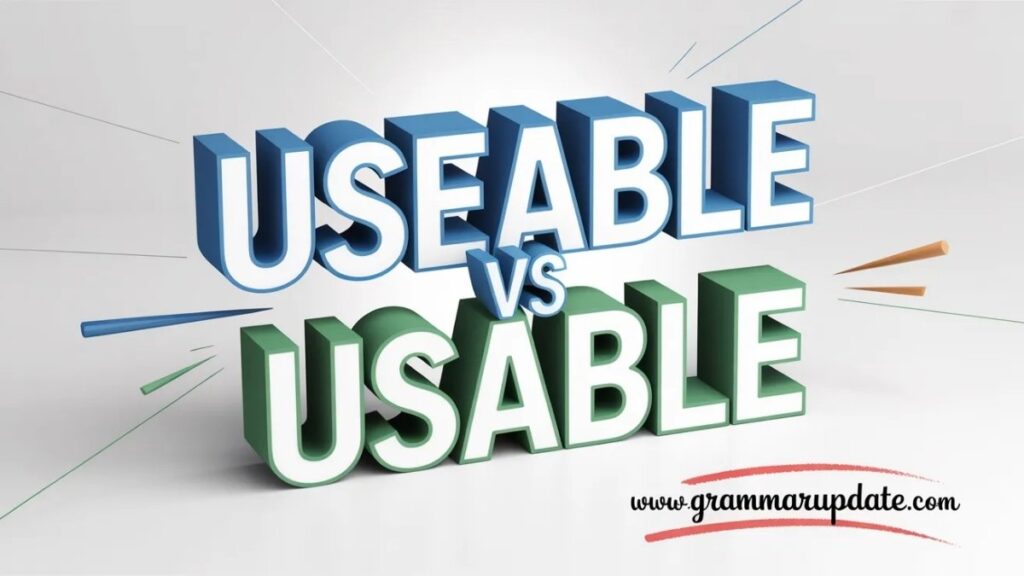
Confusion between useable vs usable is a common but easily avoidable spelling issue that often appears in everyday writing. At first glance, both forms seem correct, and that similarity is exactly what causes the mistake. However, only one is widely accepted in modern English usage. The word usable is the standard spelling used in professional, academic, and digital communication, while useable is a less common variant that can make writing appear inconsistent or outdated. In this article, the confusion around useable or usable is clarified in a structured, professional way so you can write with accuracy, confidence, and consistency every time.
Useable vs Usable Quick Answer
Let’s make this simple and practical.
- Usable is the correct and preferred spelling in modern English, while useable exists but is rarely used and often avoided in professional writing.
Example:
You write a report at work and type, “The system is fully usable.” It reads smoothly, and no one questions it. If you wrote “useable,” someone might pause and wonder if it’s a typo.
That small difference affects how professional your writing feels.
Is Useable a Word?
This is where many people hesitate: is useable a word?
- Yes, useable is technically a word, but it is not the standard choice in modern English and is rarely used in everyday or professional writing.
Example:
A student writes an assignment and uses “useable.” The teacher understands it, but marks it as less appropriate compared to “usable.” The meaning is clear, but the impression is weaker.
So while it exists, it doesn’t carry the same weight.
Usable Meaning Clear and Practical Definition
To use the word correctly, you need to understand the usable meaning.
- Usable means something is capable of being used, practical, and fit for its intended purpose.
Example:
Imagine your phone screen cracks. The phone still turns on, but the touch barely works. It exists, but it’s not really usable anymore. That’s the difference between something being present and something being functional.
Useable or Usable Meaning Is There Any Difference?
People often assume there must be a deeper difference.
- Useable and usable have the same meaning, but usable is the form people trust and recognize instantly.
Example:
Two resumes say the same thing, but one uses “usable” and the other “useable.” The hiring manager won’t think about grammar deeply, but the cleaner version feels more professional.
Perception matters.
Why Usable Is Preferred Over Useable
This preference is not random. It follows a pattern in English.
- Usable is preferred because English usually drops the silent “e” before adding “-able,” making the word simpler and more consistent.
Example:
Think of words like “movable” or “lovable.” They follow the same pattern. When people see “usable,” it fits that familiar structure, so it feels right immediately.
Difference Between Usable and Useable
The difference is not about meaning. It’s about usage and impact.
- Usable is widely used and accepted, while useable is rare and can make writing look slightly outdated or less polished.
Example:
In a business email, writing “The data is usable” sounds clean and confident. Writing “useable” might not be wrong, but it can make the sentence feel less refined.
Comparison Table: Usable vs Useable
| Feature | Usable | Useable |
|---|---|---|
| Common usage | Very common | Rare |
| Professional writing | Preferred | Avoided |
| Reader reaction | Familiar | Slight hesitation |
| Meaning | Same | Same |
Usable vs Useable UK and US English
Some spelling differences depend on location. This one does not.
- Both UK and US English prefer usable, and useable is not tied to any specific region.
Example:
Whether you’re writing for a company in London or New York, “usable” will always look correct and natural.
Correct Spelling
At this point, the choice becomes obvious.
- Usable is the correct spelling for modern writing, while useable is technically allowed but not recommended.
Example:
A blog post optimized for search engines uses “usable” because it matches what readers expect and search engines recognize.
How to Use Usable in a Sentence
Using the word correctly is simple once you see how it works.
- Usable is an adjective that describes something functional or ready for use.
Example:
You clean out your garage and sort items into piles. Some tools are broken, some are rusty, but a few are still usable. Those are the ones you keep.
Learn the difference between similar English words
Check-in vs Check In Explained and Usage
Usable Pronunciation Clear and Natural
Pronunciation is straightforward and consistent.
- Usable is pronounced as “YOO-zuh-buhl,” with emphasis on the first part of the word.
Example:
Say it out loud during a presentation. It sounds natural and clear, which is exactly what you want in professional communication.
Usable vs Useful Key Difference
These two words are often mixed up in real conversations.
- Usable means something works, while useful means something provides value or benefit.
Example:
A basic calculator is usable because it works. A smart calculator that saves time is useful because it adds value.
Comparison Table: Usable vs Useful
| Word | Meaning | Real-life idea |
|---|---|---|
| Usable | Works properly | A functioning tool |
| Useful | Helps achieve something | A tool that saves time |
Usability in Real Life (Design and Daily Use)
The idea of “usable” goes beyond grammar. It shows up in everyday life.
- Usability means how easy and practical something is to use in real situations.
Example:
You download an app. It works, but the buttons are confusing. Technically it’s usable, but it’s frustrating. A truly usable app feels simple and intuitive from the first tap.
Learn the difference between similar English words
Parents’ vs Parent’s Differences and Correct Usage
Common Mistakes with Useable or Usable
Writers often repeat the same small errors.
- Using “useable” in formal writing or mixing both spellings in the same text creates inconsistency.
Example:
A report uses “usable” in one paragraph and “useable” in another. The reader may not notice consciously, but it creates a subtle sense of inconsistency.
Learn the difference between tricky English words
Worshipped vs Worshiped Difference and Usage
Words Ending in Able vs Eable Simple Rule
This confusion connects to a broader pattern.
- Most English words drop the silent “e” before adding “-able,” which is why usable is correct.
Example:
You already use words like “lovable” and “movable” without thinking. “Usable” follows the same logic, which is why it feels natural.
Learn the difference between tricky English words
Laser vs Lazer know the Difference
Spelling Rule Table
| Base Word | Correct Form |
|---|---|
| use | usable |
| move | movable |
| love | lovable |
Usable in Everyday English
You’ll notice this word more once you pay attention.
- Usable is used in daily life to describe things that are practical and functional.
Example:
You move into a new apartment. One room is full of boxes, another is clean and ready. That clean room is usable it’s ready to live in.
When Should You Use Useable?
This is a rare situation.
- Useable might appear in informal writing, but it is not recommended for professional or clear communication.
Example:
A casual message to a friend might include “useable,” and it won’t matter much. In a job application or report, it would stand out in the wrong way.
Learn the difference between tricky English words
Moment vs Momment Difference and Usage
Practice Section
This section is designed to strengthen your understanding of useable or usable through focused exercises. Each activity helps reinforce correct spelling, grammar awareness, and consistent usage in professional writing.
Fill in the Blanks
- Complete each sentence using the correct form: usable or useable.
- The system is fully ______ for daily operations.
- We need ______ data before making any decisions.
- The device is still ______ after repairs.
- This space is small but still ______.
- The results are not ______ for analysis.
Multiple Choice Questions
- Select the correct spelling for each sentence.
- The report contains ______ information.
A. usable
B. useable - This version is not yet ______.
A. usable
B. useable - The equipment is still ______ after maintenance.
A. usable
B. useable - The interface is simple and ______.
A. usable
B. useable - We require ______ data for accurate results.
A. usable
B. useable
Error Correction
- Identify and correct the mistake in each sentence.
- The system is useable for current needs.
- We collected useable data from the survey.
- The device is still useable after cleaning.
- The results are not useable for analysis.
- The platform is simple and useable.
Sentence Transformation
- Rewrite each sentence using the correct spelling and improved clarity.
- The system is useable in its current state.
- This data is not useable for decision-making.
- The platform is useable for new users.
- The space is still useable after renovation.
- The tool remains useable despite damage.
Usage Recognition
- Determine whether the sentence uses the correct spelling.
- The software is useable.
- The data is usable.
- The device is useable.
- The interface is usable.
- The results are useable.
Quick Self Assessment
- Choose the correct statement.
- Useable is more common than usable.
- Usable is the standard spelling in modern English.
- Both spellings are equally preferred in formal writing.
- Useable is recommended in professional communication.
- Usable and useable have different meanings.
Final Practice Focus
- Always use “usable” in formal, academic, and professional writing to maintain clarity, consistency, and credibility.
Here’s a trusted source for clear word meanings:
FAQs
Which is correct, useable vs usable?
The correct and preferred spelling in modern English is usable. “Useable” exists as a rare variant, but it is not commonly used in professional, academic, or formal writing.
What does usable mean?
Usable means something is capable of being used, functional, or fit for a specific purpose. It describes whether something works properly or can serve its intended function without issues.
What is a word for useable?
There is no special separate word for “useable.” The standard form is usable, and it is the correct term used in modern English. In some contexts, words like functional, practical, or operable may also express similar ideas depending on meaning.
What is the difference between useful and usable?
Usable refers to whether something can be used or functions properly, while useful refers to whether something provides benefit or value. Something can be usable without being useful if it works but does not help much.
Is “useable” commonly misspelled?
Yes, “useable” is commonly treated as a misspelling of usable in modern writing. It often appears due to spelling confusion, but most style guides recommend avoiding it.
How to use usable in a sentence?
“Usable” is used as an adjective to describe something functional or fit for purpose. It is commonly placed before nouns or used after linking verbs to describe condition or functionality.
What are the opposite of usable?
The opposite of usable includes words like unusable, broken, faulty, or nonfunctional. These describe something that cannot be used effectively or does not work as intended.
Are usable and useable interchangeable?
No, they are not fully interchangeable in modern writing. While both carry the same meaning, usable is the standard and preferred spelling, while “useable” is rare and generally avoided in formal contexts.
Is it inaccountable or unaccountable?
The correct form is unaccountable, not “inaccountable.” It follows standard English prefix rules where “un-” is commonly used to form opposites meaning not responsible or not explainable.
Conclusion
If useable vs usable has ever caused hesitation in your writing, it is a common and understandable point of confusion. The similarity in spelling often leads to uncertainty, even for confident writers. However, the distinction is straightforward once clarified.
The correct and standard form in modern English is usable. It is widely accepted in academic, professional, and everyday communication. The form useable does exist, but it is far less common and generally considered nonstandard in formal writing contexts.
Once this rule is understood, the confusion quickly disappears. Choosing usable ensures clarity, consistency, and a more polished and professional tone in your writing.

Jhon AJS, the creative mind behind Grammar Update, is an experienced blogger passionate about simplifying English grammar. He focuses on explaining confusing word vs word differences, grammar rules, punctuation, and sentence structure in a clear and practical way. Through easy to understand guides and examples, Jhon helps readers improve their writing and communicate with confidence. With years of blogging experience, he continues to share helpful insights that make learning grammar simple, useful, and accessible for everyone.