The distinction between busing vs bussing is a common source of confusion in written English because both words sound identical but function in entirely different contexts. This similarity often leads to spelling errors and incorrect usage, particularly when writers rely on pronunciation rather than meaning. The real challenge lies not in how the words sound, but in understanding the situations where each form applies. Without this clarity, sentences can easily become misleading or grammatically incorrect. This introduction provides a clear, professional explanation of the difference, helping you eliminate confusion, avoid common mistakes, and use both terms accurately and confidently in any context.
Busing vs Bussing Quick Answer
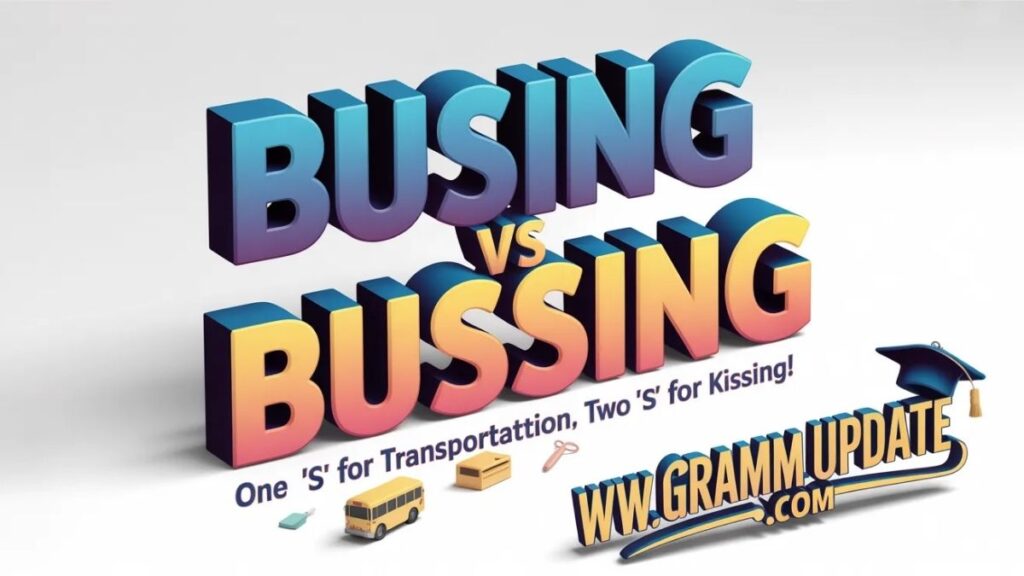
The simplest way to understand busing vs bussing is to separate meaning before spelling. Busing refers to transporting people using buses, while bussing refers to clearing tables in restaurants or informal slang usage.
The key idea is context. If the sentence is about movement of people, education, or public transport, busing is correct. If the sentence is about restaurant work or casual slang like kissing, bussing is correct.
Comparison Table
| Word | Meaning | Context | Formality | Example |
|---|---|---|---|---|
| Busing | Transporting people by bus | Schools, public transport | Formal | Students were busing to school from rural areas |
| Bussing | Clearing tables / slang kissing | Restaurants, informal speech | Semi-formal or informal | The staff was bussing tables after dinner rush |
What Does Busing Mean?
The busing meaning refers to the transportation of passengers from one place to another using buses. It is commonly used in education systems, government transport planning, and public transit networks.
In real-world application, busing is a logistical solution designed to move large groups of people efficiently. School districts often rely on it to ensure equal access to education, especially when students live far from school campuses.
In urban environments, busing is part of broader public transportation systems that reduce traffic congestion and improve mobility for workers and students alike.
Key Examples in Context
- School transportation systems moving students across districts
- Example: Rural students are bused daily to urban schools for better access to education
- Public transport services helping commuters reach workplaces
- Example: City employees rely on busing systems during peak traffic hours
Learn the difference between confusing more English words
Whose vs Who’s Difference and Using Each Word Correctly
What Does Bussing Mean?
The bussing meaning changes depending on context. In professional usage, especially in hospitality, it refers to clearing and resetting restaurant tables, In informal slang, it can also refer to kissing, though this usage is casual and not suitable for formal writing.
In restaurants, bussing is part of operational flow. It ensures that tables are quickly cleared so new customers can be seated without delays. This directly impacts service speed, customer satisfaction, and restaurant efficiency.
In slang, “bussing” is often used in online communication to describe affectionate kissing, usually in a playful or exaggerated way.
Key Examples in Context
- Restaurant table clearing and cleaning process
- Example: The busser was bussing tables quickly during the dinner rush
- Informal slang usage referring to kissing
- Example: The couple was bussing on the cheek in a viral video
Fix common more word mistakes in English
Message vs Messege Which Spelling Is Correct?
Busing or Bussing Tables Explained
The phrase busing or bussing tables is one of the most searched confusion points in English grammar. The correct term in restaurant usage is bussing tables.
This happens because English spelling rules often double consonants when forming present participles. In hospitality vocabulary, “bus” becomes “bussing” when referring to table service.
Bussing tables is not just cleaning. It is a structured part of restaurant workflow that supports waiters, improves table turnover, and maintains cleanliness standards.
Table: Restaurant Roles and Workflow
| Role | Responsibility | Example in Real Service |
|---|---|---|
| Busser | Clears and resets tables | The busser removed plates and reset the table within two minutes |
| Waiter | Takes orders and serves food | The waiter brought meals and managed customer requests |
| Kitchen Staff | Prepares food | The kitchen prepared dishes for fast service flow |
Overview
- Bussing tables ensures fast customer turnover
- Example: During peak hours, bussers kept all tables ready within minutes
- Bussers support waiters for smooth service operations
- Example: Waitstaff focused on orders while bussers handled cleanup
Fix common more word mistakes in English
To Bad vs Too Bad Which is correct and usage?
Busing vs Bussing Meaning and Core Difference
The difference between busing vs bussing grammar is entirely contextual. Both words come from the same root “bus,” but evolved into different meanings based on industry usage.
Busing always refers to transportation systems involving buses. Bussing refers to restaurant table service or informal slang. Mixing them creates confusion because the spelling difference is subtle but meaning is completely different.
Detailed Comparison Table
| Aspect | Busing | Bussing |
|---|---|---|
| Industry | Transportation | Hospitality / slang |
| Core Function | Moving people | Cleaning tables / slang kissing |
| Usage Type | Formal | Informal / professional |
| Example | Students were bused to school daily | Tables were bussed after dinner service |
Pronunciation of Busing and Bussing
Both busing pronunciation and bussing pronunciation are identical. They are both pronounced as “BUS-ing.” This lack of pronunciation difference is one of the main reasons people confuse the two words in writing.
Since spoken English does not separate them, writers must rely entirely on context and spelling to identify meaning correctly.
Overview
- Both words sound exactly the same in conversation
- Example: “BUS-ing” can refer to school transport or restaurant cleaning depending on context
- Spelling is the only reliable distinction
- Example: Written form determines whether it refers to buses or restaurants
More Related Articles You May Find Helpful
Requester vs Requestor Which Is Correct and usage?
Bused vs Bussed
The past tense forms bused or bussed follow the same rule of context-based meaning.
Usage Breakdown
- Bused is used for transportation contexts
- Bussed is used for restaurant or slang contexts
Table Past Tense Examples
| Word | Meaning | Example Sentence |
|---|---|---|
| Bused | Transported by bus | Students were bused to school during construction work |
| Bussed | Cleared restaurant tables | Staff bussed all tables after the banquet ended |
Overview
- Bused relates to movement of people
- Example: Workers were bused to a construction site
- Bussed relates to hospitality operations
- Example: The team bussed tables quickly after dinner service
More Related Articles You May Find Helpful
Noteable vs Notable Correct Spelling and Usage
Why People Confuse Busing and Bussing

The confusion happens for several interconnected reasons. First, both words share the same pronunciation, which eliminates auditory distinction. Second, both come from the root word “bus,” which creates the assumption that they are the same word with different spellings. Third, informal slang usage of bussing introduces additional meaning that is unrelated to transportation or grammar rules.
Overview
- Identical pronunciation leads to spelling uncertainty
- Example: “BUS-ing” heard in speech gives no meaning clues
- Shared root word creates false assumption of similarity
- Example: both derived from “bus,” but used differently
- Social media slang expands meaning confusion
- Example: bussing used for kissing in casual online posts
Learn the difference between tricky more English words
Unorganized vs Disorganized Difference and Use?
Grammar Rule Behind Busing vs Bussing
The grammatical distinction comes from verb formation patterns in English. When forming present participles, English often doubles consonants when a short vowel precedes the final consonant. This is why bussing appears in restaurant terminology.
However, transportation usage follows standardized dictionary conventions that keep the simpler form busing.
Overview
- Doubling consonants forms bussing in hospitality usage
- Example: bus → bussing (table service)
- Transportation keeps single consonant form
- Example: bus → busing (school transport)
Learn the difference between confusing more English words
Unkept vs Unkempt Difference and Usage
Real-World Usage in American and British English
Both American English and British English use the same distinction between busing and bussing. There is no major difference in meaning, though bussing is more commonly used in American restaurant industry vocabulary.
Overview
- Both dialects use busing for transportation
- Example: Students are bused to school in both regions
- Bussing is widely used in American hospitality industry
- Example: Bussing tables is a standard restaurant role in the US
Learn the difference between tricky more English words
Lilies vs Lillies Which Is the Correct Spelling?
Practice Session Busing vs Bussing
Test your understanding of busing vs bussing with these practice exercises. Focus on meaning, context, and correct spelling.
Fill in the Blanks
- The school district is __________ students from rural villages to urban schools.
- The restaurant staff was __________ tables after a busy lunch hour.
- City authorities improved __________ routes to reduce traffic congestion.
- He works part-time __________ tables at a downtown restaurant.
- The government expanded __________ programs for equal education access.
- The team was __________ dishes during peak dinner service.
- Many students depend on __________ systems for daily transportation.
- She earns extra money __________ tables on weekends.
- The city increased __________ services for commuters this year.
- The restaurant manager assigned him to __________ tables quickly.
- Public schools rely heavily on __________ to transport students.
- The staff finished __________ all tables before the next customers arrived.
- Rural children are __________ to nearby towns for schooling.
- The waiter asked the busser to start __________ tables immediately.
- The government reviewed its student __________ policies.
- During rush hour, staff kept __________ plates and glasses nonstop.
- The city improved its public __________ system last year.
- The restaurant is known for fast and efficient table __________.
- Many commuters rely on daily __________ services.
- The busser was busy __________ tables during the event.
- Schools often provide __________ for students living far away.
- The staff began __________ the dining area after closing time.
- The district expanded student __________ to reduce travel distance.
- He spent the evening __________ tables in a crowded café.
- The city is planning new __________ routes for better connectivity.
Answers
- busing
- bussing
- busing
- bussing
- busing
- bussing
- busing
- bussing
- busing
- bussing
- busing
- bussing
- busing
- bussing
- busing
- bussing
- busing
- bussing
- busing
- bussing
- busing
- bussing
- busing
- bussing
- busing
Here’s a trusted source for clear word meanings:
FAQs
What is the difference between busing and bussing?
Busing refers to transporting people using a bus, while bussing refers to clearing tables in restaurants or informal slang like kissing. The meaning depends on context, not pronunciation.
Is it busing or bussing for restaurants?
The correct spelling in restaurants is bussing tables, not busing. It refers to cleaning, clearing, and resetting tables after customers finish eating.
Is bussing a real word?
Yes, bussing is a real word, but it has two meanings: restaurant table service and informal slang for kissing. The meaning changes based on context.
What does busing mean in schools?
Busing in schools means transporting students by bus to different schools or districts to manage distance, capacity, or integration programs.
Why do people confuse busing and bussing?
People confuse them because both words sound identical. The spelling difference only becomes clear in writing, not in speech.
How do you remember busing vs bussing?
Use a simple rule: busing = transportation, bussing = restaurants or slang. Context always decides the correct form.
Can bussing mean kissing?
Yes, in informal slang, bussing can mean kissing, but this usage is not suitable for formal writing or academic content.
Which is correct: bused or bussed?
Bused refers to transportation (students bused to school), while bussed refers to restaurant work (tables bussed after service).
Is busing used in British and American English?
Yes, busing is used in both British and American English, mainly for transportation contexts. The meaning stays the same across regions.
Learn the difference between tricky more English words
Mama vs Momma Correct Spelling and Difference
Conclusion
In the end, busing vs bussing stops feeling confusing once you stop overthinking it. The words only look tricky because they sound identical, not because they share meaning. One word moves people through transportation systems, while the other clears tables in restaurants or shows up in casual slang where grammar takes a back seat. Most mistakes happen when writers rely on sound instead of context, and that leads to the wrong spelling slipping into sentences without notice.
Once you lock the meaning to the situation, the confusion disappears fast. Use busing when you talk about buses, schools, or public transport. Use bussing when you describe restaurant work or informal expressions. That simple habit keeps your writing clean, accurate, and professional without any extra effort. Now the choice stays easy, and the mistake stays out of your sentences.

Jhon AJS, the creative mind behind Grammar Update, is an experienced blogger passionate about simplifying English grammar. He focuses on explaining confusing word vs word differences, grammar rules, punctuation, and sentence structure in a clear and practical way. Through easy to understand guides and examples, Jhon helps readers improve their writing and communicate with confidence. With years of blogging experience, he continues to share helpful insights that make learning grammar simple, useful, and accessible for everyone.