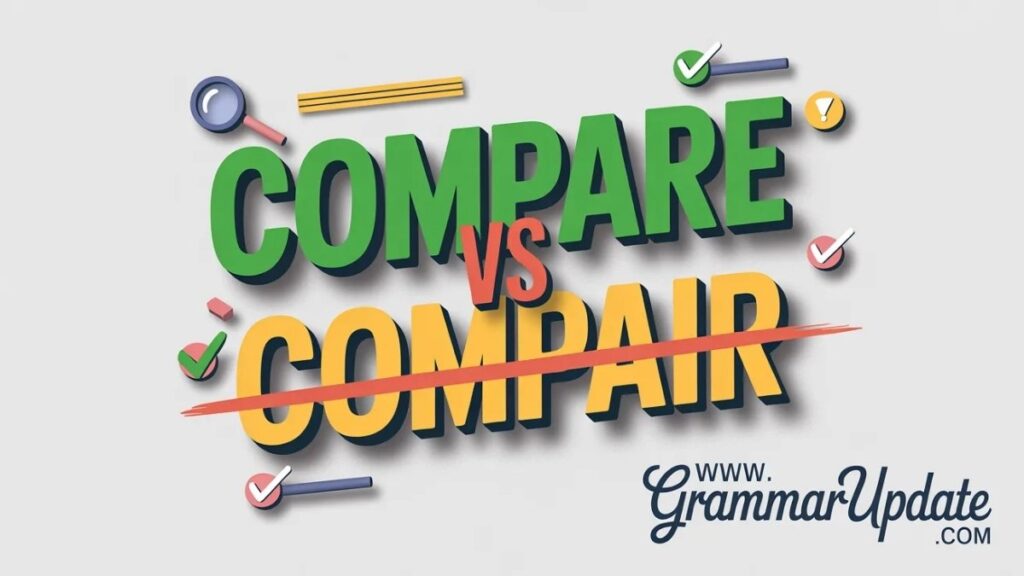
If you’ve ever hesitated while writing and questioned compair vs compare, you’re experiencing one of the most common spelling confusions in English. The error feels natural because “compair” sounds correct when spoken, especially since it resembles familiar words like chair, repair, and fair. This phonetic similarity often misleads writers into assuming the spelling is accurate. However, English spelling does not always match pronunciation, and this is where the confusion begins. In this guide, we will clearly resolve this issue, correct frequent grammatical mistakes, and explain the proper usage of compair vs compare in a simple, professional, and educational way so you can write with clarity, accuracy, and confidence in any context.
Compair vs Compare Quick Answer
Let’s answer the question immediately.
The correct spelling is:
Compare
The incorrect spelling is:
Compair
In standard English, compare is the accepted word used by dictionaries, style guides, educational institutions, publishers, and businesses.
| Word | Correct Spelling? | Accepted in Standard English? | Meaning |
|---|---|---|---|
| Compair | No | No | Misspelling of compare |
| Compare | Yes | Yes | To examine similarities and differences |
If your goal is accurate English writing, always choose compare.
What Does Compare Mean?
To understand why compare is correct, it’s helpful to understand the actual compare meaning.
Compare Definition
The most common compare definition is:
To examine two or more people, objects, ideas, situations, or pieces of information in order to identify similarities, differences, or relationships.
Comparison is one of the most important thinking skills humans use.
Every day people compare:
- Prices before making purchases
- Universities before applying
- Job offers before accepting employment
- Cars before buying
- Insurance policies before choosing coverage
- Research findings before reaching conclusions
Whenever you place two or more things side by side and evaluate them, you compare them.
Compare Word Meaning in Different Contexts
The compare word meaning remains generally consistent across different situations, but the specific purpose of comparison can vary.
Comparison for Similarities
Sometimes compare means finding similarities.
Examples:
- Critics compare a new actor to a famous movie star.
- Fans compare an athlete to a sports legend.
- Reviewers compare a new smartphone to previous models.
In these examples, the focus is primarily on shared qualities.
Comparison for Differences
At other times, compare focuses on differences.
Examples:
- Compare the prices before making a purchase.
- Compare the features of both software programs.
- Compare the benefits and drawbacks of each option.
Here, the goal is to identify distinctions and evaluate alternatives.
Is Compair a Word?
One of the most frequently searched grammar questions is:
Is Compair a Real Word?
In modern Standard English, compair is not recognized as the correct spelling of the verb compare.
Most major dictionaries list compare as the accepted spelling. Grammar checkers and proofreading software also identify compair as a spelling error.
Therefore:
- Compare = Correct
- Compair = Incorrect
If you’re asking, “Is compair correct spelling?”, the answer is no.
Why Is Compair So Common?
Although compair is incorrect, many people continue to use it.
Several factors contribute to this mistake.
Pronunciation Creates Confusion
The word compare is pronounced:
kuhm-PAIR
Because the second syllable sounds like the word pair, many writers instinctively spell it with air.
Influence of Similar Words
English contains numerous words ending in -air:
- Fair
- Chair
- Hair
- Repair
- Stair
- Affair
These familiar spelling patterns encourage people to write compair instead of compare.
Fast Typing
Typing quickly often leads to spelling mistakes.
Many writers do not notice the error because the incorrect spelling looks plausible.
English Language Learning Challenges
English learners frequently rely on pronunciation when spelling unfamiliar words.
Since English spelling is not always phonetic, pronunciation-based spelling can lead to mistakes like compair.
Difference Between Compair and Compare
The difference between compair and compare is simple but important.
| Feature | Compair | Compare |
|---|---|---|
| Correct English spelling | No | Yes |
| Accepted by dictionaries | No | Yes |
| Academic writing | Incorrect | Correct |
| Professional communication | Incorrect | Correct |
| Publishing standard | Incorrect | Correct |
| Grammar checker approval | No | Yes |
The answer to “What is the difference between compair and compare?” is straightforward:
Compare is the correct word. Compair is a misspelling.
Compare Pronunciation
Understanding compare pronunciation helps explain why the mistake occurs.
The standard pronunciation is:
/kəmˈper/
Phonetic breakdown:
kuhm-PAIR
Notice that the final sound resembles the word pair. However, pronunciation alone does not determine spelling.
English contains many words whose spelling differs from what pronunciation might suggest.
For example:
| Pronunciation | Correct Spelling |
|---|---|
| Defin-it-lee | Definitely |
| Sep-er-it | Separate |
| Re-seev | Receive |
| Kuhm-pair | Compare |
This is one reason English spelling can be challenging.
Compare Word Origin
The compare word origin helps explain why the spelling uses -are rather than -air.
The word comes from the Latin verb:
comparare
Meaning:
To match together, pair together, or examine side by side.
The word later entered Old French before becoming part of Middle English.
Because English inherited the spelling from earlier languages, the modern form remained compare.
This historical development explains why compare does not follow the spelling pattern of words like chair or repair.
More Related Articles You May Find Helpful
In Line vs Inline Which One Is Correct and Usage
Compare Grammar and Usage
Understanding compare grammar is essential for correct writing.
Compare Verb Meaning
The compare verb meaning refers to the act of examining relationships between two or more things.
Examples:
- Compare the prices carefully.
- Compare the research findings.
- Compare the performance of both teams.
- Compare different investment strategies.
In each sentence, compare functions as a verb.
Compare Usage in English
The phrase compare usage in English refers to how the word appears in everyday communication.
Compare is commonly used in:
Academic Writing
Students and researchers compare:
- Historical events
- Scientific studies
- Literary works
- Economic systems
Business Writing
Professionals compare:
- Revenue figures
- Market trends
- Product performance
- Competitor strategies
Everyday Conversation
People compare:
- Restaurants
- Cars
- Vacation destinations
- Electronic devices
Because comparison is a fundamental thinking process, compare remains one of the most frequently used verbs in English.
How to Use Compare Correctly
Many learners ask:
How to use compare in a sentence?
The simplest rule is:
Use compare whenever you evaluate similarities, differences, or relationships between two or more things.
Compare Examples in Sentences
Everyday Examples
- Let’s compare our answers before submitting the assignment.
- We compared several hotels before booking our trip.
- Compare both options carefully.
Professional Examples
- The report compares quarterly sales figures.
- Investors compare market performance before making decisions.
- Managers compare employee productivity data.
Academic Examples
- Researchers compare findings from multiple experiments.
- Historians compare different political systems.
- Students compare themes across literary works.
These examples demonstrate proper compare usage in English.
Compare Past Tense
Many people wonder:
What is the past tense of compare?
The answer is:
Compared
Examples:
- We compared the data yesterday.
- Scientists compared the results.
- The committee compared all proposals.
Which Is Correct?
The correct form is:
Compared
The incorrect form is:
Compaired
Examples:
Correct:
- We compared several products.
- They compared the available options.
Incorrect:
- We compaired several products.
Because compair is not a standard English word, compaired is also incorrect.
More Related Articles You May Find Helpful
Half Day vs Half-Day Which is correct and Usage
Compare With vs Compare To
One of the most discussed grammar topics involves compare with vs compare to.
Both expressions are correct, but traditional grammar guides make a distinction.
Compare With
Use compare with when examining both similarities and differences.
Example:
- Compare this year’s revenue with last year’s revenue.
Compare To
Use compare to when highlighting similarities.
Example:
- The author compared life to a journey.
Comparison Table
| Expression | Traditional Purpose |
|---|---|
| Compare with | Examine similarities and differences |
| Compare to | Emphasize similarities |
Modern usage often treats them interchangeably, but understanding the distinction can improve writing precision.
Compare and Contrast Meaning
The phrase compare and contrast meaning appears frequently in education.
Compare
Identify similarities and differences.
Contrast
Focus primarily on differences.
Example:
Compare and contrast urban and rural lifestyles.
Teachers use compare-and-contrast assignments to develop critical thinking, analytical reasoning, and writing skills.
Compare Noun Meaning
Many people search for compare noun meaning because they encounter expressions such as:
Beyond compare
In this context, compare functions as a noun-like expression.
Meaning:
Better than anything else.
Example:
- Her dedication is beyond compare.
However, in most situations, writers prefer the noun comparison.
Examples:
- The comparison revealed important differences.
- A comparison of the two products showed clear advantages.
Learn the difference between tricky more English words
Stigmatism vs Astigmatism Difference and Usage
Compare Synonyms
Expanding your vocabulary improves both writing and communication.
Common compare synonyms include:
- Analyze
- Examine
- Assess
- Evaluate
- Review
- Study
- Measure
- Contrast
- Match
- Relate
Each synonym carries a slightly different meaning, but all involve some form of evaluation or analysis.
Learn the difference between tricky more English words
Breakroom vs Break Room Which Spelling Is Correct?
Compare Antonyms
Common compare antonyms include:
- Ignore
- Separate
- Divide
- Disconnect
- Distinguish
- Isolate
These words generally represent actions that move away from comparison.
Compere vs Compare
Another common source of confusion is compere vs compare.
Although the words sound somewhat similar, their meanings differ completely.
| Word | Meaning |
|---|---|
| Compare | Examine similarities and differences |
| Compere | Host or present an event |
Compere Meaning
A compere is someone who introduces speakers, performers, or guests during an event.
Examples:
- The compere introduced the keynote speaker.
- She served as the compere at the awards ceremony.
- The compere kept the audience engaged throughout the event.
The word appears more frequently in British English than American English.
Learn the difference between tricky more English words
Busing vs Bussing Difference and Correct Usage
Master of Ceremonies Meaning
A master of ceremonies performs a role similar to a compere.
Typical responsibilities include:
- Introducing speakers
- Announcing performers
- Guiding event schedules
- Managing transitions
- Engaging the audience
Examples include:
- Wedding hosts
- Conference moderators
- Award-show presenters
- Event coordinators
Lilies vs Lillies Which Is the Correct Spelling?
Show Host Meaning
The phrase show host meaning refers to a person who leads or presents a program.
Examples include:
- Television hosts
- Radio hosts
- Podcast hosts
- Game-show hosts
This meaning has no connection to compare, but users often confuse these terms because of similar pronunciation.
CompAir Compressor A Brand Name Exception
One exception deserves special attention.
CompAir is a recognized industrial compressor brand.
Because the brand name contains “CompAir,” some people mistakenly assume that compair is an accepted English spelling.
However, the brand name does not change standard grammar rules.
Examples:
Correct:
- The factory purchased a CompAir compressor.
- We need to compare compressor prices.
The first example refers to a company name. The second uses the English verb compare.
Fix common more word mistakes in English
Unorganized vs Disorganized Difference and Use?
Common English Spelling Mistakes Similar to Compair
Compair belongs to a larger group of spelling mistakes that occur frequently in English.
| Incorrect | Correct |
|---|---|
| Compair | Compare |
| Compaired | Compared |
| Recieve | Receive |
| Seperate | Separate |
| Definately | Definitely |
| Occured | Occurred |
| Untill | Until |
| Alot | A lot |
Learning these commonly misspelled words can significantly improve writing accuracy.
Fix common more word mistakes in English
Requester vs Requestor Which Is Correct and usage?
Why Correct Spelling Matters in Professional Writing
Spelling mistakes affect more than grammar.
They can influence how readers perceive:
- Professionalism
- Attention to detail
- Education level
- Credibility
- Communication skills
Consider these examples:
Incorrect:
I can compair financial reports and identify trends.
Correct:
I can compare financial reports and identify trends.
The second sentence appears more polished and professional.
In competitive environments, small details often make a significant difference.
Fix common more word mistakes in English
To Bad vs Too Bad Which is correct and usage?
Practice Exercise Compare vs Compair
Complete each sentence using the correct word: compare, compared, comparing, compares, or comparison.
- Before buying a new laptop, you should __________ different models carefully.
- The teacher asked students to __________ the two poems.
- We __________ several hotels before booking our vacation.
- A detailed __________ helped us choose the better option.
- The analyst is __________ this year’s sales with last year’s figures.
- She always __________ prices before making a purchase.
- Researchers __________ the results of multiple experiments.
- The report includes a __________ of the two marketing strategies.
- Customers often __________ products online before buying them.
- The scientist is __________ data from different sources.
- The manager __________ employee performance every quarter.
- We __________ the advantages and disadvantages of each option.
- Their __________ revealed several important differences.
- Historians frequently __________ events from different periods.
- The committee __________ all proposals before making a decision.
- A side-by-side __________ showed which product offered better value.
- Investors are __________ market trends closely.
- The article __________ the benefits of both approaches.
- Students must __________ the themes in both novels.
- The final __________ highlighted the strengths of each candidate.
- Journalists often __________ statistics from multiple sources.
- The company __________ customer feedback to improve its services.
- We are __________ several software programs for our project.
- The researcher presented a thorough __________ of the findings.
- Compare, compared, comparing, and comparison all come from the same word, __________.
Answers
- compare
- compare
- compared
- comparison
- comparing
- compares
- compared
- comparison
- compare
- comparing
- compares
- compared
- comparison
- compare
- compared
- comparison
- comparing
- compares
- compare
- comparison
- compare
- compares
- comparing
- comparison
- compare
Here’s a trusted source for clear word meanings:
FAQs
How Do You Spell Compare or Compair?
The correct spelling is compare. The spelling compair is incorrect and is considered a common English spelling mistake.
What Is the Meaning of the Word Compair?
Compair has no accepted meaning in Standard English because it is a misspelling of compare. However, CompAir is a brand name used by an industrial compressor manufacturer.
What Is the Correct Spelling of Compare?
The correct spelling is compare. It is the standard form recognized by dictionaries, grammar guides, and educational institutions.
What Does “Compare” Mean?
Compare means to examine two or more things to identify similarities, differences, or relationships between them.
What Is a Comparand?
A comparand is one of the items, people, or concepts being compared. The term is commonly used in academic, scientific, and technical writing.
How Do You Say “Compare”?
Compare is pronounced /kəmˈper/. The final syllable sounds like “pair,” but the correct spelling remains compare.
What Is an Example of Compete?
Compete means to participate in a contest, rivalry, or activity where individuals or groups try to achieve a better result than others.
What Are 5 Examples of Compare?
Compare is commonly used when discussing products, services, prices, research findings, business performance, historical events, and academic subjects.
Is It Compare or Compere?
Both words are correct but have different meanings. Compare means to examine similarities and differences, while compere means a host, presenter, or master of ceremonies.
What’s a Better Word for Compare?
Depending on the context, alternatives to compare include analyze, evaluate, assess, examine, review, study, and contrast.
Do You Use Than to Compare?
Yes. The word than is commonly used when showing differences between two people, things, qualities, or situations.
What Is an Example for Compare?
Compare is used when evaluating two or more things to identify their similarities, differences, or relationships.
What Does “Compere” Mean?
A compere is a person who hosts, presents, or introduces speakers, performers, or guests at an event.
Which Is Correct, Comparism or Comparison?
Comparison is the correct and widely accepted word in modern English. Comparism is generally considered nonstandard and rarely used in formal writing.
Is “Compere” a French Word?
Yes. Compere originated from French before becoming part of the English language. Today, it commonly refers to a host or presenter.
What Is the Meaning of Compare?
The meaning of compare is to examine similarities, differences, or relationships between two or more things.
What’s the Difference Between Compare and Compair?
Compare is the correct English spelling recognized by dictionaries and grammar authorities. Compair is a misspelling and should not be used in standard writing.
What Are 5 Examples of Compare Sentences?
Compare sentences are used to evaluate two or more items, ideas, products, services, people, or situations by discussing their similarities and differences.
What Is the Noun Form of Compare?
The noun form of compare is comparison. It refers to the act of examining similarities and differences between two or more things.
Learn the difference between confusing more English words
Message vs Messege Which Spelling Is Correct?
Conclusion
If compair vs compare still feels confusing, you’re not alone but once you understand it, the mistake becomes easy to avoid. The confusion happens because compair vs compare sounds almost identical when spoken, even though only one is correct. In Standard English, compair vs compare is not a real choice because compare is the only accepted spelling.
Many writers accidentally use compair vs compare because “compair” feels natural, but English spelling doesn’t follow sound alone. The correct form is always compare, whether you are writing academically, professionally, or casually.
So the rule is simple: every time you think compair vs compare, remember that compair is a mistake, and compare is the correct spelling, no matter the context.

Jhon AJS, the creative mind behind Grammar Update, is an experienced blogger passionate about simplifying English grammar. He focuses on explaining confusing word vs word differences, grammar rules, punctuation, and sentence structure in a clear and practical way. Through easy to understand guides and examples, Jhon helps readers improve their writing and communicate with confidence. With years of blogging experience, he continues to share helpful insights that make learning grammar simple, useful, and accessible for everyone.