
Writing a simple question like “How are you faring?” often creates unexpected confusion, even for experienced writers, especially when it gets compared with “ Faring vs Fairing ”. The issue usually starts when “fairing” is used by mistake, which completely changes the meaning of the sentence. Although both words sound the same, they belong to very different contexts. One describes how a person is doing in life or a situation, while the other belongs to engineering and vehicle design. This small but critical error can reduce clarity and professionalism in writing. In this guide on how are you faring or fairing vs correct usage, we will break down the difference clearly, highlight common mistakes, and help you use the right word with confidence.
How Are You Faring or Fairing Which Is Correct?

The correct expression is “How are you faring?” when you are asking about someone’s condition, progress, or well-being.
The word faring refers to how a person is managing in life or in a specific situation, while fairing does not fit this context at all.
For example, you can say, “How are you faring after starting your new job?” This means you are asking how someone is coping or adjusting. But “How are you fairing?” is incorrect because fairing belongs to a technical field, not human communication.
Key idea to remember:
- Faring belongs to people and situations
- Fairing belongs to machines and engineering design
Example:
“How are you faring these days after the move?” — correct and natural usage
Faring Meaning, What It Actually Describes
The faring meaning comes from the verb fare, which describes how someone is doing, coping, or progressing through a situation in life.
For example, when you say “She is faring well after the surgery,” it means she is recovering and managing the situation successfully. If you say “They are not faring well under pressure,” it shows struggle or difficulty.
Key idea to remember:
- Faring means managing or progressing through life situations
- It reflects condition, not just a simple good or bad
Example:
“He is faring better than before after changing his environment.” shows improvement over time
More Confusing Words Made Simple
Symptomatology vs Symptomology Differences and Usage
Fairing Meaning A Completely Different World
The fairing meaning belongs to engineering, aviation, and mechanical design. A fairing is a physical structure used to reduce air resistance and improve movement efficiency in vehicles or machines.
For example, in aviation you might hear, “The aircraft fairing reduces drag and improves fuel efficiency.” In motorcycles, “The motorcycle fairing protects the rider from wind and improves speed stability.”
Key idea to remember:
- Fairing is a physical object used in machines
- It improves aerodynamics and performance
Example:
“The motorcycle fairing makes high-speed riding smoother and more stable.”
Difference Between Faring vs Fairing
The difference between faring and fairing becomes easy once you separate human life from mechanical design. One word describes emotional or physical progress in people, while the other describes structural components in engineering.
For example, “She is faring better than last month” refers to personal improvement. Meanwhile, “The aircraft fairing reduces drag during flight” refers to a technical function.
Key idea to remember:
- Faring means human condition or progress
- Fairing means mechanical structure or part
Example:
“He is faring well after the relocation, while the aircraft fairing improves flight efficiency.”
More Confusing Words Made Simple
Inexcusable vs Unexcusable Difference and Usage
Comparison Table Faring vs Fairing
| Word | Meaning | Context | Example |
|---|---|---|---|
| Faring | How someone is doing or progressing | Human life, emotions, situations | “She is faring well after the surgery.” |
| Fairing | A structure that reduces air resistance | Engineering, aviation, motorcycles | “The aircraft fairing improves aerodynamics.” |
How Are You Faring Correct Usage in Life

The phrase how are you faring correct usage depends on tone and situation. It is more thoughtful and slightly formal compared to casual greetings.
For example, you might ask, “How are you faring these days after everything that happened?” when checking on someone going through a difficult period. In a professional setting, you could say, “I hope you are faring well with your new responsibilities,” which sounds respectful and sincere.
Key idea to remember:
- Use it in thoughtful or formal situations
- It shows deeper concern than casual greetings
Example:
“How are you faring after the transition to your new role?”
More Confusing Words Made Simple
Skiid vs Skied Difference and Usage
How Are You Doing vs Faring
The difference between how are you doing vs faring comes down to tone and emotional depth. How are you doing is casual, quick, and commonly used in everyday conversations. It works when you don’t need emotional detail.
On the other hand, how are you faring feels more intentional and reflective. It often appears in situations where someone has experienced change, difficulty, or recovery.
Key idea to remember:
- Doing is casual and general
- Faring is thoughtful and situation-based
Example:
“How are you doing?” vs “How are you faring after the incident?”
Faring in a Sentence Real Usage You Can Learn From
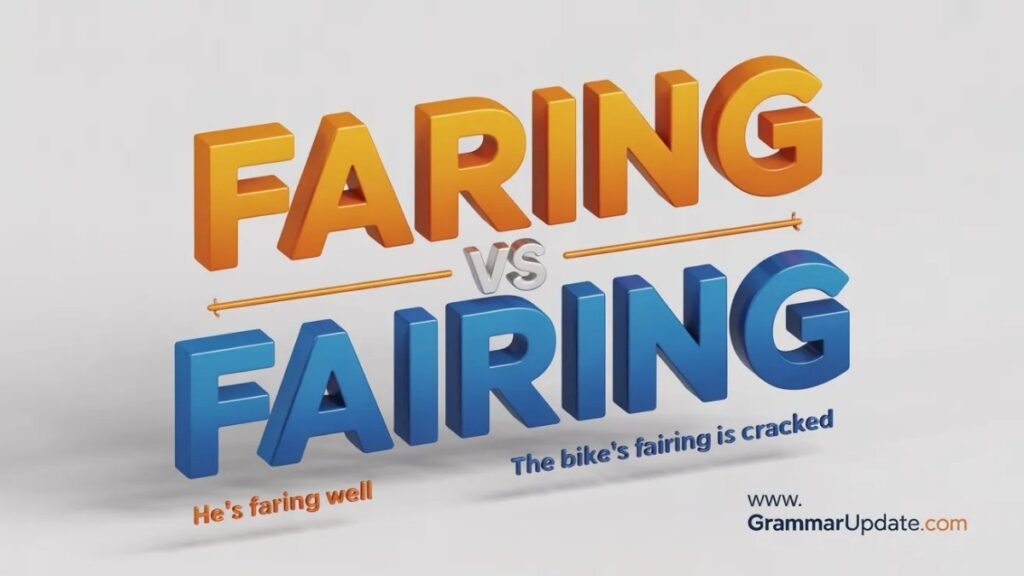
The phrase faring in a sentence helps show how naturally the word fits into everyday English when used correctly.
For example, “She is faring better after switching careers” shows improvement. In contrast, “He is not faring well in his current situation” shows struggle or difficulty. You can also say, “How are you faring in your new environment?” which is a neutral check-in.
Key idea to remember:
- Always relates to progress or condition
- Works in positive, negative, or neutral contexts
Example:
“The team is faring well despite the challenges this season.”
More Confusing Words Made Simple
Dysregulated vs Disregulated Correct Usage Explained
Faring Well Meaning and Its Variations
The phrase faring well meaning refers to doing well, coping successfully, or progressing in a positive direction.
For example, “The company is faring well despite economic pressure” shows stability. In contrast, “The team is not faring well this year” shows decline. You can also say “She is faring better than before,” which shows improvement over time.
Key idea to remember:
- Indicates positive or improving condition
- Often used in formal or descriptive writing
Example:
“Despite setbacks, he is faring better than expected.”
Is It Fairing Well or Faring Well?
The correct phrase is faring well, not fairing well. This is one of the most common grammar mistakes because both words sound identical.
Saying “She is fairing well” is incorrect because fairing does not describe human conditions. It refers only to physical structures in engineering or vehicles.
Key idea to remember:
- Faring is correct for people
- Fairing is incorrect in human context
Example:
“She is faring well in her new role after the promotion.”
How Did You Fare Meaning (Past Tense Explained)

The phrase how did you fare meaning refers to past performance or outcome. It is commonly used when evaluating results after an event or situation.
For example, “She fared well in the interview” means she performed successfully. In contrast, “They fared badly in the competition” means the outcome was poor.
Key idea to remember:
- Used for past results or outcomes
- Common in evaluation and reporting
Example:
“How did you fare in the final exam?”
More Confusing Words Made Simple
Grately vs Greatly Differences and Correct Usage
Synonyms of Faring for Better Expression
The word faring can be replaced with simpler and more natural alternatives depending on context. This helps avoid repetition and keeps communication smooth.
For example, instead of saying “How are you faring?” you can say “How are you managing these days?” or “How have you been coping?”
Key idea to remember:
- Synonyms improve natural flow in conversation
- Useful for both casual and formal writing
Example:
“How have you been holding up lately?”
Why People Confuse Faring and Fairing
The confusion happens because both words sound identical and share similar spelling patterns. However, their meanings come from completely different origins.
The word fairing appears mostly in technical fields like aviation and engineering, while faring appears in everyday human communication. Because most people rarely encounter fairing, they mistakenly use it where faring should be used.
Key idea to remember:
- Same pronunciation causes confusion
- Different contexts create mistakes in writing
Example:
“He is faring well after surgery, not fairing well.”
More Confusing Words Made Simple
Check-in vs Check In Explained and Usage
Practice Session Faring vs Fairing
This section will help you quickly master faring vs fairing by testing your understanding in different formats. Read carefully, focus on meaning, and choose the word that fits the context.
Fill in the Blanks
- How are you ______ after moving to a new place?
- The motorcycle ______ improves stability at high speed.
- She is ______ much better after changing her treatment plan.
- The aircraft ______ reduces air resistance during flight.
- He is not ______ well under constant pressure at work.
- The company is ______ better than expected despite challenges.
- Engineers redesigned the front ______ for better aerodynamics.
- After recovery, he is ______ better than before.
Multiple Choice Questions
- How are you ______ these days?
A) faring
B) fairing - The motorcycle ______ helps reduce wind resistance.
A) faring
B) fairing - She is ______ well after the surgery.
A) faring
B) fairing - The aircraft ______ improves fuel efficiency.
A) faring
B) fairing - He is not ______ well in stressful situations.
A) faring
B) fairing
Answers
- faring
- fairing
- faring
- fairing
- faring
- faring
- fairing
- faring
- A) faring
- B) fairing
- A) faring
- B) fairing
- A) faring
Quick Final Reminder
If the sentence talks about a person, situation, health, or progress, the correct word is always faring. If it talks about a machine, vehicle, or aerodynamic structure, the correct word is always fairing.
Here’s a trusted source for clear word meanings:
FAQs
Can I say “how are you faring”?
Yes. It is correct and means how someone is doing or coping.
What does fairing mean?
Fairing is a machine part used in vehicles to reduce air resistance.
How someone is faring meaning?
It means how someone is doing or managing in a situation.
Is “how are you faring” correct?
Yes, it is grammatically correct and slightly formal.
What is the difference between faring and fairing?
Faring is for people and progress. Fairing is for machines and aerodynamics.
Conclusion
The confusion between “how are you Faring” and “Fairing” is one of those small grammar traps that can quietly slip into writing and change the meaning completely. At first glance, they look almost identical, and they sound exactly the same when spoken, which makes the mistake surprisingly easy to make.
Once you break it down, the difference becomes clear. “Faring” belongs to people and describes how someone is doing, coping, or progressing in a situation. “Fairing,” on the other hand, belongs to engineering and refers to a physical component used in vehicles to improve aerodynamics. Mixing them up can make a sentence sound incorrect or out of place, even if the intent is right.
Now that the distinction is clear, you can write with more confidence and precision. The next time you ask about someone’s well-being, you’ll know exactly which word fits and you won’t second-guess it again.

Jhon AJS, the creative mind behind Grammar Update, is an experienced blogger passionate about simplifying English grammar. He focuses on explaining confusing word vs word differences, grammar rules, punctuation, and sentence structure in a clear and practical way. Through easy to understand guides and examples, Jhon helps readers improve their writing and communicate with confidence. With years of blogging experience, he continues to share helpful insights that make learning grammar simple, useful, and accessible for everyone.