Whoa vs woah can be confusing because both spellings look right and sound the same. If you’re unsure which one to use, the answer is actually pretty simple. “Whoa” is the standard spelling, while “woah” is a common informal variant. Both can express surprise, excitement, amazement, or shock, so the meaning usually doesn’t change. The main difference is how the words are spelled and where you use them. In this guide, you’ll learn the meaning, pronunciation, spelling, and everyday usage of whoa and woah. By the end, you’ll know which form fits formal writing and when the casual version works best.
quick answer
| Feature | Whoa | Woah |
|---|---|---|
| Standard spelling | Yes | Informal variant |
| Basic meaning | Stop, slow down, surprise, amazement | Usually the same |
| Pronunciation | Generally the same | Generally the same |
| Traditional use | Command to stop or slow a horse | Later spelling variant |
| Formal writing | Preferred | Usually avoid |
| Casual writing | Common | Common |
| Texting and social media | Common | Common |
| Best choice when unsure | Yes | No |
Whoa is the safest spelling for standard English. Woah is better understood as an informal spelling variant, not a completely different word.
Fix common more word mistakes in English
Coozie vs Koozie Which one Is Correct and usage ?
Whoa vs Woah What Is the Difference?
The main whoa vs woah difference comes down to spelling and context rather than meaning.
Whoa is the established spelling that has been used in English for centuries. It functions mainly as an interjection. Traditionally, people used it as a command telling a horse or another animal to stop or slow down. Modern speakers also use it to express surprise, amazement, shock, excitement, or disbelief.
Woah generally carries those same meanings. However, it has a more informal feel and appears frequently in casual writing, online conversations, social media, and stylized dialogue.
For example:
- Whoa, slow down!
- Whoa, that’s incredible!
- Woah, I didn’t expect that.
- Woah, look at that!
The meaning doesn’t suddenly change because the letters move around.
That distinction matters because some explanations make the two spellings sound as though they have separate definitions. In ordinary English usage, they don’t.
If you’re wondering what is the difference between whoa and woah, think of it this way: whoa is the conventional form, while woah is a common informal variant.
Is “Whoa” or “Woah” Correct?
If you’re asking is whoa or woah correct, the safest answer is whoa.
Whoa is the standard spelling and the form you should normally choose in edited English. That makes it the better option for school assignments, professional documents, articles, reports, and other formal contexts.
Woah isn’t simply meaningless or incomprehensible, though. English speakers have used the variant widely, particularly in casual communication. Its presence in everyday writing explains why many people assume it must be an equally standard spelling.
The distinction is more useful than calling one form “real” and the other “fake.”
| Situation | Recommended spelling |
|---|---|
| Academic assignment | Whoa |
| Professional document | Whoa |
| Formal article | Whoa |
| Business communication | Whoa |
| Casual text | Whoa or woah |
| Social media post | Whoa or woah |
| Online chat | Whoa or woah |
| Informal dialogue | Either |
| Character-specific dialogue | Either, depending on style |
Therefore, if someone asks which is correct whoa or woah, use whoa unless you have a specific reason to reproduce an informal style.
Learn the difference between basic English word mistakes
Occurring vs Occuring Which one Is Correct?
What Does Whoa Mean?
The whoa meaning depends on the situation, but the word has two closely related uses.
First, whoa can serve as a command to stop or slow down. This traditional use has a strong connection with horses and riding.
Second, whoa works as an expression of surprise or strong emotion. Someone might say it after seeing something unexpected, impressive, shocking, or exciting.
The whoa definition can therefore be summarized as an interjection used to:
- Tell someone or an animal to stop or slow down
- Express surprise
- Show amazement
- React to something shocking
- Show excitement
- Signal disbelief
- Ask someone to pause during a conversation
Whoa as a Stop Command
The oldest familiar use involves stopping or slowing a horse.
For example:
“Whoa, easy there.”
The speaker is telling the horse to slow down or stop.
The same idea now works figuratively with people.
“Whoa, slow down. I haven’t finished explaining.”
Nobody expects the listener to be riding a horse. Instead, the speaker wants the conversation or action to pause.
That shift from a literal command to a broader conversational expression is an important part of the word’s modern usage.
Whoa as an Expression of Surprise
Modern English uses whoa far beyond its original command sense.
Consider:
“Whoa! That’s a huge building.”
Here, the speaker isn’t asking anything to stop. The word simply introduces a strong reaction.
It can communicate surprise, admiration, shock, or excitement depending on what follows.
For example:
“Whoa! You actually won?”
“Whoa, that view is beautiful.”
“Whoa, I didn’t see that coming.”
The surrounding sentence tells you exactly what kind of reaction the speaker intends.
Learn the difference between basic English word mistakes
Accommodate vs Accomodate Which one Is Correct?
What Does Woah Mean?
The woah meaning is generally the same as the meaning of whoa.
Woah can express surprise, amazement, excitement, disbelief, or a request to slow down. The spelling feels more informal, but the underlying expression remains the same.
For example:
1.“Woah, that’s expensive.”
2.“Woah, hold on.”
3.“Woah! Look at that.”
“Woah, I can’t believe you did that.”
In each example, replacing woah with whoa would normally leave the meaning unchanged.
This is why the woah definition shouldn’t be presented as though it describes a separate English word with completely different functions.
Is Woah a Word?
The answer to is woah a word requires a little context.
Woah is widely used in written English, especially informal English. Major dictionary resources recognize its relationship with whoa and discuss it as a variant spelling.
However, frequency doesn’t automatically make every spelling equally standard.
English contains many informal variants that people understand and use regularly. Some become accepted over time, while others remain strongly associated with casual speech or online writing.
Woah sits in that gray area for many writers. It is recognizable and widespread, but whoa remains the safer conventional form.
Is Whoa a Word?
Yes. Whoa is an established English word with a long documented history.
It functions as an interjection and has both its traditional stop-command sense and its modern emotional uses.
So if someone asks is whoa a word, the answer is straightforward: yes.
Learn the difference between basic English word mistakes
Principal vs Principle Difference and usage ?
Whoa vs Woah Spelling Why Are There Two Forms?
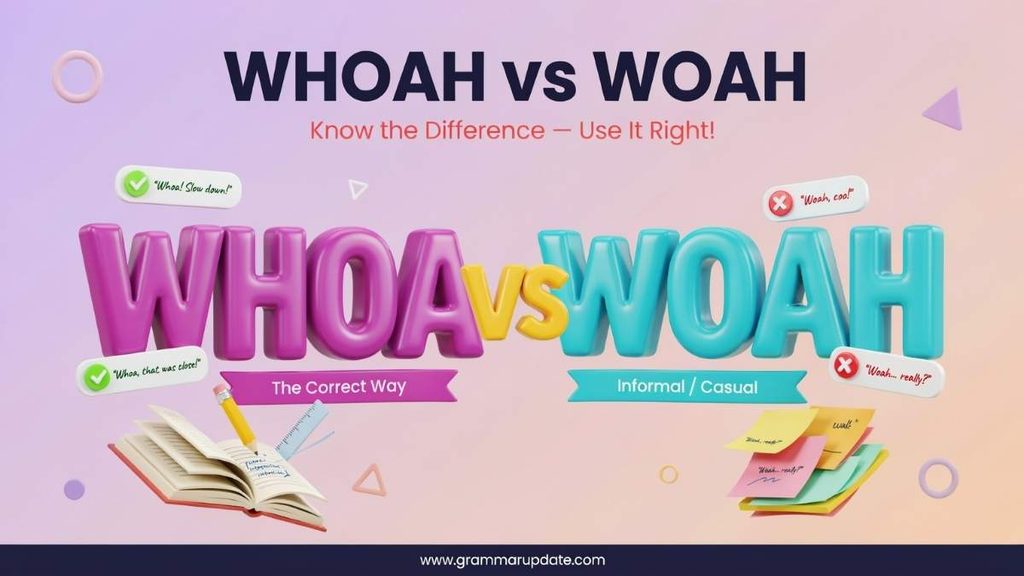
English spelling often develops variations when writers try to represent spoken language.
Interjections are particularly prone to this problem. People learn them through speech before they ever see them written. When they later write the sound down, different spellings can emerge.
Whoa has the longer-established spelling history. Woah developed later as an alternative representation of the same basic sound.
Online communication has helped informal variants spread even faster. Texting, social media, memes, comments, and online communities allow people to experiment with spelling without the editing rules that usually apply to books, newspapers, or academic writing.
The result is a familiar pattern:
spoken sound → different attempts to represent it → competing spellings → one conventional form plus informal variants.
That process explains why woah can look completely natural even though whoa remains the standard spelling.
Whoa vs Woah Etymology
The whoa vs woah etymology also helps explain the spelling debate.
Whoa has a long history in English. Historical dictionaries trace it back to an older interjection related to ho, which people used as a call or command, including when controlling horses.
Over time, whoa developed into the familiar command associated with stopping or slowing a horse.
Its meaning then expanded. Speakers began using the word outside riding situations to tell people to pause, slow down, or reconsider something.
Eventually, the emotional use became extremely common:
“Whoa, that’s amazing!”
The spelling woah appeared much later as a variant.
That history matters because it shows why whoa has the stronger claim as the traditional standard form. Woah didn’t need to develop a completely separate meaning. It developed as another way of writing the same spoken expression.
Whoa vs Woah Pronunciation
The whoa vs woah pronunciation is generally the same.
Most English speakers pronounce both forms as one syllable. The spelling difference doesn’t normally signal a different sound.
Regional accents can naturally affect the exact vowel quality. That’s normal in English. However, speakers generally don’t use one pronunciation for whoa and a completely different pronunciation for woah.
This gives us an important spelling lesson:
Different spellings don’t necessarily create different pronunciations.
The same thing happens with many English words and expressions. Written forms can vary while speech remains essentially unchanged.
Whoa and Woah Pronunciation in American English
In American English, both forms usually have the same basic pronunciation.
You don’t normally divide the word into two syllables. It functions as a short, single-syllable interjection.
The spelling whoa doesn’t mean that every letter receives a separate sound. Likewise, woah isn’t normally pronounced as two separate parts.
Whoa and Woah Pronunciation in British English
British English also uses whoa as the conventional spelling. Accent differences may affect how the vowel sounds, but the spelling contrast between whoa and woah does not normally create two separate pronunciations.
So the whoa and woah pronunciation distinction is much smaller than the spelling difference suggests.
Learn the difference between basic English word mistakes
Your vs You’re Difference and which is correct ?
Whoa vs Woah in American and British English
The difference between whoa and woah isn’t like color and colour.
American English and British English don’t normally use whoa and woah as two separate national spellings.
Instead, whoa is the conventional spelling in both varieties. Woah appears as an informal alternative.
That means you shouldn’t use this rule:
American English = whoa
British English = woah
That would be misleading.
A better rule is:
Standard English = whoa
Informal or stylistic English = whoa or woah
The same principle generally applies whether you’re writing for American or British readers.
When to Use Whoa
Knowing when to use whoa becomes simple once you consider your audience and the level of formality.
Use whoa when you want the conventional spelling.
Use Whoa as a Command
For example:
“Whoa! Easy, boy.”
“Whoa, slow down.”
“Whoa, stop for a second.”
The word can address an animal directly or tell a person to pause.
Use Whoa to Express Surprise
For example:
“Whoa! That’s incredible.”
“Whoa, I didn’t expect that.”
“Whoa, you’ve grown since I last saw you.”
Here, whoa introduces an emotional reaction.
Use Whoa in Professional Writing
Whoa is the safer option in:
- Academic writing
- Business writing
- Formal articles
- Reports
- Professional communication
- Educational content
- Edited publications
Even when the surrounding sentence is casual, whoa doesn’t look out of place.
Woah can sometimes make the sentence look deliberately informal.
Learn the difference between basic English word mistakes
Breached VS Breeched difference and Which Is Correct?
When to Use Woah
Knowing when to use woah requires more attention to tone.
Woah works well when the writing deliberately sounds conversational, spontaneous, or informal.
You may encounter it in:
- Text messages
- Social media
- Online chats
- Memes
- Casual comments
- Informal dialogue
- Creative writing
- Character speech
For example:
“Woah, that’s wild.”
“Woah! You really did it.”
“Woah, wait a minute.”
In a casual message, the spelling can feel natural.
Is Woah an Informal Spelling?
Yes. Woah is commonly treated as an informal spelling variant of whoa.
That doesn’t mean every use of woah is a mistake. Context matters.
Imagine a novelist writing dialogue for a teenager:
“Woah, you actually bought that?”
The spelling could help establish a relaxed, contemporary voice.
Now imagine the same word appearing in a formal academic paper. There, whoa would be the better choice.
The difference comes from register, not meaning.
Is Woah Grammatically Correct?
The question is woah grammatically correct isn’t quite the right question because grammar and spelling deal with different things.
Grammar controls how words function together in a sentence. Spelling controls how those words appear in writing.
Woah can function grammatically as an interjection, just as whoa can. The concern is whether its spelling fits the writing context.
In standard edited English, whoa is the safer form.
In informal English, woah can work naturally.
Learn the difference between confusing word pairs
Disastrous vs Disasterous difference and usage ?
Whoa vs Woah in Texting and Social Media
Digital communication has made informal spelling much more visible.
When people talk, they don’t have to decide whether the sound should be written as whoa or woah. They simply say it.
Texting changes that. A speaker has to turn a sound into letters, and informal writing gives people plenty of freedom to experiment.
That is why both spellings appear so frequently online.
Whoa Meaning in Chat
In chat, whoa can mean:
- “That’s surprising.”
- “That’s impressive.”
- “Wait a moment.”
- “Slow down.”
- “I can’t believe that.”
For example:
“Whoa, you actually met him?”
The word signals an emotional reaction before the main statement.
Woah Meaning in Chat
The Woah can perform the same function:
“Woah, you actually met him?”
The difference is mostly stylistic.
The second spelling may look more relaxed or expressive, but the speaker’s intended meaning remains clear.
What Does Woah Mean in Texting?
In texting, woah often emphasizes a spontaneous reaction.
For example:
“Woahhhh, that’s unbelievable.”
The extra letters aren’t part of the standard spelling. They simply stretch the written form to imitate the way someone might prolong the sound while speaking.
Similar examples include:
“Noooo!”
“Yessss!”
“Whaaat?”
These forms belong to expressive informal writing rather than standard spelling.
Learn the difference between confusing word pairs
Airfoil vs Aerofoil difference and usage?
Whoa vs Woah in Writing
The best choice depends heavily on the type of writing.
| Type of writing | Best choice | Explanation |
|---|---|---|
| School assignment | Whoa | Conventional spelling |
| College essay | Whoa | More appropriate for edited prose |
| Professional email | Whoa | Standard and polished |
| Business report | Whoa | Fits formal writing |
| Blog article | Whoa | Safest for broad audiences |
| Text message | Either | Informal context |
| Social media | Either | Both appear commonly |
| Online comment | Either | Casual style |
| Fiction dialogue | Either | Character voice can influence the choice |
| Quoted material | Original form | Preserve the quotation accurately |
The more formal the context, the stronger the case for whoa.
The more conversational the context, the more freedom you have.
Whoa vs Woah Examples in Sentences
Seeing the words in context makes the distinction easier.
Command to Stop
“Whoa! The horse is running too fast.”
The speaker uses whoa as a traditional command.
Request to Slow Down
“Whoa, slow down. I can’t keep up.”
The word now applies to a person rather than an animal.
Surprise
“Whoa! You finished that already?”
The speaker expresses surprise.
Amazement
“Whoa, this view is incredible.”
The word expresses admiration or amazement.
Shock
“Whoa, I didn’t know that happened.”
The speaker reacts to unexpected information.
Excitement
“Whoa! We actually won!”
The interjection introduces an excited reaction.
Informal Variant
“Woah, that’s a massive house.”
The meaning remains the same. The spelling simply has a more casual feel.
Learn the difference between confusing word pairs
Equipment vs Equiptment difference and usage ?
Whoa vs Woah A Closer Look at Context
Consider these examples:
| Sentence | What it communicates |
|---|---|
| Whoa, slow down. | A request to pause |
| Whoa! That’s amazing. | Amazement |
| Whoa, seriously? | Surprise or disbelief |
| Woah, that’s wild. | Casual surprise |
| Woahhh! No way! | Strong informal excitement |
The spelling alone doesn’t determine the emotion.
For instance, both of these can express surprise:
“Whoa! That’s unbelievable.”
“Woah! That’s unbelievable.”
The difference is subtle. The first looks more conventional. The second looks more casual.
Punctuation also affects the tone.
“Whoa!”
sounds sharper and more energetic.
“Whoa, wait.”
sounds more conversational.
“Whoa…”
can suggest hesitation, disbelief, or someone processing what they have just seen.
Common Whoa vs Woah Mistakes
Treating Woah as a Completely Different Word
Whoa and woah generally represent the same interjection.
Assigning separate dictionary meanings to them creates unnecessary confusion.
Assuming Woah Is Always Wrong
This is another oversimplification.
Woah is widely understood and commonly used in informal communication. Calling it meaningless ignores actual English usage.
The better explanation is that whoa is the standard form and woah is a common informal variant.
Assuming Whoa Is Only Used for Horses
Historically, the horse connection is important.
Modern English, however, uses whoa much more broadly.
“Whoa, that’s expensive!”
doesn’t involve a horse at all.
Giving Whoa and Woah Different Meanings
There is no reliable rule that says whoa means surprise while woah means amazement.
Both forms can express either reaction.
Context does the real work.
Using Woah in Formal Writing
Readers will understand woah, but formal writing usually benefits from conventional spelling.
If you’re writing an academic assignment or professional document, choose whoa.
Adding Too Many Letters
Forms such as whoaaa or woahhhh can work in texting because they imitate an extended spoken reaction.
They don’t belong in standard edited prose.
Whoa, There A Useful Modern Expression
The phrase “whoa, there” deserves attention because it shows how flexible the word has become.
For example:
“Whoa, there. Let’s not make a decision yet.”
The speaker isn’t commanding a horse.
Instead, the phrase means something close to:
- Hold on.
- Slow down.
- Wait a moment.
- Let’s reconsider this.
It often sounds less harsh than a direct command.
That makes whoa useful in everyday conversation. A single short interjection can interrupt a discussion without immediately turning the exchange into an argument.
Whoa vs Woah and Informal English
Informal English constantly changes.
People shorten words, stretch sounds, invent spellings, use slang, and adapt language to new communication platforms. Written language doesn’t always behave like formal grammar textbooks suggest.
Woah is a good example.
Its widespread use doesn’t automatically make it the preferred standard spelling. At the same time, its widespread use means it would be inaccurate to pretend that nobody uses it or that readers don’t recognize it.
English has room for both conventional and informal forms.
The key is knowing when each one fits.
Learn the difference between confusing word pairs
Bass vs Base Differences and usage ?
Practice Session Whoa vs Woah
Fill in each blank with Whoa vs Woah.
- ______! That horse is moving too fast.
- ______, I didn’t expect the movie to end like that.
- ______, that’s an incredible view!
- The rider shouted, “______!” when the horse started running.
- ______, you finished the entire project in one day?
- “______,” she said, stepping back in surprise.
- ______! Slow down and let me explain.
- He typed “______!” after seeing the huge surprise online.
- ______, that car is much more expensive than I expected.
- The trainer yelled, “______!” to make the horse stop.
- ______, I never knew you could play the piano that well.
- She reacted with “______!” when she saw the final score.
- ______, let’s take a moment before we make a decision.
- He posted “______!” after watching the amazing video.
- ______! Be careful near the edge.
- The cowboy pulled the reins and shouted, “______!”
- ______, that’s a lot of money for one jacket.
- “______,” he said, clearly shocked by the news.
- ______, I think we’ve gone too far.
- She texted, “______! That was unexpected.”
- ______, this place looks completely different at night.
- The rider said, “______!” when the horse began speeding up.
- ______, I can’t believe you actually did it!
- He used “woah” in his casual social media post to show surprise. Is this usage acceptable?
- For formal or professional writing, which spelling is generally safer:
whoaorwoah?
Answers
- Whoa
- Whoa
- Whoa
- Whoa
- Whoa
- Whoa
- Whoa
- Woah
- Whoa
- Whoa
- Whoa
- Woah
- Whoa
- Woah
- Whoa
- Whoa
- Whoa
- Whoa
- Whoa
- Woah
- Whoa
- Whoa
- Whoa
- Yes.
- Whoa
Here’s a trusted source for clear word meanings:
FAQs
What is the standard spelling of the interjection?
“Whoa” is the standard spelling. It is traditionally used as an interjection to express surprise, amazement, shock, or a request to stop or slow down.
Does “whoa” have multiple meanings?
Yes. “Whoa” can express a strong reaction to something unexpected or impressive. It can also work as a command to stop or slow down, especially when addressing a horse.
Is “woah” appropriate in formal writing?
“Woah” is generally considered an informal spelling variant. In academic, professional, or carefully edited writing, “whoa” is the safer choice because it follows the conventional spelling.
Is “woah” common in online communication?
Yes. “Woah” appears frequently in texts, social media posts, comments, memes, and other casual digital conversations. Writers often choose it to give a reaction a more relaxed or expressive tone.
Are “whoa” and “woah” pronounced the same way?
Yes. In ordinary English usage, both spellings are pronounced the same way. The main distinction is their spelling and the level of formality associated with each form.
Can “whoa” express excitement?
Yes. “Whoa” can show excitement as well as surprise, amazement, disbelief, or shock. For example, someone might say, “Whoa, that was incredible!”
Can “whoa” be used as a command?
Yes. “Whoa” has traditionally been used as a command telling a horse to stop or slow down. The same expression can also tell someone to pause or back off in a conversation.
Is “woah” always considered a spelling mistake?
No. “Whoa” remains the conventional spelling, but “woah” is widely used as an informal variant. Calling it a mistake in every context would overlook its established use in casual and online writing.
Why is “whoa” more common in edited writing?
“Whoa” has a long history as the conventional spelling and is the form generally preferred in dictionaries and edited English. As a result, writers tend to choose it when they want their text to follow standard usage.
Can “woah” be used in fictional dialogue?
Yes. Fiction writers can use “woah” in dialogue to reflect casual speech, contemporary online language, or a character’s personal style. “Whoa” works just as naturally when the writer prefers the standard spelling.
Can “whoa” express disbelief?
Yes. You can use “whoa” when something seems difficult to believe. For example, “Whoa, you actually finished it already?” shows surprise and disbelief.
Can “whoa” mean “wait”?
In casual conversation, yes. “Whoa” can signal that someone should pause, slow down, or give you a moment to respond. Its exact meaning depends on the surrounding context.
Does punctuation affect the tone of “whoa”?
Yes. Punctuation can make the reaction sound stronger or softer. “Whoa!” sounds more intense, while “Whoa, really?” sounds more conversational and questioning.
Is “whoa” used in everyday speech?
Yes. People commonly use “whoa” in conversation when they encounter something surprising, impressive, unexpected, or overwhelming.
Is “whoa” used in both American and British English?
Yes. “Whoa” is recognized in both varieties of English. It isn’t a US-versus-UK spelling difference like “color” and “colour.” “Woah” is mainly an informal spelling variation rather than a separate British form.
Does “woah” have a different meaning from “whoa”?
Usually, no. In most contexts, “woah” communicates the same basic reaction as “whoa.” The difference is primarily in spelling and register rather than meaning.
Which spelling is better for an edited article?
“Whoa” is generally the better choice for an edited article because it is the conventional standard spelling. You can still encounter “woah” in quotations, dialogue, social media references, or other intentionally informal contexts.
Can “whoa” be used without referring to a horse?
Yes. Modern English uses “whoa” far beyond its traditional horse-related command. You can use it to react to surprising news, an impressive achievement, a sudden event, or something that makes you want someone to pause.
Learn the difference between confusing word pairs
Sightseeing vs Siteseeing Which One Is Correct?
Conclusion
The confusion over whoa vs woah is easy to clear up. Both spellings are used to express surprise, excitement, amazement, or a sudden reaction. However, “whoa” is the standard spelling and the better choice for formal, academic, professional, and edited writing. “Woah” is a common informal variant that you’ll often see in texts, social media, casual messages, and dialogue.
If you’re unsure which one to use, choose “whoa.” It’s the conventional spelling and works in almost any context. Use “woah” when you want a more casual or expressive tone. In short, the meaning usually stays the same; the spelling simply changes the feel. No need to let two little vowels turn a simple word into a grammar rodeo.

Jhon AJS, the creative mind behind Grammar Update, is an experienced blogger passionate about simplifying English grammar. He focuses on explaining confusing word vs word differences, grammar rules, punctuation, and sentence structure in a clear and practical way. Through easy to understand guides and examples, Jhon helps readers improve their writing and communicate with confidence. With years of blogging experience, he continues to share helpful insights that make learning grammar simple, useful, and accessible for everyone.