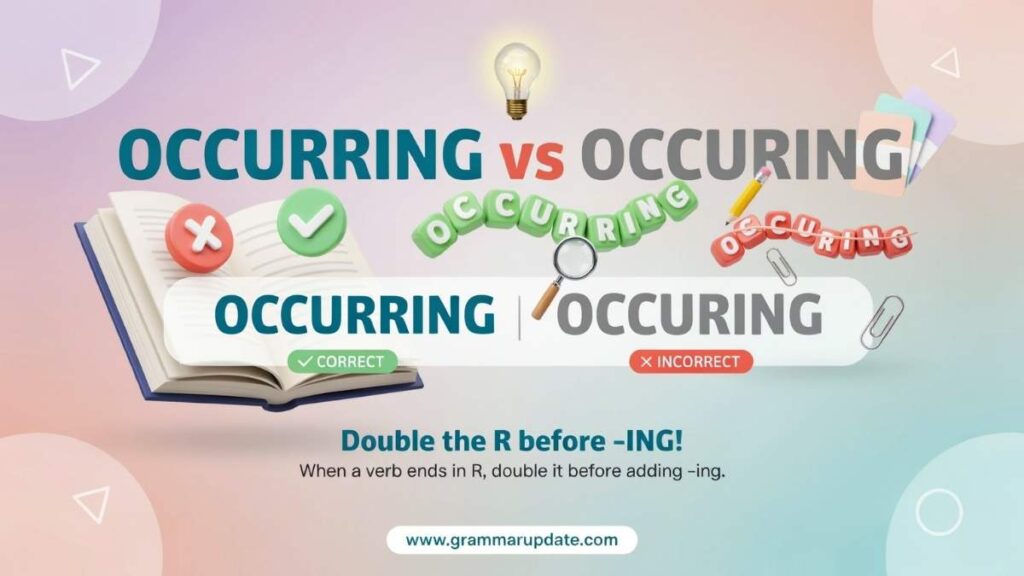
English spelling can turn a simple word into a surprisingly tricky puzzle. “Occurring” is a good example. If you have ever paused over occurring vs occuring, the confusion is understandable because both spellings look nearly identical. However, only one is correct. The correct spelling is “occurring,” with two r’s, while “occuring” is a common spelling mistake. The reason becomes clear when you look at how “occur” changes when you add -ing. In this guide, you’ll learn what “occurring” means, why the r doubles, how to use it correctly, and an easy way to remember the spelling so you can write it with confidence.
Quick Answer
Occurring is the correct spelling. Occuring is an incorrect spelling and does not have a separate meaning or grammatical function in standard English.
| Word | Status | Meaning |
|---|---|---|
| Occurring | Correct | Happening, taking place, or existing |
| Occuring | Incorrect | Misspelling of occurring |
| Occurred | Correct | Happened or took place |
| Occured | Incorrect | Misspelling of occurred |
| Occurrence | Correct | An event or instance of something happening |
| Occurence | Incorrect | Misspelling of occurrence |
For example:
The problem is occurring again.
The word occurring describes something that is happening at the present time. Therefore, if you are choosing between occurring vs occuring which is correct, use occurring.
The easiest formula to remember is:
occur + ing = occurring
That extra r matters.
Learn the difference between confusing word pairs
Accommodate vs Accomodate Which one Is Correct?
Occurring Meaning and Usage
What Does Occurring Mean?
The basic occurring definition is “happening” or “taking place.” The verb occur can also describe something that exists or is present in a particular place or group. Cambridge Dictionary gives both of these meanings for occur.
For example:
The accident occurred yesterday.
Here, occur means happen.
Now consider this sentence:
Certain minerals occur naturally in this region.
In this case, occur means exist or are found naturally.
As a result, the meaning of occurring depends on the context. When you describe an event, it usually means happening. When you describe a substance, condition, species, or feature, it can mean existing or being present.
For example:
The chemical reaction is occurring at a high temperature.
The reaction is happening.
A naturally occurring mineral was found in the rock.
The mineral exists naturally in the rock.
This broader meaning makes occurring useful in everyday English as well as scientific, academic, technical, and professional writing.
Occurring Meaning in English
The occurring meaning in English is closely connected to the verb occur. In most everyday sentences, occurring describes an event, activity, process, or situation that is happening.
For example:
A delay is occurring because of heavy traffic.
Several changes are occurring at the same time.
An unusual reaction is occurring inside the container.
However, occurring does not always describe an event that someone can see happening. It can also describe something that exists naturally or appears in a particular environment.
For example:
Naturally occurring substances can be found in many foods.
The disease occurs more frequently in certain populations.
Therefore, the word can describe both an event that takes place and something that exists or is found.
Learn the difference between confusing word pairs
Endure vs Indure Which Spelling Is Correct?
Occurring Grammar and Verb Form
From a grammar perspective, occurring is the present participle of occur.
The main occur verb forms are:
| Form | Word | Example |
|---|---|---|
| Base form | occur | Problems can occur. |
| Third-person singular | occurs | The problem occurs often. |
| Past tense | occurred | The problem occurred yesterday. |
| Past participle | occurred | The problem has occurred before. |
| Present participle | occurring | The problem is occurring now. |
Cambridge Dictionary specifically identifies occurring as the present participle and occurred as both the past tense and past participle of occur.
This distinction helps explain why the word belongs in different sentence structures.
Consider these examples:
Problems occur unexpectedly.
1.The problem occurs every winter.
2.The problem occurred yesterday.
3.The problem has occurred before.
4.The problem is occurring right now.
Although these words come from the same root verb, each one serves a different grammatical purpose.
Occurring as a Present Participle
The present participle form occurring commonly appears with forms of the verb be.
For example:
The event is occurring now.
Several problems are occurring simultaneously.
A change was occurring in the system.
The word can also appear in a participial phrase:
The errors occurring during the test affected the results.
Here, occurring describes the errors and tells you which errors affected the results.
Therefore, understanding the occurring grammar is not only about spelling. It also helps you use the word correctly in a sentence.
Is Occuring a Word?
No. Occuring is not the standard English spelling.
It is usually an incorrect spelling of occurring. The missing r does not create a new word, meaning, or grammatical form.
For example:
Incorrect: A technical problem is occuring.
Correct: A technical problem is occurring.
The difference may look tiny, but standard English requires the second form.
This also explains why the search phrase occuring meaning can cause confusion. There is no separate standard definition for occuring. If someone writes it, they normally mean occurring.
Likewise, occurring vs occuring meaning is not really a comparison between two words. It is a comparison between the correct spelling and a common spelling error.
Learn the difference between confusing word pairs
Habit vs Habbit Which Spelling Is Correct ?
Why Is Occurring Spelled With Two Rs?
This is the part that causes most of the confusion.
The base verb is occur.
When you add the suffix -ing, the final r doubles:
occur + ing = occurring
The spelling therefore becomes:
o-c-c-u-r-r-i-n-g
The word has double c because the base word occur already has double c. It has double r because the final consonant doubles when the -ing suffix is added.
That gives you a useful visual pattern:
occur → occurring
The second r is not optional, and it does not represent a different sound. It is part of the spelling convention.
Occurring With Double R
If you ever wonder whether occurring has one r or two, remember the word as two parts:
occur + ring
The final part contains rr before ing.
That gives:
occurring
Not:
occuring
The pronunciation does not make the spelling obvious because the two r’s do not create two separate r sounds. Cambridge gives the US pronunciation of occur as /əˈkɝː/ and the UK pronunciation as /əˈkɜːr/.
Consequently, listening to the word will not necessarily remind you to write both r’s. The spelling pattern does that job.
The Double Consonant Spelling Rule

The spelling of occurring relates to the broader English practice of doubling a final consonant when certain suffixes are added.
However, this rule needs some care. English does not simply double the last consonant of every verb before adding -ing. The structure of the word, syllable stress, spelling pattern, and final letters all matter.
With occur, the practical result is clear:
occur → occurring
The stress falls on the final syllable of occur, which helps explain the consonant doubling in the inflected form.
You can see a similar pattern in words such as:
refer → referring
prefer → preferring
admit → admitting
begin → beginning
The patterns are not identical in every detail, but they show why adding -ing can sometimes change the spelling of a verb rather than simply attaching the suffix unchanged.
For language learners, the most useful lesson is not to memorize a complicated technical rule. Instead, remember the correct word family.
occur
occurred
occurring
occurrence
Once these forms become familiar, the spelling becomes much easier to recognize.
Adding -ing to Occur
Adding ing to occur produces occurring.
The spelling process is:
occur + -ing → occurring
Do not remove an r.
Do not write occuring.
The final r doubles before the suffix:
occurring
This becomes especially important in formal writing because the incorrect form can easily slip through when you type quickly.
For example:
The issue is occurring again.
Several changes are occurring throughout the system.
A reaction is occurring inside the container.
The event is occurring earlier than expected.
In each sentence, occurring describes an action or process that is happening.
Adding -ed to Occur
The same word family creates another common spelling mistake.
The past tense and past participle of occur are occurred.
So:
occur + -ed → occurred
Not:
occur + -ed → occured
Cambridge Dictionary confirms that occurred serves as both the past simple and past participle of occur.
For example:
The accident occurred yesterday.
The error occurred during the first test.
The same problem has occurred several times.
This is why occurred vs occured belongs in the same spelling lesson as occurring vs occuring. Both errors involve dropping one of the two r’s.
Learn the difference between confusing word pairs
Fluorescent vs Flourescent difference and usage ?
Occurring vs Occurred vs Occurs vs Occur
These four forms often confuse language learners because they look similar and come from the same root word.
The difference becomes much clearer when you look at their grammatical roles.
| Word | Function | Example |
|---|---|---|
| occur | Base verb | Problems can occur. |
| occurs | Present tense, third-person singular | The problem occurs often. |
| occurred | Past tense and past participle | The problem occurred yesterday. |
| occurring | Present participle | The problem is occurring now. |
The base form occur refers to something that happens or exists.
1.The form occurs works with a singular third-person subject in the present tense.
2.The form occurred describes something that happened in the past or appears after helping verbs such as has, have, or had.
3.The form occurring describes something happening in progress or works within a participial phrase.
Therefore, the difference between occur, occurred and occurring is grammatical as well as temporal.
Occurrence and Occurrences
The word family does not stop with the verb forms.
The noun occurrence refers to an event, instance, or something that happens. It can also refer to the existence or presence of something.
For example:
The accident was an unusual occurrence.
Power outages are a common occurrence in the area.
Scientists studied the occurrence of the disease.
Cambridge Dictionary defines occurrence as something that happens and also uses it for the existence or presence of something.
The plural is occurrences:
Several unusual occurrences were reported.
Notice the spelling:
occurrence
occurrences
Not:
occurence
occurences
This makes occurrence another useful spelling check. If you remember that the word contains double r, you are less likely to drop one.
Learn the difference between confusing word pairs
Lose vs Loose difference and usage?
Occurring vs Occuring Key Differences
The difference between the two forms is simple once the spelling is separated from the meaning.
| Feature | Occurring | Occuring |
|---|---|---|
| Standard spelling | Yes | No |
| Meaning | Happening or existing | No separate standard meaning |
| Base verb | occur | Intended to be occur |
| Grammatical role | Present participle | Incorrect form |
| Correct usage | Standard English | Avoid |
1.There is no meaning difference between the two forms.
2.There is no American English versus British English difference in their spelling either.
3.There is simply one correct spelling: occurring.
Why Do People Misspell Occurring?
The most obvious reason is visual. Occurring contains a dense sequence of letters:
occurring
The double c is followed by double r, then i, n, and g. When someone types quickly, one of those repeated letters can easily disappear.
Another reason comes from a common assumption about adding -ing. Many verbs simply take the suffix:
work → working
help → helping
read → reading
This can make occur appear to follow the same pattern:
occur → occuring
However, that shortcut produces the wrong spelling.
The pronunciation can also contribute to the problem. Since the extra r does not create a separate syllable, hearing the word does not clearly tell you that two r’s belong in the written form.
For that reason, the best solution is to learn the word family rather than rely entirely on pronunciation.
Occurring Pronunciation
The spelling and pronunciation of occurring can seem slightly disconnected.
The base verb occur has two syllables, with the stress on the second syllable. Cambridge lists the US pronunciation as /əˈkɝː/ and the UK pronunciation as /əˈkɜːr/.
The spelling, however, stays the same in both American and British English.
So:
American English: occurring
British English: occurring
The pronunciation can vary by accent, but the spelling does not change.
That makes occurring different from words where American and British English use different spellings, such as color and colour.
Learn the difference between often confused words
Principal vs Principle Difference and usage ?
Occurring in Different Contexts
Occurring fits naturally into many types of writing because events, processes, conditions, and changes can all occur.
In everyday writing, you might say:
The delay is occurring because of traffic.
Several problems are occurring at once.
In scientific writing, you might write:
The reaction is occurring at a higher temperature.
Scientists observed changes occurring in the sample.
In professional writing, you might write:
The error is occurring during installation.
Several technical issues are occurring across the network.
In formal writing, you might write:
The study examines changes occurring within urban populations.
In each case, occurring describes something that is happening or taking place.
Occurring in a Sentence
If you are learning how to use occurring in a sentence, pay attention to the sentence structure around it.
One common pattern uses a form of be:
The event is occurring now.
Another uses a participial phrase:
The changes occurring during the experiment were recorded carefully.
A third pattern places occurring after a noun to provide additional information:
The problems occurring in older systems require further investigation.
These structures show why occurring is more than a word you simply memorize. It has a specific grammatical role.
Learn the difference between often confused words
Your vs You’re Difference and which is correct ?
Occurring Examples in Everyday English
Consider these sentences:
A strange noise is occurring outside.
Several delays are occurring because of the storm.
The event is occurring at the community center.
Unexpected problems are occurring during the process.
These examples all describe something happening.
However, occurring can also describe natural or existing conditions:
This plant contains naturally occurring compounds.
The mineral occurs naturally in the region.
Certain species occur only in specific environments.
Cambridge Dictionary gives examples of occur being used both for events that happen and things that exist or are present.
Occurring Synonym and Related Words
The best occurring synonym depends on the context.
When occurring means happening, suitable alternatives include happening, taking place, arising, unfolding, and developing.
For example:
1.A problem is occurring.
2.A problem is happening.
3.A problem is taking place.
However, these alternatives do not always work perfectly. Occurring can describe something that exists or is found naturally, whereas happening generally describes an event.
For example:
A naturally occurring mineral is found in the rock.
In that sentence, replacing occurring with happening would change the meaning completely.
Therefore, context should guide your choice of synonym.
Learn the difference between often confused words
Breached VS Breeched difference and Which Is Correct?
Common Mistakes With Occurring
Writing Occuring
This is the most common error.
Incorrect:
The problem is occuring again.
Correct:
The problem is occurring again.
The fix is simple: restore the second r.
Writing Occured
The past form creates the same problem.
Incorrect:
The accident occured yesterday.
Correct:
The accident occurred yesterday.
Again, the final r remains doubled.
Writing Occurence
The noun form causes another familiar mistake.
Incorrect:
This is a rare occurence.
Correct:
This is a rare occurrence.
The correct noun keeps the double r.
Writing Occurences
The plural follows the same pattern.
Incorrect:
Several occurences were reported.
Correct:
Several occurrences were reported.
The spelling becomes easier when you recognize the whole word family.
Learn the difference between often confused words
Disastrous vs Disasterous difference and usage ?
Occurring Spelling Mistakes and How to Avoid Them
The best way to prevent an occurring spelling mistake is to stop treating the word as an isolated collection of letters.
Instead, connect it to its related forms:
occur
occurs
occurred
occurring
occurrence
occurrences
Once the family becomes familiar, the repeated r pattern stands out.
A second useful method is to pause whenever you type occur followed by a suffix. Check whether the final r needs to double.
For occurring:
occur + ing → occurring
For occurred:
occur + ed → occurred
For occurrence:
occurrence
This quick mental check takes only a moment and can prevent several common spelling errors.
A Simple Case Study
Imagine that a student writes the following sentence in an essay:
Several unusual events were occuring during the experiment.
The sentence communicates the intended meaning, but the spelling contains an error.
The incorrect form is:
occuring
The correct form is:
occurring
Why?
The base verb is occur. When the present participle is formed, the final r doubles before -ing.
The corrected sentence is:
Several unusual events were occurring during the experiment.
Now consider a second sentence:
The first major change occured after ten minutes.
Again, the intended meaning is clear, but the spelling is incorrect.
The correct sentence is:
The first major change occurred after ten minutes.
These examples show why learning the entire word family is more useful than memorizing one spelling in isolation.
Learn the difference between often confused words
Airfoil vs Aerofoil difference and usage?
How to Remember the Spelling of Occurring
A simple memory trick can make this word much easier.
Remember this sequence:
occur → occurred → occurring → occurrence
The base word occur contains double c.
When you form occurring or occurred, the final r remains doubled.
So the visual pattern is:
occur
occurred
occurring
occurrence
If you prefer a short reminder, think:
“Occur keeps its double c, and its r doubles before the suffix.”
That gives you the correct spelling without requiring a complicated grammar lesson.
Another useful check is to ask yourself:
Does the word contain rr before the ending?
If the answer is no, check it again.
Is Occurring the Same in American and British English?
Yes. The spelling of occurring does not change between American English and British English.
Both varieties use:
occurring
occurred
occurrence
occurrences
The pronunciation can vary between accents, but the written form remains the same. Cambridge gives different US and UK pronunciations for occur while showing the same spelling.
Therefore, there is no special British spelling such as occuring. If you are writing in American English or British English, occurring remains the standard form.
Is Occured or Occurred Correct?
Occurred is correct.
Occured is incorrect.
This distinction is worth remembering because it follows the same spelling pattern as occurring.
Compare:
occur → occurred
occur → occurring
The final r doubles in both forms.
So if you know the correct spelling of occurring, you can use that knowledge to remember occurred as well.
Does Occurring Have Double C and Double R?
Yes.
The spelling is:
o-c-c-u-r-r-i-n-g
The first pair, cc, comes from the base word occur.
The second pair, rr, appears because the final r doubles when the suffix -ing is added.
That gives the word its distinctive spelling.
If you write only one r, you get occuring, which is incorrect.
If you write only one c, you would also change the correct base spelling.
The safest form to remember is simply:
occurring
What Is the Past Tense of Occur?
The past tense of occur is occurred.
For example:
The accident occurred yesterday.
The meeting occurred earlier than expected.
The error occurred during the first test.
The past participle is also occurred:
The same problem has occurred before.
The same pattern appears in Cambridge Dictionary, which identifies occurred as both the past simple and past participle of occur.
What Is the Present Participle of Occur?
The present participle of occur is occurring.
For example:
The problem is occurring again.
Several changes are occurring at the same time.
The present participle can also appear in phrases such as:
changes occurring during the experiment
events occurring throughout the year
errors occurring during installation
Therefore, if someone asks for the present participle of occur, the answer is occurring.
What Is the Difference Between Occurring vs Occuring?
The difference is spelling, not meaning.
Occurring is the standard and correct form.
Occuring is an incorrect spelling.
There is no separate dictionary meaning that makes occuring a legitimate alternative.
Therefore:
Occurring = correct
Occuring = incorrect
That is the entire distinction.
What Is the Difference Between Occur, Occurred, and Occurring?
Occur is the base form.
Occurred is the past tense and past participle.
Occurring is the present participle.
For example:
Problems can occur unexpectedly.
The problem occurred yesterday.
The problem is occurring now.
The grammar changes because each form serves a different purpose. However, they all belong to the same word family.
Learn the difference between confusing word pairs
Equipment vs Equiptment difference and usage ?
Practice Session Occurring vs Occuring
Fill in each blank with the correct form of the word. Occurring vs Occuring
- The accident was __________ on a busy highway.
- Scientists are studying the changes __________ in the atmosphere.
- The problem keeps __________ whenever the system is updated.
- Several errors have __________ during the testing process.
- The teacher explained why the mistake was __________ so often.
- A similar event is __________ in several other cities.
- The researchers noticed an unusual __________ during the experiment.
- Heavy rainfall can cause flooding to __________ in low-lying areas.
- The issue is __________ more frequently than expected.
- The company is investigating what __________ during the meeting.
- The correct spelling is “__________,” not “occuring.”
- The word “occur” becomes “__________” when -ing is added.
- The word “occur” becomes “__________” in the past tense.
- The noun form of occur is “__________.”
- Several unexpected __________ were reported during the study.
- The same error is __________ in many student essays.
- A power outage __________ last night.
- Researchers are observing changes __________ in the environment.
- The manager wants to understand what is __________ in the department.
- The spelling “__________” contains two r’s.
- The spelling “__________” is incorrect because it has only one r.
- The accident __________ shortly after midnight.
- Strange sounds were __________ throughout the night.
- The scientists recorded every __________ during the experiment.
- Remember: occur, occurs, occurred, and __________ are the correct forms.
Answers
- occurring
- occurring
- occurring
- occurred
- occurring
- occurring
- occurrence
- occur
- occurring
- occurred
- occurring
- occurring
- occurred
- occurrence
- occurrences
- occurring
- occurred
- occurring
- occurring
- occurring
- occuring
- occurred
- occurring
- occurrence
- occurring
Here’s a trusted source for clear word meanings:
FAQs
What is the correct spelling occurring vs occuring?
The correct spelling is “occurring,” with two r’s. “Occuring” is a common spelling mistake and is not the standard English form.
What does occurring mean?
“Occurring” means happening, taking place, or existing at a particular time or place. For example, “Several changes are occurring in the workplace.”
Is occuring a word in English?
“Occuring” is not the standard spelling of the word. If you mean something that is happening or taking place, use “occurring.”
Why is occurring spelled with two r’s?
“Occurring” keeps the double c from “occur” and doubles the final r before the -ing ending. That gives you the correct spelling: occur + ing = occurring.
How do you spell occurring correctly?
The correct spelling is “occurring”: o-c-c-u-r-r-i-n-g. The easiest detail to remember is the double r before -ing.
Does occurring have one r or two?
“Occurring” has two r’s. The spelling “occuring,” with only one r after the u, is incorrect.
What is an example of occurring in a sentence?
Here is a simple example: “The same problem is occurring again.” In this sentence, “occurring” describes something that is happening.
How do you use occurring in a sentence?
Use “occurring” when you want to describe an action, event, or situation that is happening. For example, “A significant change is occurring in the local environment.”
What is the present participle of occur?
The present participle of “occur” is “occurring.” It commonly appears with forms of “be,” as in “is occurring,” “was occurring,” or “are occurring.”
What is the difference between occur and occurring?
“Occur” is the base form of the verb, while “occurring” is its present participle. For example, “Problems occur regularly” uses the base form, while “Problems are occurring regularly” describes an action in progress.
Is occurring spelled the same in American and British English?
Yes. “Occurring” has the same spelling in standard American and British English. The spelling does not change between the two varieties.
What is the spelling rule for occurring?
When “-ing” is added to “occur,” the final r is doubled, producing “occurring.” The original double c also remains, so the complete spelling contains both double c and double r.
What is the difference between occurring and occurred?
“Occurring” describes something happening, often as an ongoing action. “Occurred” is the past tense and past participle of “occur.” For example, “The problem is occurring now” refers to an ongoing event, while “The problem occurred yesterday” refers to a completed past event.
What is the noun form of occurring?
The related noun is “occurrence.” It means an event, incident, or something that happens. Its plural form is “occurrences.”
How can you remember the spelling of occurring?
A simple memory trick is to start with “occur” and remember that the final r doubles before -ing. Think of it as “occur + ring,” which produces “occurring.” This quick check can help you avoid the common “occuring” spelling mistake.
What are the correct forms of the verb occur?
The main forms are “occur,” “occurs,” “occurred,” and “occurring.” Use each form according to the tense and grammatical structure of your sentence.
conclusion
The difference between “occurring” and “occuring” comes down to one small letter, but that missing r can create a noticeable spelling mistake. The correct form is “occurring,” with two r’s. “Occuring” is incorrect.
The reason is simple. The verb “occur” becomes “occurring” when you add -ing, and the final r doubles. The same word family includes “occur,” “occurs,” “occurred,” “occurrence,” and “occurrences.”
So, when you compare occurring vs occuring, remember the double r. If you’re wondering whether occurring vs occuring has a different meaning, it doesn’t. One is correct English spelling, while the other is a spelling error.
When writing quickly, occurring vs occuring can be easy to mix up. Just keep the extra r in mind. Once you remember that pattern, the occurring vs occuring confusion disappears. In English spelling, sometimes one extra letter is exactly what you need.

Jhon AJS, the creative mind behind Grammar Update, is an experienced blogger passionate about simplifying English grammar. He focuses on explaining confusing word vs word differences, grammar rules, punctuation, and sentence structure in a clear and practical way. Through easy to understand guides and examples, Jhon helps readers improve their writing and communicate with confidence. With years of blogging experience, he continues to share helpful insights that make learning grammar simple, useful, and accessible for everyone.