If you have ever confused distress vs duress , you are definitely not alone, and your grammar skills are not under pressure either. These two words often appear similar at first glance, and as a result, they frequently lead to writing mistakes in both casual and professional communication. However, once you understand their true meanings, the confusion disappears quickly. Distress refers to emotional or physical suffering caused by stress, anxiety, or trauma, while duress refers to forced actions under threats or coercion. In this article, we will clearly explain the difference between both terms with simple explanations and practical clarity.
Quick Answer Distress vs Duress
You can quickly understand distress vs duress by separating emotion from force. Distress describes an internal emotional reaction, while duress describes external pressure that controls or forces action.
Distress meaning refers to emotional pain, anxiety, or psychological suffering caused by difficult situations or life events. Duress meaning refers to unlawful threats or pressure that force someone to act against their will.
- Distress describes emotional suffering inside a person
Example: She experienced distress after receiving bad news.
| Word | Meaning Type | Context |
|---|---|---|
| Distress | Emotional suffering | Psychology, daily life |
| Duress | Forced action under threat | Law, contracts |
What Does Distress Mean?
The distress meaning refers to emotional, mental, or physical suffering that results from stressful or traumatic experiences. People commonly use this term in psychology, healthcare, and everyday communication.
Distress always comes from within. A person feels it as a reaction to fear, sadness, anxiety, or overwhelming situations. It does not involve external force but reflects internal emotional struggle.
- Distress describes a natural emotional reaction to stress or trauma
Example: The patient showed severe emotional distress after the accident.
| Type of Distress | Explanation |
|---|---|
| Emotional distress | Anxiety, sadness, mental suffering |
More Confusing Words Made Simple
Moment vs Momment Difference and Usage
What Does Duress Mean?
The duress meaning comes from legal language. It describes a situation where someone forces or threatens another person into making a decision against their will. Lawyers often use this term in contract and criminal law.
Duress always involves external pressure. It removes free will and affects the validity of agreements or actions.
- Duress refers to external threats that force a person to act
Example: He signed the contract under duress after receiving threats.
| Type of Duress | Explanation |
|---|---|
| Legal duress | Forced action under coercion or threat |
More Confusing Words Made Simple
Insite vs Insight difference and Common Mistakes
Are Duress and Distress the Same Thing?
Many people confuse these two terms, but they are not the same. They differ completely in meaning and usage.
Distress relates to emotional suffering, while duress relates to forced actions caused by external pressure. One is psychological, and the other is legal.
- Distress reflects emotional pain, while duress reflects forced decision-making
Example: She felt distress after the incident, but he acted under duress during the agreement.
| Feature | Distress | Duress |
|---|---|---|
| Nature | Internal emotion | External coercion |
Difference Between Distress vs Duress Explained
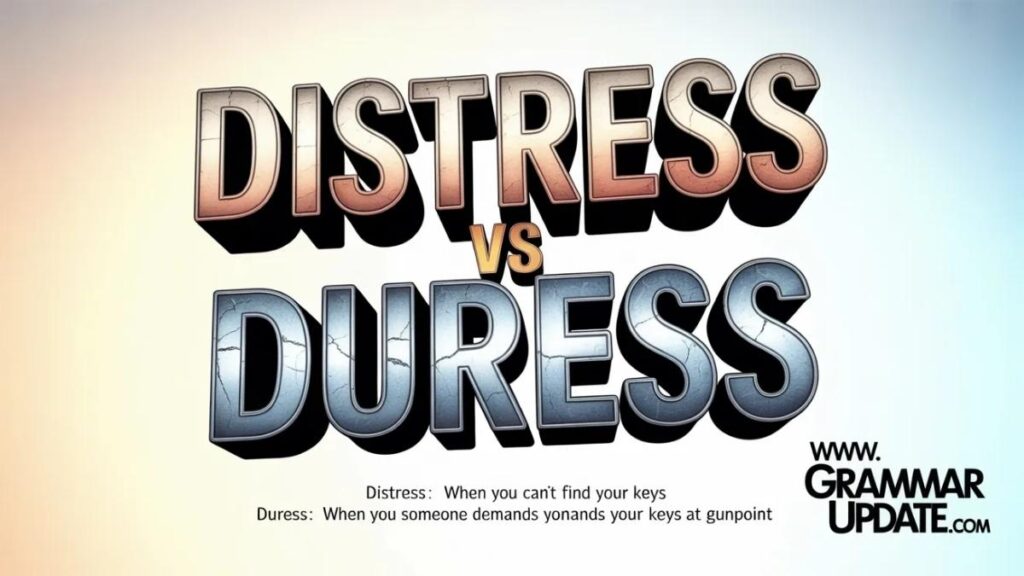
The difference between distress and duress becomes clear when you separate emotion from legal force. Distress happens inside the mind as a response to stress or trauma. Duress happens outside a person when someone applies pressure or threats.
Distress describes feelings, while duress describes loss of free will.
- Distress represents emotional suffering, while duress represents forced action
Example: He experienced distress after the news but signed under duress during questioning.
| Category | Distress | Duress |
|---|---|---|
| Source | Internal emotional state | External force or threat |
More Confusing Words Made Simple
Steer vs Stear Spelling Mistake and Usage
Distress vs Duress in Law
In legal systems, distress vs duress in law plays an important role because both terms affect legal decisions differently.
Courts treat distress as emotional harm in compensation claims, while they treat duress as a legal defense that can cancel contracts or invalidate confessions.
- Courts may cancel agreements if duress is proven
Example: The court invalidated the contract due to duress.
| Legal Concept | Meaning |
|---|---|
| Duress | Forced agreement under unlawful pressure |
Under Duress Meaning
The phrase under duress meaning refers to a situation where a person acts because of threats or pressure. Legal systems use this phrase frequently in court cases and investigations.
It shows that a person did not act freely and faced coercion.
- Under duress means acting without free will due to threats
Example: He confessed under duress during interrogation.
| Phrase | Meaning |
|---|---|
| Under duress | Forced action due to threat |
Under Distress Meaning
The phrase under distress meaning describes someone experiencing emotional or physical suffering. Unlike duress, it does not involve force or coercion.
Instead, it reflects emotional or physical condition caused by stress or trauma.
- Under distress describes emotional suffering or mental strain
Example: The passengers were under distress after the accident.
| Context | Meaning |
|---|---|
| Emotional | Anxiety, sadness, fear |
More Confusing Words Made Simple
Attornies vs Attorneys Differences and Usage
Emotional Distress Meaning
The emotional distress meaning refers to psychological suffering caused by stressful or traumatic events. Psychologists study this condition in mental health research.
Emotional distress affects thoughts, behavior, and physical health. It often appears after trauma, loss, or emotional shock.
- Emotional distress impacts mental stability and daily life functioning
Example: She suffered emotional distress after losing her job.
| Symptom Type | Example |
|---|---|
| Emotional | sadness, anxiety |
Mental Duress Legal Definition
The mental duress legal definition refers to psychological pressure that forces someone to act against their free will. Courts recognize it in both criminal and contract law.
Mental duress plays a key role in legal decisions because it can invalidate confessions or agreements.
- Mental duress proves that a decision was not made voluntarily
Example: The court rejected the confession due to mental duress.
| Type | Meaning |
|---|---|
| Mental duress | Psychological coercion |
Distress vs Duress Synonyms
Understanding synonyms helps improve vocabulary and reduces confusion between these two terms.
Distress relates to emotional suffering, while duress relates to coercion or pressure.
- Distress means emotional pain, while duress means forced action
Example: Distress = anxiety, Duress = coercion
| Word | Synonyms |
|---|---|
| Distress | anxiety, suffering |
| Duress | coercion, pressure |
Common Mistakes in Distress vs Duress Usage
Writers often confuse these words because they look similar and both describe negative situations.
Most mistakes happen when people mix emotional and legal contexts.
- Writers often use distress incorrectly in legal situations
Example: Incorrect: He signed under distress. Correct: He signed under duress.
| Mistake Type | Reason |
|---|---|
| Context confusion | emotion vs legal force |
More Confusing Words Made Simple
Comming vs Coming Difference and Correct Usage
What Does Distress Feel Like?
Distress feels overwhelming and emotionally exhausting. It affects both mental and physical health.
People often experience anxiety, sadness, or confusion during distress.
- Distress affects emotional balance and mental clarity
Example: She felt distress after receiving shocking news.
| Feeling Type | Description |
|---|---|
| Emotional | sadness, anxiety |
What Qualifies as Duress?
Duress occurs when someone forces another person to act through threats or unlawful pressure. It removes free will completely.
Courts carefully evaluate whether real coercion exists before accepting a claim of duress.
- Duress involves forced decision-making under threat
Example: He acted under duress due to employer threats.
| Condition | Example |
|---|---|
| Threat | forced signing of contract |
More Confusing Words Made Simple
Placque vs Plaque Difference and Correct Usage
What Kind of Evidence Proves Duress?
Courts require strong evidence to prove duress. This may include recordings, witness statements, or written communication.
Without evidence, courts usually reject duress claims.
- Evidence must clearly show coercion or pressure
Example: The case failed due to lack of evidence of duress.
| Evidence Type | Example |
|---|---|
| Direct | recorded threats |
More Confusing Words Made Simple
Cheer vs Chear difference and Usage Guide
What is Another Word for Duress?
Duress has several synonyms such as coercion, intimidation, pressure, and compulsion. These words describe situations where external force controls a decision.
- Duress refers to coercion or forced action in legal and formal contexts
Example: Duress = coercion or intimidation
| Word | Synonyms |
|---|---|
| Duress | coercion, pressure |
More Confusing Words Made Simple
Togather vs Together Which Is the Correct Word to Use?
Distress vs Duress Examples
Examples make the difference easy to understand. Distress always involves emotional suffering, while duress always involves forced action.
- Distress describes emotional reactions, while duress describes forced decisions
Example: She felt distress after the accident, but he signed under duress during the agreement.
| Sentence Type | Meaning |
|---|---|
| Distress | emotional suffering |
| Duress | forced action |
More Confusing Words Made Simple
Trauma vs Trama Difference and Correct Usage
Key Takeaways Distress vs Duress
The main difference remains simple. Distress refers to emotional or physical suffering, while duress refers to forced action under threat or pressure.
- Distress comes from internal emotion, while duress comes from external force
Example: Distress = anxiety, Duress = coercion
| Concept | Distress | Duress |
|---|---|---|
| Core Idea | Emotion | Force |
Practice Sessions Distress vs Duress
These practice exercises will help you clearly master the difference between distress vs duress meaning by applying the concepts in real situations. Each section focuses on correct usage, context recognition, and common confusion points.
Fill in the Blank Practice
Complete each sentence by choosing the correct word: distress or duress.
- She was in deep __________ after hearing the accident news.
- He signed the agreement under __________ because of threats.
- The child showed signs of emotional __________ during the emergency.
- The contract was declared invalid because it was signed under __________.
- Loud noise caused severe __________ among the passengers.
| Sentence | Correct Answer |
|---|---|
| 1 | Distress |
| 2 | Duress |
| 3 | Distress |
| 4 | Duress |
| 5 | Distress |
Sentence Correction Practice
Identify and correct the incorrect usage.
- He acted under distress when signing the contract.
- The news caused her duress and anxiety.
- The witness gave a statement under distress.
- The patient suffered duress after the accident.
| Sentence | Correct Form |
|---|---|
| 1 | He acted under duress when signing the contract. |
| 2 | The news caused her distress and anxiety. |
| 3 | The witness gave a statement under duress. |
| 4 | The patient suffered distress after the accident. |
Multiple Choice Practice
Choose the correct option.
- Which word relates to emotional suffering?
A) Duress
B) Distress - Which word relates to forced action under threat?
A) Distress
B) Duress - Which situation best describes duress?
A) Feeling sad after loss
B) Signing a contract due to threats - Which situation best describes distress?
A) Emotional anxiety after trauma
B) Forced confession in court
| Question | Correct Answer |
|---|---|
| 1 | B |
| 2 | B |
| 3 | B |
| 4 | A |
Context Identification Practice
Read each situation and decide whether it is distress or duress.
- A person cries after receiving bad medical news.
- A worker signs papers because of threats from a manager.
- A family feels emotional pain after losing their home.
- A suspect confesses due to intimidation during questioning.
- A student feels anxiety before an important exam.
| Situation | Correct Term |
|---|---|
| 1 | Distress |
| 2 | Duress |
| 3 | Distress |
| 4 | Duress |
| 5 | Distress |
Key Practice Rule to Remember Distress vs Duress
The easiest way to avoid confusion is to always check the source of the situation. If the situation involves internal emotions like sadness or anxiety, use distress. If it involves external pressure, threats, or force, use duress.
| Concept | Distress | Duress |
|---|---|---|
| Source | Internal emotion | External pressure |
| Meaning Focus | Feeling | Force |
| Field | Psychology | Law |
Here’s a trusted source for clear word meanings:
FAQs
Are duress and distress the same thing?
No, they are not the same. Distress vs duress meaning shows a clear difference: distress refers to emotional suffering, while duress refers to forced action under threats or coercion. Distress is internal (feelings), whereas duress is external (pressure or force).
What qualifies as duress?
Duress qualifies when someone is forced to act due to threats, violence, or unlawful pressure. In law, it must remove a person’s free will or voluntary consent.
What constitutes emotional distress?
Emotional distress includes mental suffering caused by trauma, stress, loss, or fear. It may involve anxiety, sadness, panic, or emotional exhaustion that affects daily life.
What does distress feel like?
Distress often feels overwhelming and mentally exhausting. It may include anxiety, sadness, confusion, or emotional pain that affects focus and decision-making.
What are the five signs of distress?
Common signs include persistent anxiety, irritability, sleep problems, difficulty concentrating, and emotional breakdown or sadness.
What are the two types of distress?
The two main types are emotional distress and physical distress. Emotional distress relates to mental suffering, while physical distress relates to bodily pain or discomfort caused by stress or trauma.
What kind of evidence proves duress?
Evidence of duress may include recorded threats, written messages, witness testimony, or any proof showing that a person was forced or threatened into action.
What is another word for duress?
Common synonyms for duress include coercion, intimidation, pressure, and compulsion. These words all describe situations where someone is forced to act against their free will.
Conclusion
The confusion between distress vs duress meaning happens because both words look similar, but they function in completely different ways. Distress belongs to emotional and psychological experiences, while duress belongs to legal pressure and coercion.
To remember easily, use this rule: if it involves feelings, use distress; if it involves force or threats, use duress. Once you apply this rule, your writing becomes clearer, more accurate, and more professional.

Jhon AJS, the creative mind behind Grammar Update, is an experienced blogger passionate about simplifying English grammar. He focuses on explaining confusing word vs word differences, grammar rules, punctuation, and sentence structure in a clear and practical way. Through easy to understand guides and examples, Jhon helps readers improve their writing and communicate with confidence. With years of blogging experience, he continues to share helpful insights that make learning grammar simple, useful, and accessible for everyone.