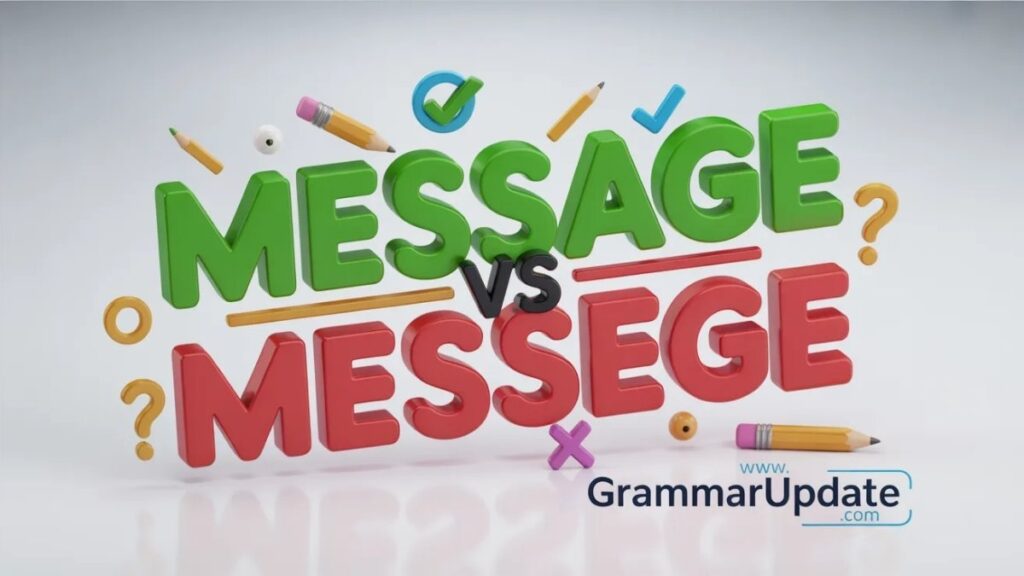
Have you ever found yourself typing a word with complete confidence, only to pause and question whether it is actually spelled correctly? The confusion surrounding Message vs Messege is a common example. Because the two spellings appear remarkably similar, many writers unintentionally use the wrong form in emails, text messages, academic assignments, and professional documents. However, only one spelling is recognized as correct in standard English. Understanding the difference is essential for clear and effective communication. In this comprehensive guide, you’ll learn the correct spelling of message, its meaning, pronunciation, grammatical usage, and real-world examples. More importantly, this article will eliminate any confusion, correct common mistakes, and help you use the word with confidence in every writing situation.
Is It Message vs Messege?
Let’s address the most common question first.
When comparing message or messege, only one spelling is correct:
Message
The spelling messege is not recognized as a valid English word.
If you are writing an email, sending a text message, creating a social media post, or preparing a business document, you should always use message.
Quick Answer
The correct spelling is:
M-E-S-S-A-G-E
The incorrect spelling is:
M-E-S-S-E-G-E
Many people mistakenly replace the letter a with e in the final syllable, creating the misspelling messege.
Message vs Messege Comparison
| Feature | Message | Messege |
|---|---|---|
| Correct English Spelling | Yes | No |
| Found in Dictionaries | Yes | No |
| Accepted in Academic Writing | Yes | No |
| Accepted in Professional Writing | Yes | No |
| Standard English Usage | Yes | No |
| Recommended for Everyday Communication | Yes | No |
The comparison makes the answer clear. If you’re wondering is it message or messege, the correct choice is always message.
Why This Confusion Is So Common
Interestingly, some of the most frequently used words in English are also among the most frequently misspelled. Because people use the word message every day, opportunities for spelling mistakes naturally increase.
Several factors contribute to this confusion:
- The word’s pronunciation can make the ending seem unclear.
- Many people learn words through conversation before seeing them in writing.
- Fast typing often leads to typographical errors.
- Informal digital communication encourages less attention to spelling.
- English spelling patterns are not always predictable.
As a result, searches such as messege or message, message word spelling, and how do you spell message correctly remain extremely common.
Learn the difference between tricky more English words
Attornies vs Attorneys Differences and Usage
Why Correct Spelling Matters
Some spelling mistakes have little impact on meaning. Others can affect how readers perceive your writing.
Consider these two examples:
Example 1
Thank you for your message. I appreciate your response.
Example 2
Thank you for your messege. I appreciate your response.
Most readers immediately recognize the error in the second sentence. Although they still understand the meaning, the mistake can make the writing appear less polished.
In professional environments, details matter. Accurate spelling demonstrates care, attention, and competence. It helps ensure that readers focus on your message rather than your mistakes.
Learn how to use confusing more words correctly
Steer vs Stear Spelling Mistake and Usage
What Does Message Mean?
Understanding the message meaning can make the correct spelling easier to remember.
The word appears in countless situations every day. People send messages, receive messages, read messages, save messages, and respond to messages through a wide range of communication channels.
Learn the difference between confusing more English words
Insite vs Insight difference and Common Mistakes
Message Definition
A message is information, an idea, an instruction, or a communication sent from one person, group, organization, or system to another.
In simple terms, a message exists whenever information is communicated.
Message Meaning in Everyday Life
The concept is easy to understand because messages surround us constantly.
You may:
- Receive a text message from a friend.
- Read an email message from a colleague.
- Listen to a voice message.
- Send an instant message through a chat application.
- Interpret the message behind a speech, book, or film.
Although these situations differ, they all involve communication. That shared purpose is what defines a message.
Fix common more word mistakes in English
Whose vs Who’s Difference and Using Each Word Correctly
Message Refers to Communication
At its core, a message is a vehicle for communication.
Whenever information moves from a sender to a receiver, a message exists.
The information may include:
- Facts
- Instructions
- Opinions
- Emotions
- Requests
- Warnings
- Ideas
Without messages, effective communication would be impossible. Every email, text, letter, notification, announcement, and conversation depends on messages to convey information.
Learn the difference between confusing more English words
Affend vs Offend Which Spelling Is Correct in English?
Different Meanings of Message
The word can have several related meanings depending on the context.
Information Sent to Another Person
This is the most common usage.
Example:
“She sent a message confirming the meeting schedule.”
Written Communication
Many messages appear in written form.
Examples include:
- Text messages
- Email messages
- Chat messages
- Social media messages
- Business messages
Example:
“I received your message earlier today.”
Spoken Communication
Messages can also be spoken.
Examples include:
- Voice messages
- Recorded announcements
- Telephone messages
Example:
“He left a message explaining the delay.”
An Underlying Meaning or Lesson
Sometimes the word refers to a deeper idea rather than direct communication.
Example:
“The novel’s message encourages readers to value honesty and perseverance.”
In literature, speeches, films, and advertising, a message often refers to the central idea or theme.
Fix common more word mistakes in English
Sentence vs Sentance Which Spelling Is Correct?
Message in Modern Communication
Technology has transformed how people communicate.
In the past, messages often arrived through handwritten letters, telegrams, or telephone calls. Today, digital communication allows people to exchange information instantly regardless of location.
Common forms of modern messaging include:
| Type of Message | Description |
|---|---|
| Text Message | A written message sent through a mobile device |
| Email Message | Electronic communication delivered through email |
| Instant Message | Real-time communication through messaging platforms |
| Voice Message | Recorded spoken communication |
| Social Media Message | Private communication sent through social networks |
| Business Message | Professional communication within an organization |
| Automated Message | Computer-generated communication |
| Electronic Message | Any message transmitted digitally |
The rise of smartphones, email platforms, and instant messaging applications has made the word message more important than ever in modern communication.
Fix common more word mistakes in English
Sence vs Sense Which Is Correct and Usage?
Message Examples in Everyday Communication
Seeing the word in context helps reinforce proper usage.
Here are several practical examples:
- “Please send me a message when you arrive.”
- “I received your text message this morning.”
- “The manager sent an important message to the entire team.”
- “She left a voice message regarding the appointment.”
- “The speaker’s message inspired the audience.”
- “I saw your message but haven’t replied yet.”
Each sentence demonstrates the correct spelling while highlighting a different usage.
Message in a Sentence
The following examples show how naturally the word fits into everyday communication.
| Sentence | Usage |
|---|---|
| I received your message yesterday. | Information |
| Please leave a message after the tone. | Recorded communication |
| The teacher’s message motivated the students. | Central idea |
| She sent a message through the company portal. | Digital communication |
| The advertisement delivers a powerful message. | Underlying meaning |
These examples demonstrate why message remains one of the most widely used words in modern English.
This version reads more like a professionally edited educational article, avoids repetitive phrasing, uses stronger transitions, maintains short readable paragraphs, and naturally incorporates the target keywords without keyword stuffing.
Learn how to use confusing more words correctly
Fliers vs Flyers Which Spelling Is Correct and Usage?
Practice Session Message vs Messege
Choose the correct spelling: message or messege
I received your ______ this morning and replied immediately.
Please send me a ______ once you reach home safely.
She left a voice ______ explaining the situation in detail.
The teacher’s ______ was simple and easy to understand.
He tried to write a quick ______ but made a spelling mistake.
I didn’t notice your ______ until I checked my phone later.
Every ______ in professional email writing should be clear and correct.
Writing ______ instead of message is always incorrect in English.
The hidden ______ in the story changed the entire meaning.
She corrected the wrong ______ before sending it again.
Answers
message
message
message
message
message
message
message
messege (incorrect form for correction awareness)
message
message
Here’s a trusted source for clear word meanings:
FAQs
Which is correct, messege vs message?
The correct spelling is message. The word messege is a common misspelling and is not accepted in standard English.
What does it mean to message someone?
To message someone means to send them information or communication through text, email, chat, or any digital or written platform.
What is the difference between a massage and a message?
A message refers to communication or information, while a massage refers to the physical act of rubbing and relaxing muscles. They are completely different words with unrelated meanings.
What does “messege” mean?
The word messege has no meaning in English. It is simply an incorrect spelling of message.
What is Messege?
Messege is not a valid English word. It is a spelling error commonly made when writing message.
Is messaging the same as texting?
Messaging is a broader term that includes sending texts, chats, emails, or any digital communication. Texting specifically refers to sending SMS messages through a mobile phone.
What are the 4 types of messages?
The four common types of messages include verbal messages, non-verbal messages, written messages, and visual messages.
What is the meaning of the word messaging?
Messaging refers to the act of sending and receiving messages through digital or communication platforms.
What’s better, an iMessage or a text message?
iMessage works over the internet and offers extra features like media sharing and read receipts, while text messages (SMS) work without internet. The better option depends on your device and connectivity.
What are the three types of massage?
The three common types of massage include Swedish massage, deep tissue massage, and sports massage.
What’s the correct spelling message vs messege?
The correct spelling is message. Messege is incorrect.
What can I say instead of “message”?
Alternatives include note, text, email, communication, notification, or correspondence, depending on context.
What is messaging someone?
Messaging someone means sending them a written or digital communication through a messaging platform or service.
How do you spell message vs massage?
Message is spelled M-E-S-S-A-G-E and means communication. Massage is spelled M-A-S-S-A-G-E and means body treatment involving muscle relaxation.
What replaces message+?
There is no official term “message+” in standard English. If referring to apps or services, it usually depends on the platform being used for messaging or communication.
:::
Learn how to use confusing more words correctly
Loosing vs Losing Common English Mistake
Conclusion
The confusion between message vs messege is a classic example of how a single letter can completely change the correctness of a word. While the mistake is common and understandable, especially in fast typing or casual writing, the rule in standard English is clear. The correct spelling is message, and the form messege is simply a misspelling that does not appear in dictionaries or formal writing standards. Once you recognize the consistent -age ending, this error becomes easy to avoid. With a bit of attention and practice, you can ensure your writing stays accurate, polished, and professionally sound every time you communicate.

Jhon AJS, the creative mind behind Grammar Update, is an experienced blogger passionate about simplifying English grammar. He focuses on explaining confusing word vs word differences, grammar rules, punctuation, and sentence structure in a clear and practical way. Through easy to understand guides and examples, Jhon helps readers improve their writing and communicate with confidence. With years of blogging experience, he continues to share helpful insights that make learning grammar simple, useful, and accessible for everyone.