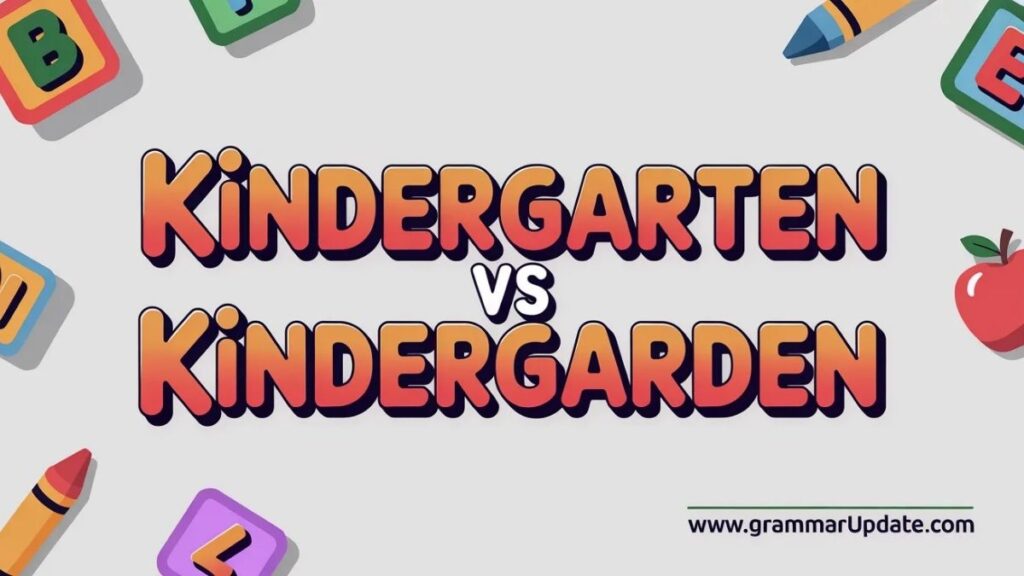
The confusion between kindergarten vs kindergarden is one of the most common spelling errors in English, especially in educational writing. At first glance, the word sounds like it should include “garden,” which leads many writers to naturally add an extra “d” without hesitation. This small but repeated mistake appears in school assignments, online searches, and everyday communication. The issue is not a lack of understanding, but the way pronunciation influences spelling. Since English often borrows words from other languages, spelling does not always match how a word sounds. In this article, you will clearly understand the correct spelling, its meaning, and why this confusion continues to happen.
Kindergarten vs Kindergarden Quick Answer
The correct spelling is kindergarten.
The spelling “kindergarden” is incorrect in standard English.
Many people confuse the word because the pronunciation sounds close to “garden.” However, pronunciation does not determine spelling in this case. The word comes from German, which explains why the spelling looks unusual to English speakers.
Here is the difference clearly:
| Word | Correct or Incorrect | Explanation |
|---|---|---|
| Kindergarten | Correct | Official spelling used in English |
| Kindergarden | Incorrect | Common spelling mistake |
The correct spelling of kindergarten always uses “garten,” not “garden.”
Example Sentences
Correct examples:
- My daughter starts kindergarten next month.
- He teaches music in kindergarten.
- Kindergarten helps children develop social and academic skills.
Incorrect examples:
- My daughter starts kindergarden next month.
- She works at a kindergarden school.
What Does Kindergarten Mean?
The kindergarten meaning refers to an early childhood education program designed for young children before they enter elementary school. In most American schools, kindergarten includes children between the ages of five and six.
Kindergarten introduces children to structured learning while helping them develop communication skills, classroom behavior, emotional awareness, and early academic abilities.
Children usually learn:
| Learning Area | Skills Developed |
|---|---|
| Reading | Letter recognition and phonics |
| Writing | Basic handwriting and sentence formation |
| Math | Counting and number recognition |
| Social Skills | Sharing and teamwork |
| Communication | Listening and speaking skills |
The kindergarten definition often describes it as a class or school that prepares children for formal education.
Example Sentences
- Kindergarten teaches children the basics of reading and math.
- Many schools offer full-day kindergarten programs.
- Early childhood experts consider kindergarten an important educational stage.
The German Origin of Kindergarten
Understanding the German origin of kindergarten immediately explains why the spelling looks different from ordinary English words.
The word comes directly from German and combines two separate words:
| German Word | English Meaning |
|---|---|
| Kinder | Children |
| Garten | Garden |
The literal translation becomes:
“Children’s garden”
This phrase reflected the educational philosophy behind the original kindergarten system. Educators believed children should grow naturally in supportive learning environments, much like plants growing in a garden.
Because English borrowed the original word directly from German, it preserved the original spelling.
That is why:
- Kindergarten is correct
- Kindergarden is incorrect
Example Sentences
- Kindergarten comes from the German language.
- The children’s garden meaning reflects early education philosophy.
- Many German words in English keep their original spelling patterns.
Fix common more word mistakes in English
Receive vs Recieve Which is Correct and Usage?
Who Created Kindergarten?
The modern kindergarten system was developed by Friedrich Fröbel during the nineteenth century.
Fröbel believed young children learn best through creativity, movement, social interaction, and guided exploration rather than strict memorization.
His educational ideas changed early childhood education permanently. Instead of forcing children into rigid academic structures too early, he encouraged playful learning environments that supported emotional and intellectual growth.
That philosophy inspired the term:
“Children’s garden”
Modern kindergarten classrooms still reflect many of Fröbel’s original ideas.
Example Sentences
- Friedrich Fröbel created the first kindergarten system.
- His teaching philosophy influenced modern early childhood education.
- Many classroom activities used today reflect Fröbel’s educational methods.
Why Is It Kindergarten and Not Kindergarden?
One of the most common online questions is:
Why is it kindergarten and not kindergarden?
The answer comes from the word’s German roots.
In German, “garten” means garden. Since English borrowed the original spelling directly, the word remained “kindergarten.”
Many English speakers automatically replace “garten” with “garden” because “garden” feels more familiar in English. The pronunciation also sounds similar, which increases confusion.
However, official dictionaries, schools, and grammar references all recognize only one correct spelling.
Example Sentences
Correct:
- Kindergarten prepares children for elementary school.
- She teaches at a kindergarten academy.
Incorrect:
- Kindergarden prepares children for elementary school.
- He works in a kindergarden classroom.
Learn how to use confusing more words correctly
Quantify vs Qualify Differences and Correct Usage
Kindergarten Pronunciation Explained
The kindergarten pronunciation causes much of the spelling confusion.
In American English, kindergarten is usually pronounced:
KIN-der-gar-ten
Phonetic pronunciation:
/ˈkɪn.dɚˌɡɑr.tən/
The middle sound resembles the word “garden” in casual speech. Because of that, many people incorrectly assume the spelling should also include “garden.”
English contains many words where pronunciation and spelling do not perfectly match.
Examples include:
| Word | Pronunciation |
|---|---|
| Wednesday | Wensday |
| Colonel | Kernel |
| Island | Silent “s” |
| Kindergarten | Sounds close to “kindergarden” |
Example Sentences
- Many students struggle with kindergarten pronunciation.
- Pronunciation confusion often causes spelling mistakes.
- The spoken sound does not change the correct spelling.
Learn the difference between confusing more English words
Courtesy vs Curtesy Usage and Common Mistakes
Kindergarten in English Language
The word “kindergarten” is fully accepted in both American and British English.
In the United States, kindergarten refers to the first official school year before first grade. Schools across the country use the term in educational systems, curriculum standards, and classroom programs.
In the United Kingdom, schools more commonly use terms such as “nursery” or “reception.” However, British dictionaries still recognize the word “kindergarten.”
The spelling remains identical in both versions of English.
Example Sentences
- Kindergarten spelling in American English uses “garten.”
- British English also recognizes the word kindergarten.
- The spelling does not change between countries.
Kindergarten or Preschool the Difference
Many parents compare kindergarten or preschool while choosing educational programs for their children.
Although both involve early childhood education, they serve different purposes.
| Feature | Preschool | Kindergarten |
|---|---|---|
| Typical Age | 3–4 years old | 5–6 years old |
| Main Focus | Play-based learning | Academic readiness |
| Classroom Structure | Flexible | More structured |
| Educational Goal | Social development | Elementary school preparation |
Preschool usually focuses on emotional development and social interaction. Kindergarten introduces more formal academic instruction.
Example Sentences
- Parents often compare kindergarten or preschool before enrollment.
- Preschool focuses heavily on play-based learning.
- Kindergarten introduces structured classroom instruction.
Learn the difference between confusing more English words
Excited vs Exited learn the Difference and Usage
Common Spelling Mistakes Related to Kindergarten
The kindergarden misspelling remains one of the most common educational spelling mistakes in English.
Many incorrect versions appear online and in student writing.
| Incorrect Spelling | Correct Spelling |
|---|---|
| Kindergarden | Kindergarten |
| Kindergardin | Kindergarten |
| Kindergarton | Kindergarten |
These mistakes happen because people rely on pronunciation rather than the actual spelling.
English borrows words from many languages, including German, French, Latin, and Greek. As a result, spelling patterns often feel inconsistent.
Example Sentences
Incorrect:
- She works in a kindergarden school.
- My child starts kindergarden next year.
Correct:
- She works in a kindergarten school.
- My child starts kindergarten next year.
Kindergarten Grammar Rules
Understanding kindergarten grammar helps improve academic and professional writing.
In most situations, “kindergarten” should remain lowercase unless it appears in an official title.
Correct examples:
- My son starts kindergarten this year.
- She teaches kindergarten in California.
Capitalized examples:
- Lincoln Elementary Kindergarten Program
- Happy Days Kindergarten Academy
Example Sentences
- Kindergarten should usually remain lowercase in sentences.
- Official program names may capitalize the word.
- Grammar rules for educational terms follow standard English conventions.
Fix common more word mistakes in English
Meating vs Meeting Difference and Usage
Kindergarten Plural Spelling
Many people also struggle with the plural form of kindergarten.
The correct plural spelling is:
Kindergartens
Incorrect versions include:
- Kindergardens
- Kindergartenes
- Kindergardenes
Although the word comes from German, English plural rules apply after the word enters English vocabulary.
Example Sentences
- Several kindergartens expanded enrollment this year.
- Public kindergartens introduced new reading programs.
- Rural kindergartens received additional educational funding.
Learn how to use confusing more words correctly
Rumor vs Rumour Difference and Usage
Examples of Kindergarten in a Sentence
Learning through examples helps reinforce correct spelling naturally.
Everyday Examples
- My daughter begins kindergarten in August.
- Kindergarten teaches children classroom routines.
- He works as a kindergarten teacher.
- Parents attended the kindergarten orientation meeting.
- The kindergarten students practiced letter recognition.
Academic Examples
- Researchers studied literacy development in kindergarten classrooms.
- Kindergarten readiness improves long-term academic performance.
- Early reading programs support kindergarten learning outcomes.
Professional Examples
- The school district expanded kindergarten enrollment.
- Teachers attended kindergarten curriculum training.
- The kindergarten program focuses on social and academic growth.
Learn how to use confusing more words correctly
Authorization vs Authorisation Which is Correct?
Why People Continue to Spell Kindergarten Wrong
The persistence of the “kindergarden” mistake shows how strongly pronunciation influences spelling habits.
When people hear the word spoken aloud, the brain searches for familiar English patterns. Since “garden” already exists as a common English word, many writers unconsciously replace “garten” with “garden.”
Search engines and social media also contribute to the confusion because incorrect spellings appear frequently online.
However, popularity never changes official spelling standards.
Professional dictionaries, educational institutions, grammar experts, and schools all recognize only one correct spelling:
Kindergarten
Example Sentences
- Many people spell kindergarten wrong because of pronunciation confusion.
- Search engines often display common misspellings.
- Official dictionaries recognize only the spelling “kindergarten.”
Fix common more word mistakes in English
Flys vs Flies Correct Spelling and Common Mistakes
Educational Importance of Kindergarten
Kindergarten plays a critical role in early childhood education and development.
Strong kindergarten programs improve:
| Development Area | Educational Benefit |
|---|---|
| Reading Skills | Better literacy development |
| Communication | Improved language skills |
| Social Interaction | Stronger teamwork abilities |
| Emotional Growth | Better classroom confidence |
| Academic Readiness | Easier transition into elementary school |
Research consistently shows that children who attend quality kindergarten programs often perform better academically in later years.
Example Sentences
- Kindergarten supports emotional and academic development.
- Early education strongly influences future learning success.
- Quality kindergarten programs improve literacy skills.
Learn how to use confusing more words correctly
Phoenix vs Pheonix Difference and Usage
Memory Tricks for Correct Kindergarten Spelling
Simple memory techniques can help you remember the spelling permanently.
One of the easiest methods involves remembering the original German words.
| Word Part | Meaning |
|---|---|
| Kinder | Children |
| Garten | Garden |
Once you connect the spelling to its German meaning, the word becomes much easier to remember.
Another useful trick involves this sentence:
“Children grow in a children’s garden.”
That mental image reinforces both the meaning and spelling at the same time.
Example Sentences
- Memory tricks help students learn difficult spellings.
- Understanding word origins improves spelling accuracy.
- German roots explain the spelling of kindergarten.
Kindergarten vs Kindergarden Comparison
The difference between the two spellings becomes very simple once you understand the word’s history and grammar.
| Question | Correct Answer |
|---|---|
| Correct spelling | Kindergarten |
| Incorrect spelling | Kindergarden |
| Word origin | German |
| Literal meaning | Children’s garden |
| Correct plural | Kindergartens |
| Accepted in dictionaries | Kindergarten only |
Example Sentences
- Kindergarten is the correct spelling in English.
- Kindergarden is considered a spelling mistake.
- The word retains its original German structure.
Fix common more word mistakes in English
Treet vs Treat Spelling Confusion and Usage
Practice Session Kindergarten vs Kindergarden
Choose the correct spelling
- The correct spelling is __________.
- “__________” is a common misspelling.
- Children usually start __________ at age 5.
- The word __________ comes from German.
- “Kinder” means children and “__________” means garden.
- Many people incorrectly write __________ instead of kindergarten.
- Kindergarten is part of early __________ education.
- The correct form in English is __________.
- A child learns basic reading skills in __________.
- The plural form of kindergarten is __________.
- British English also recognizes the word __________.
- The correct spelling does not include “__________”.
- Kindergarten is often the first year of formal __________.
- “Kindergarden” has no official __________ in English.
- The word kindergarten refers to a “children’s __________.”
- Kindergarten helps prepare children for __________ school.
- The correct spelling of kindergarten does not change in American or __________ English.
- Many people make spelling mistakes because of __________ confusion.
- Kindergarten is a key stage in early __________ development.
- The correct answer is always __________, not kindergarden.
Answers
- kindergarten
- kindergarden
- kindergarten
- kindergarten
- Garten
- kindergarden
- childhood
- kindergarten
- kindergarten
- kindergartens
- kindergarten
- garden
- education
- meaning
- garden
- elementary
- British
- pronunciation
- childhood
- kindergarten
Here’s a trusted source for clear word meanings:
FAQs
Why is it kindergarten and not kindergarden?
The correct spelling is kindergarten because the word comes from German. “Kinder” means children, and “Garten” means garden.
What is correct, kindergarten or kindergarden?
Kindergarten is correct. “Kindergarden” is a common misspelling.
Do British people say kindergarten?
Yes, British English recognizes the word “kindergarten,” although “nursery” and “reception” are more commonly used in the UK.
What is the meaning of kindergarden?
“Kindergarden” has no official meaning because it is not a correct English word. It is a misspelling of “kindergarten.”
Why do Americans call kindergarten kindergarten?
Americans adopted the word from Germany along with the early childhood education system.
Does delaying kindergarten reduce ADHD?
Some studies suggest older children may appear less likely to receive early ADHD diagnoses because of maturity differences, but delaying kindergarten does not prevent ADHD.
Does 90% of brain development happen before kindergarten?
Yes, experts say much of a child’s brain development happens before age five, which makes early education important.
Which country has the toughest education system?
Countries such as South Korea, Singapore, China, and Japan are often considered to have highly demanding education systems.
Why is kindergarten not spelled kindergarden?
The spelling remains “kindergarten” because English kept the original German word “Garten” instead of changing it to “garden.”
Is it kindergarden vs kindergarten in the US?
In the United States, the correct spelling is always kindergarten.
Which is correct, kindergarten vs kindergarden?
Kindergarten is the correct spelling in both American and British English.
conclusion
The confusion between kindergarten vs kindergarden is a clear example of how English spelling can easily mislead writers. The mistake usually happens because the word sounds like it should include “garden,” which encourages the addition of an extra “d.” As a result, this error appears frequently in school writing, online searches, and everyday communication, even among fluent English users. However, the correct spelling is always “kindergarten,” while “kindergarden” is simply a common misspelling. Once the German origin of the word is understood, the structure becomes much easier to remember. Ultimately, this example highlights how English spelling is shaped by history rather than pronunciation.

Jhon AJS, the creative mind behind Grammar Update, is an experienced blogger passionate about simplifying English grammar. He focuses on explaining confusing word vs word differences, grammar rules, punctuation, and sentence structure in a clear and practical way. Through easy to understand guides and examples, Jhon helps readers improve their writing and communicate with confidence. With years of blogging experience, he continues to share helpful insights that make learning grammar simple, useful, and accessible for everyone.