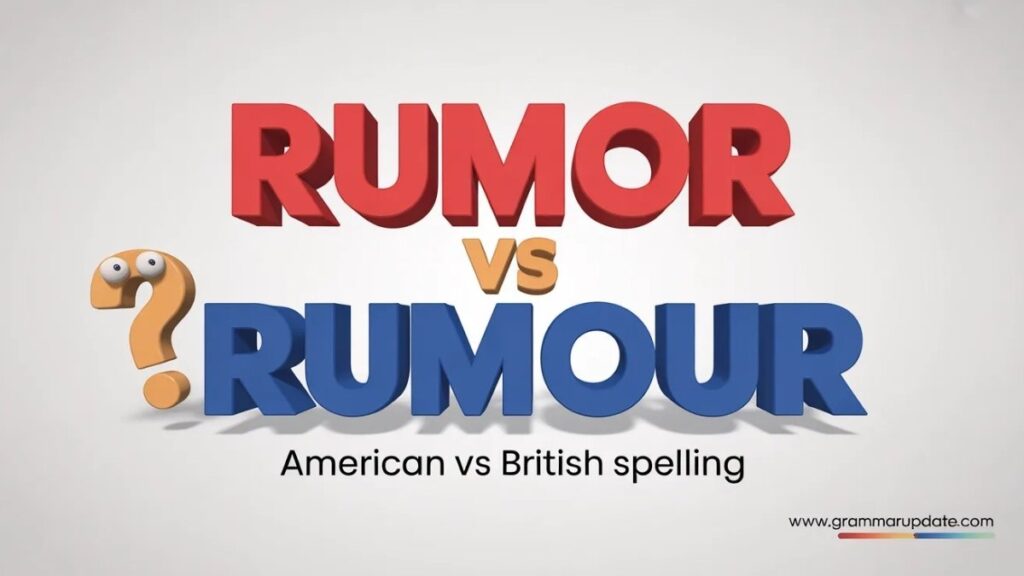
The confusion between rumor vs rumour is one of those small English spelling differences that quietly causes big mistakes in writing. At first glance, it feels like there must be a “right” and “wrong” version, which leads many writers to second-guess themselves or overthink simple sentences. In reality, both spellings are correct, but they belong to different English systems. American English prefers “rumor,” while British English uses “rumour,” and that’s where most of the confusion starts. This article will clear up the spelling rules, meaning, usage patterns, and common mistakes so you can write confidently without mixing styles or losing clarity in your communication.
Rumor vs Rumour Quick Answer

The fastest way to clear the confusion is to connect spelling with region.
- “Rumor” is the standard American English spelling
Example: The rumor about the new policy spread across the office within hours. - “Rumour” is the standard British English spelling
Example: The rumour about the new policy spread across the office within hours.
| Spelling | Region | Status | Meaning |
|---|---|---|---|
| rumor | United States | Correct | Unconfirmed information |
| rumour | UK, Commonwealth countries | Correct | Unconfirmed information |
The meaning remains identical in both forms, which is why the confusion is purely visual, not linguistic.
Meaning of Rumor vs Rumour in English
Both spellings describe the same concept: information that is not officially confirmed but is widely circulated among people.
A rumor or rumour usually spreads through conversation, media, or digital platforms before facts are verified. It can be true, partly true, or completely false, but the defining feature is lack of confirmation at the time it spreads.
- A rumor is unverified information shared informally among people
Example: The rumor about the merger caused panic among employees. - A rumour carries the same meaning in British English usage
Example: The rumour about the merger caused panic among employees.
| Term | Meaning | Context |
|---|---|---|
| rumor | unverified information | US English |
| rumour | unverified information | UK English |
The semantic meaning does not change at all. Only spelling conventions differ.
Fix common more word mistakes in English
Realize vs Realise Which is Correct and Usage?
Why Rumor and Rumour Are Spelled Differently
The spelling difference is rooted in the evolution of English across regions.
American English underwent spelling simplification reforms in the 18th and 19th centuries, most notably influenced by Noah Webster. The goal was to make English spelling more phonetic and efficient. This led to the removal of certain letters, including the “u” in words like rumor.
British English, however, preserved older spellings influenced by Latin and French origins. These historical spellings include the “u” that American English later dropped.
- American English simplified spelling for efficiency
Example: rumor replaces rumour for consistency in US writing - British English preserved traditional spelling forms
Example: rumour retains the historical “u” for consistency in UK writing
| Style | Characteristic | Example |
|---|---|---|
| US English | simplified spelling system | rumor |
| UK English | traditional spelling system | rumour |
This is part of a broader pattern of spelling variations in English across dialects.
Learn the difference between tricky more English words
Authorization vs Authorisation Which is Correct?
Rumor vs Rumour Difference in Real Usage
In practical writing, the difference is not about meaning but about audience expectation.
American newspapers, websites, and academic institutions consistently use “rumor.” British and Commonwealth publications consistently use “rumour.” Mixing both forms in a single document is considered inconsistent in professional writing.
- American English usage follows simplified spelling rules
Example: The rumor was later confirmed by officials. - British English usage follows traditional spelling rules
Example: The rumour was later confirmed by officials.
| Feature | Rumor | Rumour |
|---|---|---|
| Grammar role | noun | noun |
| Usage region | US English | UK English |
| Meaning | identical | identical |
Learn the difference between tricky more English words
Smoky vs Smokey Differences and Correct Usage
Grammar and Word Forms of Rumor vs Rumour

Both versions behave identically in grammar. They function as nouns and follow standard English sentence structure rules.
A rumor can act as a subject or object in a sentence. The same applies to rumour in British English.
The verb forms also follow the same regional pattern. American English uses “rumored,” while British English uses “rumoured.”
- Rumor functions as a noun in American English sentences
Example: The rumor turned out to be false after investigation. - Rumour functions the same way in British English sentences
Example: The rumour turned out to be false after investigation.
| Form | US English | UK English |
|---|---|---|
| noun | rumor | rumour |
| verb form | rumored | rumoured |
There is no grammatical difference between the two systems.
Learn how to use confusing more words correctly
Treet vs Treat Spelling Confusion and Usage
Usage in Modern Communication
In modern communication, spelling choice depends heavily on audience and platform.
News organizations maintain strict regional spelling consistency. Academic writing follows style guides based on location. Digital content creators often adjust spelling based on SEO targeting.
- American media consistently uses “rumor” in headlines and reporting
Example: Officials denied the rumor immediately. - British media consistently uses “rumour” in reporting and analysis
Example: Officials denied the rumour immediately.
| Context | US English | UK English |
|---|---|---|
| Journalism | rumor | rumour |
| Academic writing | rumor | rumour (UK institutions) |
| Business writing | depends on audience | depends on audience |
The key principle is audience alignment rather than universal correctness.
Why Rumor Looks Incorrect to Some Readers
The perception of correctness often depends on exposure. Readers trained in British English naturally expect the “u” in words like colour, favour, and rumour. Removing it makes the word feel unfamiliar.
American readers experience the opposite reaction. The “u” appears unnecessary or foreign because it is not part of their standard spelling system.
- British readers associate “rumour” with correctness due to traditional spelling patterns
Example: colour, honour, rumour feel consistent together - American readers associate “rumor” with correctness due to simplified spelling norms
Example: color, honor, rumor feel consistent together
| Perception | Cause |
|---|---|
| UK spelling preference | historical retention of “u” |
| US spelling preference | spelling simplification |
This is a psychological effect shaped by language exposure.
Learn the difference between tricky more English words
Phoenix vs Pheonix Difference and Usage
Spread Rumors Meaning and Social Behavior
The phrase “spread rumors” refers to the circulation of unverified information among people through communication channels.
Rumors often spread when information is unclear, incomplete, or emotionally engaging. Social behavior plays a major role in how quickly rumors travel across groups.
- People spread rumors when information is uncertain or intriguing
Example: Employees spread a rumor about organizational changes - Emotional intensity increases rumor transmission speed
Example: Fear-based rumors spread faster than neutral information
| Factor | Effect on Spread |
|---|---|
| uncertainty | increases sharing |
| emotional impact | increases speed |
This connects to communication studies and misinformation research.
Learn how to use confusing more words correctly
Tapping vs Taping Difference and Correct Usage
Rumor vs Gossip vs Myth
Although often used interchangeably, these terms have different meanings.
A rumor is unverified information. Gossip is informal conversation, often about personal matters. A myth is a traditional story or belief that may not be factually accurate.
- Rumor refers to unconfirmed information circulating among people
Example: The rumor about layoffs was incorrect - Gossip refers to informal personal talk
Example: Office gossip often spreads quickly
| Term | Meaning |
|---|---|
| rumor | unverified information |
| gossip | personal informal talk |
| myth | traditional or cultural belief |
Plural Forms and Variations
The plural form also follows regional spelling rules.
American English uses “rumors,” while British English uses “rumours.” The same rule applies to related verb forms like “rumored” and “rumoured.”
- Rumors is used in American English writing
Example: Rumors about the company were false - Rumours is used in British English writing
Example: Rumours about the company were false
| Singular | Plural US | Plural UK |
|---|---|---|
| rumor | rumors | rumours |
Consistency across all forms is essential in professional writing.
Learn how to use confusing more words correctly
Flys vs Flies Correct Spelling and Common Mistakes
Professional Writing and Consistency Rule
In formal writing, consistency matters more than preference. Writers must choose one spelling system and apply it throughout the entire document.
- Writers should stick to one regional spelling system throughout content
Example: Using “rumor” consistently in a US article - Brands must align spelling with target audience expectations
Example: UK websites consistently use “rumour”
| Rule | Importance |
|---|---|
| consistency | prevents confusion |
| audience alignment | improves readability |
Real-World Usage in Media and Communication
Different platforms apply different spelling rules depending on audience.
Social media often mixes both spellings due to global participation. Journalism maintains strict regional standards. Business communication follows brand and audience consistency rules.
- Social media content often includes mixed spelling due to global users
Example: posts may contain both rumor and rumour - Newspapers follow strict regional spelling conventions
Example: UK papers consistently use rumour
| Platform | Spelling Behavior |
|---|---|
| social media | mixed usage |
| journalism | region-specific |
Learn how to use confusing more words correctly
Convertor vs Converter Which Spelling Is Correct?
Psychological Understanding of Rumors
Rumors spread due to human cognitive and social behavior patterns.
People tend to share information when they are uncertain or emotionally affected. This creates a chain reaction where unverified information spreads rapidly before being corrected.
- Uncertainty increases likelihood of sharing information
Example: unclear news leads to rumor circulation - Emotional reactions accelerate rumor transmission
Example: alarming rumors spread faster than neutral facts
| Cause | Behavioral Effect |
|---|---|
| uncertainty | increased sharing |
| emotion | faster spread |
Learn the difference between tricky more English words
Togather vs Together Which Is the Correct Word to Use?
Practice Session rumor vs rumour

Fill in each blank with the correct form: rumor / rumour / rumors / rumours
- The __________ about the new policy spread quickly through the office.
- In American English, the correct spelling is __________.
- British newspapers often report political __________.
- Nobody could confirm the __________ about the celebrity.
- The __________ turned out to be completely false.
- She heard a strange __________ about the company merger.
- Social media is full of unverified __________.
- The manager denied the __________ immediately.
- In the UK, people usually write __________ instead of rumors.
- The __________ caused confusion among students.
- There were many __________ circulating online yesterday.
- He started a false __________ without evidence.
- The press office addressed all the __________ quickly.
- It was just a __________, not confirmed news.
- American English prefers the spelling __________ in all official documents.
- The __________ spread faster than the truth.
- Journalists must verify __________ before publishing.
- The town was full of wild __________ about the incident.
- The __________ was finally proven incorrect.
- People often believe __________ without checking facts.
- The article clarified several online __________.
- She laughed at the ridiculous __________ going around school.
- In British English, __________ is the standard spelling.
- The __________ created unnecessary panic in the company.
- Both “rumor” and “rumour” mean unverified __________.
Answer Key
- rumor / rumour
- rumor
- rumours
- rumor / rumour
- rumor / rumour
- rumor / rumour
- rumors / rumours
- rumor / rumour
- rumours
- rumor / rumour
- rumors / rumours
- rumor / rumour
- rumors / rumours
- rumor / rumour
- rumor
- rumor / rumour
- rumors / rumours
- rumors / rumours
- rumor / rumour
- rumors / rumours
- rumors / rumours
- rumors / rumours
- rumour
- rumor / rumour
- information
Here’s a trusted source for clear word meanings:
FAQs
Is it spelled rumor or rumour?
Both spellings are correct. “Rumor” is used in American English, while “rumour” is used in British English and most Commonwealth countries. The meaning is the same in both cases.
How do Canadians spell rumor?
Canadian English generally follows British spelling conventions, so “rumour” is more common in formal writing. However, “rumor” is also understood and sometimes used, especially in informal or digital content.
How do you pronounce rumour?
“Rumour” is pronounced exactly the same as “rumor.” It sounds like ROO-mer /ˈruː.mər/. The difference is only in spelling, not pronunciation.
Which words do Americans spell differently?
American English often simplifies British spellings by removing letters like “u” or shortening endings. Common examples include color (colour), honor (honour), center (centre), and rumor (rumour).
How do Brits spell rumors?
In British English, the plural form is “rumours.” The singular is “rumour,” and the plural simply adds “s.”
Why did Americans change spelling?
American spelling reforms were influenced by Noah Webster, who aimed to simplify English and make spelling more consistent and phonetic. This led to changes like “rumor” instead of “rumour.”
What’s the most misspelled word in America?
There is no single official answer, but commonly misspelled words in American English include “definitely,” “separate,” and “receive.” Confusions like “rumor vs rumour” also appear frequently among learners and writers.
Fix common more word mistakes in English
Shinny vs Shiny Which Spelling Is Correct?
Conclusion
The confusion around rumor vs rumour is really just English playing a harmless trick on writers. One letter changes, but the meaning never does. There is no hidden grammar rule waiting to catch you out. American English drops the “u,” while British English keeps it, and that is the entire story.
Once you understand this, the spelling stops feeling like a mistake and starts feeling like a choice. Most errors happen when people unknowingly mix both styles in the same writing, not because either version is wrong. So the simple fix is consistency. Pick one system, stick with it, and stop overthinking every “u” you see. English is flexible here, not fussy, and your writing will instantly look cleaner and more confident when you treat it that way.

Jhon AJS, the creative mind behind Grammar Update, is an experienced blogger passionate about simplifying English grammar. He focuses on explaining confusing word vs word differences, grammar rules, punctuation, and sentence structure in a clear and practical way. Through easy to understand guides and examples, Jhon helps readers improve their writing and communicate with confidence. With years of blogging experience, he continues to share helpful insights that make learning grammar simple, useful, and accessible for everyone.