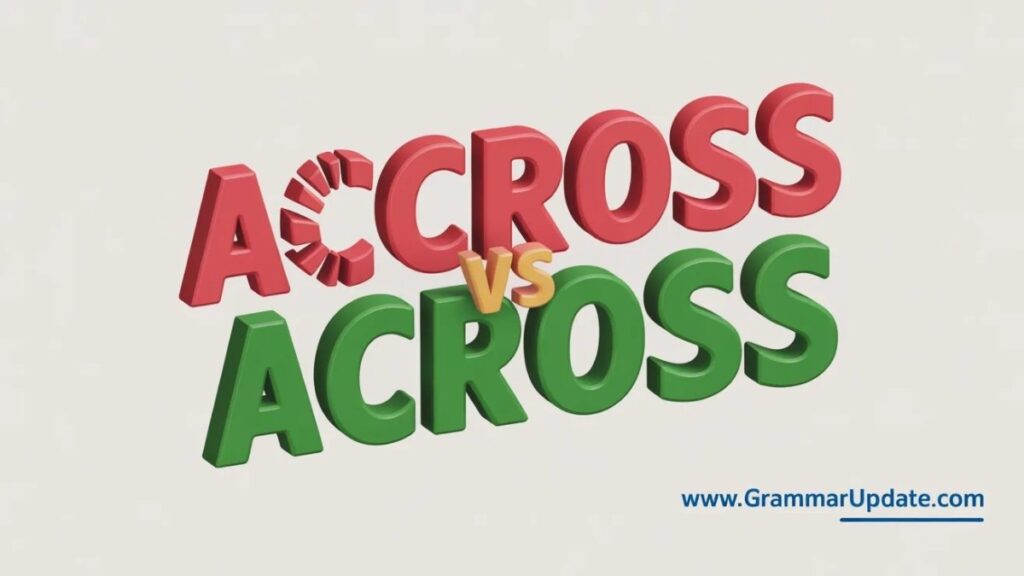
English has a talent for making simple things oddly confusing. Take the classic dilemma: is it Accross vs Across? That extra “c” sneaks in like an uninvited guest, turning confident writing into a quiet grammar slip. The accross vs across mix-up appears more often than you’d expect, even in polished content. It’s a small mistake, yet it can make your writing look less precise than it really is. The good news is that this isn’t a tricky rule buried in a grammar book. Once you understand why “across” is correct, you’ll catch the error instantly and write with clarity, confidence, and zero second guessing.
The Correct Spelling Explained
The confusion around correct spelling accross or across comes up more often than you’d expect. It shows up in casual writing, academic work, and even professional communication.
There’s no gray area here. Only one version is correct.
- Across is the only accepted spelling in English
- Accross is always considered a spelling error
| Word | Correct | Usage | Status |
|---|---|---|---|
| Across | Yes | Standard English | Valid |
| Accross | No | None | Incorrect |
If you’re wondering which is correct accross or across, you now have a definitive answer. Across wins every time.
What Does Across Mean in English?
Understanding the word itself helps eliminate confusion. When people search for what does across mean or across definition and examples, they’re trying to anchor the spelling in meaning.
“Across” describes movement, position, or coverage from one side to another.
- It often shows movement across space or distance
- It can also describe distribution over an area or group
| Usage Type | Meaning | Example |
|---|---|---|
| Movement | From one side to another | Walk across the road |
| Position | On the opposite side | The shop is across the street |
| Distribution | Spread over | News spread across the city |
This is the core across word meaning in English. Every correct usage connects back to that idea of spanning or crossing.
More Confusing Words Made Simple
Commit vs Comit Correct Spelling and Usage
Accross vs Across Meaning Explained
Many assume both words have slightly different meanings. That’s not the case.
When you search for accross vs across meaning explained, you’ll find one key truth: only one word carries meaning.
- Across has a clear definition and usage
- Accross has no meaning in standard English
| Term | Meaning Exists | Recognized | Example |
|---|---|---|---|
| Across | Yes | Yes | Walk across the field |
| Accross | No | No | Not applicable |
So the difference between accross and across isn’t subtle. One is real. The other isn’t.
Why Is Across Spelled With One “C”?
This question—why is across spelled with one c only reveals how English spelling can confuse even experienced writers.
The word comes from combining “a-” and “cross.” There’s no grammatical reason to double the “c.”
- The root word is “cross,” not “ccross”
- English spelling rules don’t apply uniformly here
| Component | Meaning | Contribution |
|---|---|---|
| a- | on/in | Adds direction |
| cross | to pass over | Core meaning |
| across | combined form | Final word |
This explains the accross vs across spelling difference clearly.
Why Do People Spell Across Wrong?
If “across” is so straightforward, why do people keep writing “accross”? The answer lies in patterns and habits.
This falls under common spelling mistakes across English confusion words.
- People assume double consonants based on similar words
- Fast typing leads to extra letters slipping in unnoticed
| Cause | Explanation | Result |
|---|---|---|
| Pattern confusion | Words like “account” influence spelling | Adds extra “c” |
| Pronunciation | Sounds unclear in speech | Misinterpretation |
| Typing speed | Less attention to detail | Mistakes |
This explains why queries like accross vs across reddit appear so often.
More Confusing Words Made Simple
Transferred vs Transfered, Which Is Correct?
Accross vs Across Grammar Rules Explained
To understand accross vs across grammar, you need to look at how “across” functions in sentences.
It works as both a preposition and an adverb.
- As a preposition, it connects objects and direction
- As an adverb, it describes movement independently
| Grammar Role | Function | Example |
|---|---|---|
| Preposition | Shows relation | Walk across the bridge |
| Adverb | Describes action | She moved across |
This breakdown simplifies the across grammar explanation.
How to Use Across in a Sentence Correctly
Learning how to use across in a sentence becomes easier when you see patterns in real examples.
Correct usage always reflects movement or position.
- Use it when describing movement from one side to another
- Use it when showing coverage or spread
| Sentence Type | Example | Correct |
|---|---|---|
| Movement | He ran across the field | Yes |
| Position | The bank is across the street | Yes |
| Incorrect | He ran accross the field | No |
These across examples in sentences make the distinction obvious.
Across vs Through vs Over: Key Differences
Many learners confuse similar directional words. Understanding them improves clarity.
- “Across” refers to surface-level movement
- “Through” implies movement inside something
| Word | Meaning | Example |
|---|---|---|
| Across | Surface crossing | Walk across the road |
| Through | Inside passage | Walk through the tunnel |
| Over | Above movement | Jump over the fence |
This comparison answers across vs through vs over difference explained clearly.
More Confusing Words Made Simple
Naive vs Nieve, Which Spelling Is Correct and Usage?
Synonyms and Similar Words to Across
When exploring accross vs across synonym, it’s helpful to know alternatives.
Still, context matters. Not every synonym works in every sentence.
- Some words replace across in movement contexts
- Others work better for distribution meanings
| Synonym | Use Case | Example |
|---|---|---|
| Over | Movement | Walk over the bridge |
| Through | Passage | Go through the forest |
| Throughout | Distribution | Spread throughout the region |
This resolves accross vs across oxford dictionary meaning.
Across Spelling UK vs US: Any Difference?
Some words change spelling between regions. This one doesn’t.
- UK English uses across
- US English also uses across
| Region | Spelling | Variation |
|---|---|---|
| UK | Across | None |
| US | Across | None |
| Global | Across | Standard |
So across spelling UK remains unchanged.
Is Accross Ever Correct to Use?
This question appears often: is accross ever correct to use.
The answer remains absolute.
- It is never correct in standard English
- It does not appear in any recognized dictionary
| Scenario | Acceptable | Reason |
|---|---|---|
| Academic writing | No | Incorrect spelling |
| Professional use | No | Reduces credibility |
| Informal use | No | Still wrong |
This confirms is accross correct spelling in English it is not.
More Confusing Words Made Simple
Scoup vs Scoop Differences and Usage
The Impact of Spelling Errors on Writing
Spelling errors may seem small, but they carry weight.
- They reduce reader trust and professionalism
- They distract from your main message
| Impact Area | Effect | Outcome |
|---|---|---|
| Credibility | Lower trust | Negative impression |
| Clarity | Disruption | Reader confusion |
| Professionalism | Weakened | Less authority |
This is why fixing common grammar mistakes in English writing matters.
More Confusing Words Made Simple
Manuel vs Manual When to Use Each One in Writing
Practice Session
Fill in the Blanks
Complete each sentence with the correct spelling: across
- She walked ______ the bridge to reach the other side.
- The news spread ______ the entire city within minutes.
- He came ______ an old photo while cleaning his room.
- We traveled ______ three different countries last summer.
- The river flows ______ the valley and reaches the sea.
Multiple Choice Questions
Choose the correct option: across or accross
- She ran ______ the street to catch the bus.
a) accross
b) across - The message was shared ______ the company very quickly.
a) accross
b) across - I found my keys ______ the table this morning.
a) accross
b) across - They moved ______ the border at night.
a) accross
b) across - The children played ______ the field until sunset.
a) accross
b) across
Here’s a trusted source for clear word meanings:
FAQs
Is it “accross” or “across”?
The correct spelling is across. The form “accross” is always incorrect in standard English writing.
Why do people spell “across” with two c’s?
Most people get confused because English often doubles consonants in words like account or access. That pattern tricks the brain, but “across” does not follow it.
Is “accross” ever correct in any form of English?
No. “Accross” is not recognized in dictionaries or formal writing. It is always considered a spelling mistake.
What does “across” mean in simple terms?
It means moving from one side to another or being positioned on the opposite side of something, like a street, river, or area.
Can “across” be used in different ways in a sentence?
Yes. It can work as both a preposition and an adverb. For example, She walked across the road or He looked across.
Why is spelling “across” important?
Correct spelling improves clarity and professionalism. Even small mistakes like “accross” can make writing look careless.
How can I stop making this mistake?
A simple trick is to remember: “across has one c because you only cross once.” Repetition and spell check tools also help reinforce it.
Final Takeaway
To bring everything together, the confusion around accross vs across is one of those small but surprisingly persistent English mistakes. It often slips in unnoticed, not because the rule is difficult, but because our brains tend to follow familiar spelling patterns. Still, the correct choice is always simple: “across” is right, and “accross” is incorrect in all standard English usage.
Once you understand this, the uncertainty disappears completely. You stop second-guessing yourself and start writing with more confidence and precision. It’s a small correction, but it makes a noticeable difference in clarity and professionalism. From here on, every time you write it, you’ll get it right without hesitation—and that extra “c” won’t stand a chance.

Jhon AJS, the creative mind behind Grammar Update, is an experienced blogger passionate about simplifying English grammar. He focuses on explaining confusing word vs word differences, grammar rules, punctuation, and sentence structure in a clear and practical way. Through easy to understand guides and examples, Jhon helps readers improve their writing and communicate with confidence. With years of blogging experience, he continues to share helpful insights that make learning grammar simple, useful, and accessible for everyone.