A missing letter can cause a surprisingly tricky spelling mistake. That’s exactly what happens with aquire. It looks close to the correct word, but one important letter is missing. So, should you write acquire vs aquire? The correct spelling is acquire. Aquire is simply a common spelling mistake. In this guide, you’ll learn the acquire vs aquire spelling, meaning, pronunciation, grammar, and proper usage in clear, simple language. You’ll also see easy examples that show how acquire works in real sentences. By the end, you’ll know exactly when to use acquire and how to avoid this sneaky spelling mistake in your writing.
quick answer
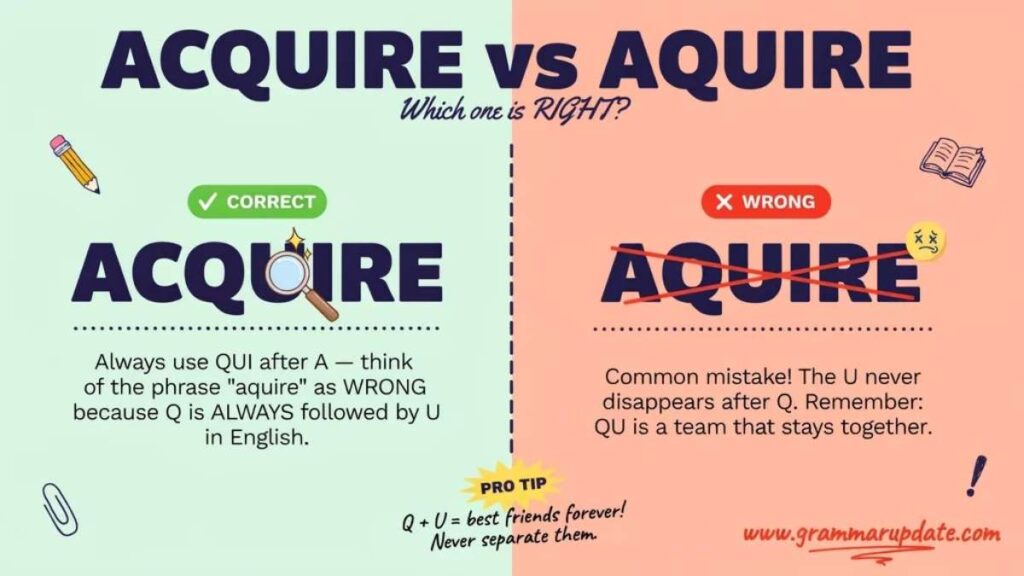
The correct spelling is acquire.
Aquire is an incorrect spelling of acquire. It is usually created when someone leaves out the c in the middle of the word.
Here is the basic difference:
| Word | Correct spelling? | Meaning |
|---|---|---|
| Acquire | Yes | To get, gain, obtain, or develop something |
| Aquire | No | Incorrect spelling of acquire |
The difference between acquire vs aquire is therefore not a difference in meaning. It is a difference between the correct spelling and a spelling error.
If you are wondering whether to write acquire vs aquire, choose acquire every time.
The correct spelling of acquire is:
A-C-Q-U-I-R-E
The incorrect version is:
A-Q-U-I-R-E
That missing c is the entire problem.
Learn the difference between confusing more English words
Atheist Vs Athiest Which Spelling Is Correct?
Is Aquire a Word?
No. Aquire is not the standard English spelling of a word.
You may occasionally see aquire in emails, social media posts, student writing, online comments, or other informal communication. Its appearance in writing does not make it correct. It is simply a common spelling mistake for acquire.
For example:
Incorrect: She wants to aquire new skills.
Correct: She wants to acquire new skills.
The mistake is easy to understand because the c in acquire is not strongly noticeable when the word is pronounced. English spelling does not always match pronunciation perfectly, so relying only on sound can lead to mistakes.
If you are checking whether aquire is a word, the answer is no in standard English. The correct English word is acquire.
Acquire Definition and Meaning
The acquire definition is relatively simple: to get, gain, obtain, develop, or come into possession of something.
However, acquire has a wider range of uses than the everyday word get.
You can acquire something physical, such as a house or a collection. You can also acquire something less tangible, such as knowledge, experience, confidence, or a habit.
For example:
She acquired a new laptop for work.
He acquired valuable experience during his internship.
The company acquired a smaller competitor.
Children acquire language naturally as they grow.
She acquired the habit of checking her email every morning.
In each sentence, acquire describes the process of gaining or obtaining something.
Learn the difference between confusing more English words
Believe Vs Belive Which one Is Correct?
What Does Acquire Mean?
The acquire meaning changes slightly depending on the context, but the central idea remains the same: you gain, obtain, or develop something.
Acquire Can Mean Get Something
In many situations, acquire simply means to get something.
For example:
The museum acquired several rare paintings.
The company acquired new equipment.
He acquired a second-hand car.
The word sounds more formal than get, but the basic idea is similar.
You could say, “She got a new collection of books,” in everyday conversation. In a formal article, however, “She acquired a new collection of books” may sound more appropriate.
Acquire Can Mean Gain Knowledge
Acquire can describe the process of gaining knowledge or information.
For example:
Students acquire knowledge through study and experience.
She acquired a great deal of information during her research.
The course helped participants acquire new knowledge.
Here, acquire does not mean physically receiving something. It describes gradually gaining something through learning or experience.
Acquire Can Mean Learn a Skill
You can also acquire a skill.
For example:
He acquired strong communication skills during college.
She acquired the technical skills needed for the position.
You can acquire skills through practice, education, training, or experience.
This is one reason acquire appears frequently in educational and professional writing.
Acquire Can Mean Develop a Habit
Acquire can also describe something that develops over time.
For example:
He acquired the habit of waking up early.
She acquired an interest in photography.
The child acquired a taste for spicy food.
In these examples, the person did not simply receive something from someone else. The quality, habit, or preference developed gradually.
Acquire Can Mean Obtain Ownership
Acquire is often used when someone gains ownership or control of something.
For example:
The company acquired a smaller business.
She acquired ownership of the property.
The investor acquired additional shares.
This use is especially common in business, finance, and legal writing.
Learn the difference between confusing more English words
Solicited vs Unsolicited Differences and Usage
Is Acquire a Verb?
Yes. Acquire is a verb.
The acquire verb meaning is to get, gain, obtain, develop, or come into possession of something.
For example:
They acquired new equipment.
She acquired valuable experience.
The company acquired another business.
The base form is acquire. Its other common forms include acquires, acquired, and acquiring.
| Form | Example |
|---|---|
| Acquire | They acquire new customers every month. |
| Acquires | The company acquires smaller businesses. |
| Acquired | She acquired valuable experience. |
| Acquiring | He is acquiring new skills. |
The related noun is acquisition.
For example:
The company announced the acquisition of a smaller competitor.
Notice the spelling connection between acquire and acquisition. Remembering this relationship can make the correct spelling easier to recognize.
Acquire Grammar and Usage
Acquire follows the normal grammar patterns of a regular English verb.
The base form is acquire.
The third-person singular form is acquires.
The past tense and past participle are acquired.
The present participle is acquiring.
For example:
I acquire new skills through practice.
She acquires knowledge quickly.
He acquired the property last year.
They are acquiring new customers.
One spelling detail deserves attention: acquiring drops the final e before adding -ing.
Acquire becomes acquiring, not acquireing.
This is another place where writers sometimes make mistakes.
Common Forms of Acquire
Understanding the different forms of acquire can help you recognize the word in different types of writing.
Acquire is the base form.
Example: You can acquire new skills.
Acquires is used with he, she, it, or a singular noun in the present tense.
Example: The company acquires new customers every year.
Acquired is the past tense and past participle.
Example: She acquired extensive experience in the field.
Acquiring is the present participle.
Example: The business is acquiring new equipment.
Acquisition is the related noun.
Example: The acquisition changed the company’s strategy.
These forms may look different at first, but they all connect to the same word family.
Learn the difference between confusing more English words
Acceptable Vs Aceptable Which one Is Correct?
Why Do People Spell Acquire as Aquire?
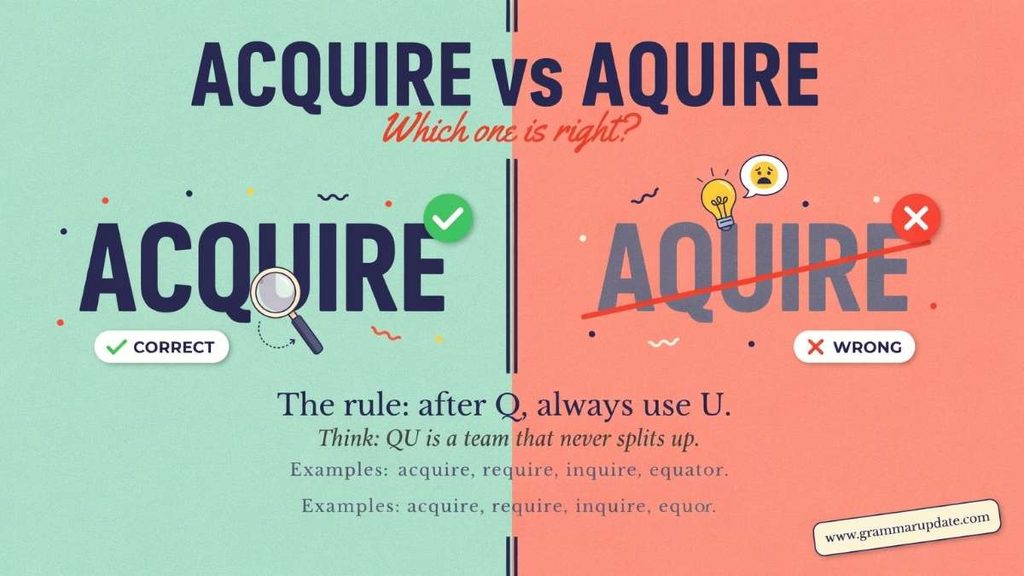
The aquire spelling mistake is common because acquire does not sound exactly the way it looks.
When people pronounce acquire, the c is not especially noticeable. As a result, someone may hear something closer to “uh-quire” and naturally type aquire.
Another reason is visual familiarity. English contains many words beginning with similar patterns, and writers sometimes remove letters that seem unnecessary.
Fast typing can also cause the problem. When someone is writing quickly, the c may simply disappear.
For example, someone might type:
I need to aquire more information.
The writer probably knows the intended word. The problem is simply the missing c.
English spelling contains many words where pronunciation does not provide a perfect guide to spelling. Acquire is one of them.
Acquire Vs Aquire Difference
The acquire vs aquire difference is straightforward.
Acquire is the correct English word.
Aquire is an incorrect spelling.
There is no separate definition for aquire, and there is no special situation where aquire becomes the correct alternative.
For example:
Incorrect: The company plans to aquire new assets.
Correct: The company plans to acquire new assets.
Incorrect: She hopes to aquire more experience.
Correct: She hopes to acquire more experience.
Incorrect: He acquired a new skill.
Correct: He acquired a new skill.
The first two incorrect sentences contain the same spelling mistake. The last sentence uses the correct form.
Learn the difference between tricky grammar more words
Acquaintance Vs Acquaintence Which one Is Correct?
Acquire Vs Aquire Meaning
The acquire vs aquire meaning question can be answered in one sentence: acquire has a standard English meaning, while aquire is simply an incorrect spelling.
Acquire can mean to get, gain, obtain, develop, or come into possession of something.
Aquire does not have a separate meaning.
So if you are looking for the acquire word meaning, remember the central idea of gaining something.
You can acquire:
Knowledge
Experience
Skills
Information
Property
Assets
Ownership
A habit
An interest
A reputation
A language
A taste or preference
The exact meaning depends on what follows the verb.
Learn the difference between tricky grammar more words
Envisage vs Envision difference and usage?
Acquire Vs Aquire Pronunciation
Pronunciation can explain why this spelling mistake happens so often.
Acquire is generally pronounced with the stress on the second syllable, roughly like “uh-KWYR.”
The c does not stand out as a separate sound. That can make the spelling harder to remember.
This is a good example of why pronunciation alone cannot always tell you how to spell an English word.
If you are unsure, do not rely only on how acquire sounds. Remember the written pattern:
AC + QUIRE = ACQUIRE
That small visual trick can save you from repeatedly making the same spelling mistake.
How Do You Spell Acquire?
If you are asking, “How do you spell acquire?” the answer is:
A-C-Q-U-I-R-E
A useful way to break it down is:
AC + QUIRE
The c comes before quire.
You can also connect acquire with acquisition. Both words contain the important c.
Acquire
Acquired
Acquiring
Acquisition
Seeing the word family together can make the spelling easier to remember.
Learn the difference between tricky grammar more words
Holistic vs Wholistic Which one Is Correct?
How Do You Spell Aquire?
If you are asking, “How do you spell aquire?” there is an important correction to make.
Aquire is not the correct spelling.
The correct spelling is acquire.
A quick comparison makes the difference obvious:
Aquire — incorrect
Acquire — correct
If you catch yourself writing aquire, stop and add the c.
Acquire in a Sentence
Seeing acquire in context makes its meaning much easier to understand.
Here are several acquire sentence examples:
She hopes to acquire new skills this year.
The company acquired a smaller competitor.
He acquired valuable experience during his internship.
Students acquire knowledge through reading and practice.
The museum acquired several historical documents.
She acquired a taste for traditional food while traveling.
The business is acquiring new equipment.
He acquired ownership of the property last month.
The child acquired a second language at an early age.
The athlete acquired greater confidence after months of training.
These examples show why acquire is such a flexible word. It can describe getting something immediately, but it can also describe something that develops gradually.
Acquire Vs Get
Acquire and get can have similar meanings, but they do not always sound the same.
Get is extremely common in everyday English. It is short, natural, and flexible.
Acquire is more formal and often appears in professional, academic, business, legal, and technical writing.
For example:
Everyday: I need to get some experience.
More formal: I need to acquire some experience.
Everyday: She got a new skill.
More formal: She acquired a new skill.
Everyday: The company got a new building.
More formal: The company acquired a new building.
The words are not perfect substitutes in every sentence. Get has many meanings that acquire does not have.
For instance, you can say:
1.Get up.
2.Get ready.
3.Get angry.
4.Get tired.
You cannot replace get with acquire in those expressions.
Acquire Vs Obtain
Acquire and obtain are closely related, but there is a subtle difference in emphasis.
Obtain often focuses on successfully getting or securing something.
Acquire can focus more broadly on gaining, developing, accumulating, or coming into possession of something.
For example:
She obtained permission to enter the building.
He acquired extensive knowledge through years of study.
The company obtained a license.
The company acquired another business.
In the first examples, obtain emphasizes securing something. In the second, acquire suggests gaining or developing something over time.
The acquire vs obtain meaning depends heavily on context.
Acquire Vs Inquire
The Acquire and inquire look somewhat similar, but their meanings are completely different.
Acquire means to get, gain, or obtain something.
Inquire means to ask for information.
For example:
She wants to acquire new skills.
She wants to inquire about the course.
The company acquired the property.
The customer inquired about the price.
A useful memory trick is simple:
Acquire = get
Inquire = ask
Do not confuse these two words simply because they share a similar ending.
Acquire Synonyms
The best acquire synonym depends on the sentence.
Common acquire synonyms include get, obtain, gain, secure, attain, develop, learn, purchase, receive, and accumulate.
However, these words are not always interchangeable.
Acquire knowledge.
Gain knowledge.
Acquire experience.
Gain experience.
Acquire property.
Purchase property.
Acquire ownership.
Obtain ownership.
Acquire a skill.
Learn a skill.
The meaning may remain similar, but the tone and emphasis can change.
For example, purchase specifically suggests buying something, while acquire can refer to obtaining something in many different ways.
Learn the difference between tricky grammar more words
Cocoon vs Cacoon Which one Is Correct?
Common Phrases With Acquire
Acquire appears naturally with many nouns.
Some common combinations include acquire knowledge, acquire skills, acquire experience, acquire information, acquire a habit, acquire a reputation, acquire property, acquire assets, acquire ownership, acquire a company, acquire a business, and acquire a language.
These combinations are useful because they show how flexible the word can be.
For example:
Students acquire knowledge.
Employees acquire skills.
Professionals acquire experience.
Companies acquire assets.
Investors acquire shares.
Children acquire language.
People can acquire habits.
The word remains the same, but its exact meaning becomes clearer from the noun that follows it.
Acquire in Business and Finance
Acquire is particularly common in business and finance.
When one company buys or takes control of another company, writers often use acquire.
For example:
The technology company acquired a smaller startup.
The business acquired a competing brand.
The corporation acquired several new assets.
Investors acquired additional shares.
In this context, acquire often has a more precise and professional tone than get.
A business report would usually say:
The company acquired a competitor.
rather than:
The company got a competitor.
Acquire can also refer to property, assets, shares, ownership, customers, technology, or other valuable resources.
Learn the difference between tricky grammar more words
Unpure vs Impure Which one Is Correct?
Acquire in Education and Everyday Life
The Acquire is not limited to formal business writing.
You can use it when talking about learning, personal development, experience, interests, and habits.
For example:
Children acquire language naturally.
Students acquire knowledge through education.
You can acquire practical skills through experience.
Travel can help you acquire a deeper understanding of other cultures.
People often acquire habits without realizing it.
Someone may acquire an interest in music after hearing a particular artist.
Someone may acquire confidence after repeatedly practicing a difficult skill.
These uses show an important feature of acquire: the thing you gain does not have to be physical.
Common Acquire Spelling Mistakes
Once you know the correct spelling, several related mistakes become easier to avoid.
| Incorrect | Correct |
|---|---|
| Aquire | Acquire |
| Aquires | Acquires |
| Aquired | Acquired |
| Aquiring | Acquiring |
| Acquireing | Acquiring |
The most common mistake is dropping the c.
Another common mistake occurs when writers add -ing. The correct form is acquiring, not acquireing.
Remember that the final e disappears before -ing:
Acquire → Acquiring
The c stays.
Learn the difference between tricky grammar more words
In Process vs In Progress Difference and usage?
Acquire Correct Spelling A Simple Memory Trick
The easiest way to remember the acquire correct spelling is to divide the word into two parts:
AC + QUIRE
That gives you:
ACQUIRE
The c is right there between a and quire.
Another useful memory connection is acquisition.
Acquire and acquisition belong to the same word family, and both make the c easier to notice.
You can also remember a simple sentence:
“I must acquire the correct spelling.”
The more often you see and use the correct form, the less likely you are to type aquire.
Acquire Usage When Should You Use It?
Use acquire when you want to describe getting, gaining, obtaining, developing, or coming into possession of something.
It works especially well when the thing being gained is knowledge, experience, skill, property, ownership, information, a habit, or an asset.
For casual conversation, get may sound more natural.
For example:
I got some experience working there.
That sounds perfectly normal.
I acquired some experience working there.
That sounds more formal.
Neither sentence is automatically wrong. The better choice depends on the tone and context.
In academic, professional, business, and formal writing, acquire can often provide a more precise tone.
Acquire Vs Aquire Examples
The easiest way to understand the acquire vs aquire spelling difference is to look at real sentence patterns.
Incorrect: She wants to aquire new skills.
Correct: She wants to acquire new skills.
Incorrect: The company plans to aquire another business.
Correct: The company plans to acquire another business.
Incorrect: He aquired valuable experience.
Correct: He acquired valuable experience.
Incorrect: They are aquiring new customers.
Correct: They are acquiring new customers.
Incorrect: Students acquire knowledge through practice.
Correct: Students acquire knowledge through practice.
Notice the pattern. Whenever you see aquire, aquired, or aquiring, check whether the c has disappeared.
Learn the difference between tricky grammar more words
Kaftan vs Caftan Difference and Which one Is Correct?
Practice Session Acquire Vs Aquire
Fill in each blank with the correct form of the word acquire.
- She wants to ______ new skills before starting her career.
- The company plans to ______ a smaller competitor.
- He ______ valuable experience during his internship.
- Students ______ knowledge through reading and practice.
- The museum recently ______ several historical documents.
- She is ______ a better understanding of the subject.
- The business ______ new equipment every few years.
- He hopes to ______ more professional experience.
- The investor ______ additional shares last month.
- Children naturally ______ language as they grow.
- She has ______ a strong interest in photography.
- The company is ______ new customers every month.
- He ______ ownership of the property in 2025.
- You can ______ useful skills through regular practice.
- The organization hopes to ______ more resources.
- She ______ extensive knowledge of the subject during college.
- The business is ______ new technology to improve its services.
- He ______ the habit of exercising every morning.
- The company has ______ several smaller brands.
- Students can ______ valuable experience through internships.
- She wants to ______ a deeper understanding of English grammar.
- The company ______ new clients throughout the year.
- He is ______ the skills necessary for the position.
- The business recently ______ another company.
- Regular practice can help you ______ confidence and experience.
Answers
- acquire
- acquire
- acquired
- acquire
- acquired
- acquiring
- acquires
- acquire
- acquired
- acquire
- acquired
- acquiring
- acquired
- acquire
- acquire
- acquired
- acquiring
- acquired
- acquired
- acquire
- acquire
- acquires
- acquiring
- acquired
- acquire
Here’s a trusted source for clear word meanings:
FAQs
Does aquire mean buy?
No. Aquire is a misspelling of acquire. If you mean “buy,” “obtain,” or “get,” the correct word is acquire.
What’s a better word for acquire?
The best alternative depends on the context. You could use obtain, gain, secure, attain, develop, get, or purchase. For example, “gain experience” sounds natural, while “purchase property” specifically refers to buying it.
When should you use acquire?
Use acquire when you mean to get, gain, develop, or come into possession of something. It works well with knowledge, skills, experience, property, assets, habits, and ownership. The word also fits naturally in formal, academic, and professional writing.
What is the difference between acquire and acquisition?
Acquire is a verb, while acquisition is a noun. You acquire something, but an acquisition is the act or result of acquiring it. For example, “The company acquired a new business” uses the verb, while “The acquisition was completed in June” uses the noun.
Is it acquire vs aquire?
Acquire is the correct spelling. Aquire is a spelling mistake. The correct form contains a c before quire: A-C-Q-U-I-R-E.
What does aquire mean?
Aquire has no standard meaning in English because it is not the correct spelling. In most cases, a writer who uses aquire means acquire.
What does acquire mean?
Acquire means to get, gain, obtain, develop, or come into possession of something. You can acquire knowledge, experience, skills, property, information, habits, or ownership.
What is the opposite of acquire?
The opposite of acquire depends on the context. Common opposites include lose, relinquish, surrender, give away, dispose of, and forfeit. For example, acquiring an asset is generally the opposite of disposing of it.
How can I use acquire in a sentence?
Use acquire when someone gets, gains, develops, or obtains something. For example, “She worked hard to acquire the skills needed for the position.”
Is acquiring the same as buying?
No. Acquiring is broader than buying. Buying means getting something by paying for it, while acquiring can involve learning, developing, receiving, gaining, or purchasing something. You can acquire knowledge through study without buying it.
What can I say instead of acquisition?
Depending on the context, you could use purchase, takeover, procurement, obtaining, gain, or addition. In business writing, “takeover” may work when one company gains control of another, while “purchase” emphasizes a transaction.
What are two types of acquisitions?
Two common types of business acquisitions are asset acquisitions and stock acquisitions. An asset acquisition involves purchasing selected assets of a business. A stock acquisition involves purchasing shares and gaining ownership or control of the company.
What is a fancy word for acquire?
A more formal alternative to acquire is obtain. Other possibilities include procure, secure, attain, and gain. However, the best choice depends on the context and the type of thing being obtained.
Does acquire mean purchase?
Acquire can mean purchase when something is obtained by paying for it, particularly in business or formal writing. However, acquire has a broader meaning than purchase because you can acquire something without buying it.
Is aquire a verb?
No. Aquire is not the correct spelling of an English verb. The correct verb is acquire.
What is an example of acquire?
A simple example is, “The student acquired valuable research skills during the course.” Here, acquired means gained or developed.
What is it called to acquire something?
The act or process of acquiring something is called an acquisition. Acquire is the verb, while acquisition is the related noun.
Are acquisition and acquire the same?
No. They are related words with different grammatical roles. Acquire is a verb, and acquisition is a noun. For example, “The company will acquire the property” uses acquire, while “The acquisition was finalized” uses acquisition.
What does the word “acquire” mean?
Acquire means to get, gain, obtain, develop, or come into possession of something. It can describe both physical possessions and intangible things such as knowledge, skills, experience, and habits.
What do you mean by acquire?
To acquire something means to get or gain it. For example, if you acquire a new skill, you learn or develop that skill through practice, education, or experience.
What does it mean to acquire something?
To acquire something means to obtain it, gain it, develop it, or become its owner. The exact meaning depends on the context in which the word appears.
How do I say acquire?
Acquire is commonly pronounced approximately like “uh-KWIRE,” with the main stress on the second syllable. The pronunciation explains why some people accidentally leave out the c when spelling the word.
What does it mean if you acquire something?
If you acquire something, you have gained, obtained, developed, or come into possession of it. For example, acquiring experience means gaining experience through work, study, or practice.
What does “acquired” mean in simple words?
Acquired simply means “got,” “gained,” or “obtained.” For example, “He acquired new skills” means “He gained new skills.”
What is another word for acquire?
Depending on the sentence, another word for acquire could be get, obtain, gain, secure, attain, develop, learn, or purchase. Each synonym carries a slightly different meaning or tone.
What is a better word than acquired?
A better alternative depends on what you mean. You might use obtained, gained, developed, learned, secured, purchased, or received. For example, “acquired knowledge” can become “gained knowledge,” while “acquired property” can become “purchased property.”
What is another word for acquiring?
Possible alternatives include obtaining, gaining, securing, developing, learning, purchasing, and receiving. “Obtaining” is often a good formal substitute, while “getting” sounds more conversational.
How do you use the word acquire?
Use acquire as a verb when you want to describe getting, gaining, developing, or obtaining something. For example, “Employees can acquire valuable skills through hands-on training.”
What is it called when you acquire something?
The process or act of acquiring something is called an acquisition. For example, if a company acquires another company, the transaction may be described as an acquisition.
What is the noun of acquire?
The noun form related to acquire is acquisition. For example, “The company acquired a new property” can be rewritten as “The acquisition of the property was completed.”
Does acquiring mean buying?
No. Acquiring does not necessarily mean buying. It can refer to getting something through learning, development, inheritance, transfer, receipt, or purchase.
What are the different types of acquiring?
The meaning of acquiring depends on the context. In everyday English, you can acquire knowledge, skills, experience, habits, interests, or possessions. In business, acquiring can involve obtaining assets, shares, technology, customers, or ownership of another company.
Is acquisition a good thing?
An acquisition is not automatically good or bad. Its outcome depends on the circumstances. In business, an acquisition may create growth opportunities, expand market share, or add valuable resources. It can also create costs and integration challenges.
What is the opposite of acquiring?
Possible opposites include losing, relinquishing, surrendering, giving away, selling, and disposing of something. The appropriate antonym depends on the situation. For example, acquiring an asset contrasts with disposing of an asset.
What does “acquisition” mean in simple words?
Acquisition means the act or process of getting or obtaining something. In business, it often refers to one company obtaining ownership or control of another company.
What are the four types of acquisitions?
Four commonly discussed business acquisition structures are asset acquisitions, stock acquisitions, mergers, and consolidations. The exact classification can vary depending on the legal and financial context.
What does “acquire” mean?
Acquire means to get, gain, obtain, develop, or come into possession of something. It can describe physical things, such as property, as well as intangible things, such as knowledge or experience.
What is the antonym for acquire?
Common antonyms for acquire include lose, relinquish, surrender, dispose of, give away, and forfeit. The most accurate choice depends on what is being acquired.
What is to acquire something?
To acquire something means to get, gain, obtain, develop, or become the owner of it. For example, you can acquire a skill through practice or acquire property through a purchase.
Is it aquire or acquire?
It is acquire. Aquire is an incorrect spelling. Remember the c in the middle of the word: A-C-Q-U-I-R-E.
What is a good sentence for acquire?
A clear example is, “You can acquire valuable skills by practicing consistently.” In this sentence, acquire means gain or develop.
What is another name for acquiring?
Depending on the context, another term for acquiring could be obtaining, gaining, securing, developing, purchasing, or receiving. No single synonym works naturally in every situation.
Why does acquired mean?
Acquired means that someone got, gained, obtained, developed, or came into possession of something. It is the past tense and past participle of acquire.
What are the two forms of acquisition?
If you mean two common business acquisition structures, they are asset acquisitions and stock acquisitions. An asset acquisition involves purchasing selected assets, while a stock acquisition involves purchasing ownership interests in a company.
Learn the difference between tricky grammar more words
Covenant vs Contract What’s the Difference?
conclusion
The confusion between acquire vs aquire comes down to one small letter, but that little c can cause a surprisingly big spelling mistake.
Here’s the simple answer: acquire is correct, while aquire is incorrect. There’s no different meaning hiding behind aquire, and it isn’t an alternative spelling. It’s simply a misspelling of acquire.
The good news is that you don’t need a complicated rule to remember it. Just break the word into two parts:
AC + QUIRE = ACQUIRE
That c belongs there, so don’t let it disappear.
Remember that acquire means to get, gain, obtain, develop, or come into possession of something. You can acquire knowledge, acquire new skills, acquire experience, or acquire property. You can even acquire a habit. In other words, acquire covers much more than simply buying something.
There’s also an easy grammar connection to remember. Acquire is the verb, while acquisition is the noun. You acquire something, and the process can be called an acquisition.
So, when you’re stuck between acquire vs aquire, don’t overthink it. Look for the c. If it’s there, you’ve got the correct spelling.
English may enjoy hiding little spelling traps, but this one doesn’t have to fool you. Keep the c, write acquire, and you’re good to go.

Jhon AJS, the creative mind behind Grammar Update, is an experienced blogger passionate about simplifying English grammar. He focuses on explaining confusing word vs word differences, grammar rules, punctuation, and sentence structure in a clear and practical way. Through easy to understand guides and examples, Jhon helps readers improve their writing and communicate with confidence. With years of blogging experience, he continues to share helpful insights that make learning grammar simple, useful, and accessible for everyone.