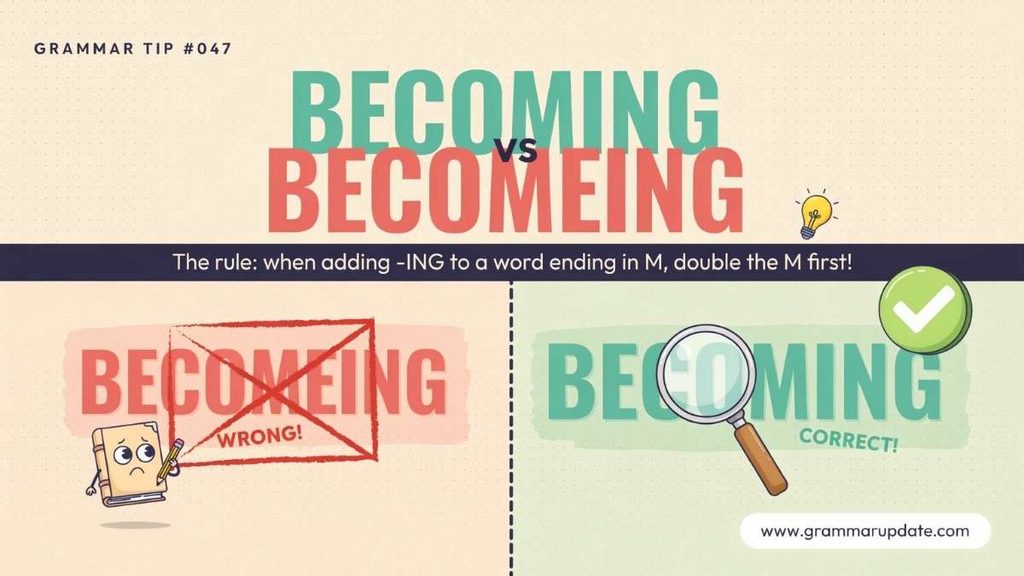
The spelling of becoming seems simple until an extra “e” sneaks into the word. That’s where the confusion between becoming vs becomeing begins. If you’re unsure which form is correct, the answer is straightforward: becoming is the standard spelling, while becomeing is a common misspelling. The reason comes down to a simple English spelling rule. When you add “-ing” to “become,” the final silent e is removed, giving you “becoming.” In this guide, you’ll learn the correct spelling, understand why the e disappears, and see how to use becoming naturally in sentences. By the end, this spelling mistake should be easy to avoid.
quick answer
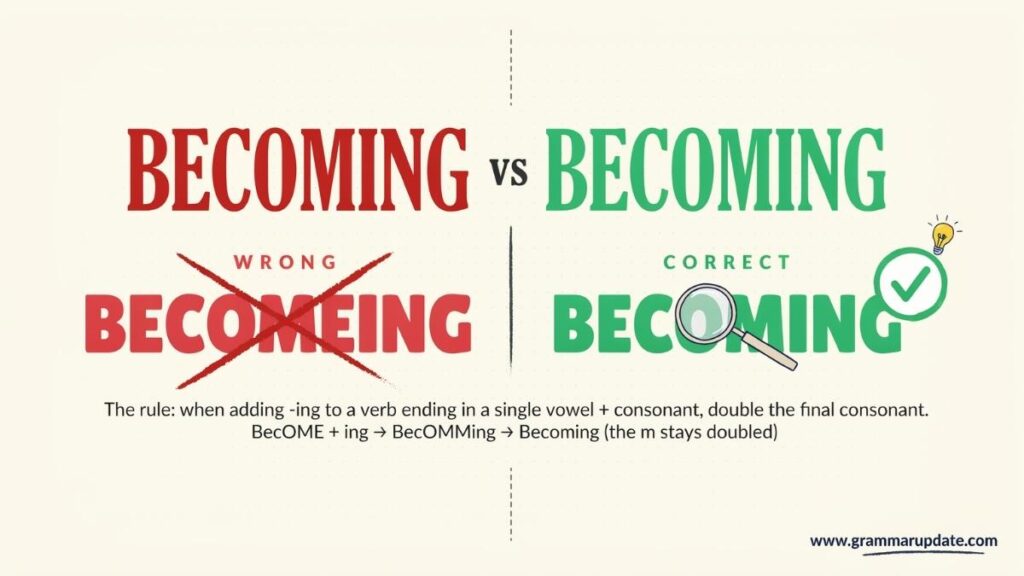
Becoming is the correct spelling. Becomeing is incorrect in standard English.
The word becoming comes from the verb become. It is the present participle of become and is commonly used to describe an action or change that is in progress.
For example:
She is becoming more confident.
The weather is becoming colder.
The problem is becoming more difficult.
In each sentence, becoming describes a change that is happening or developing.
The incorrect form becomeing comes from adding -ing directly to the complete spelling of become. Although that might seem logical, English spelling rules often require a small change when a suffix is added.
In this case, the final silent e disappears.
Become becomes becoming.
This gives us the answer to the question “becoming vs becomeing which is correct?” Becoming is correct.
The same answer applies if the question is written as “becoming vs becomeing,” “becomeing or becoming,” or “becomeing vs becoming.” The standard spelling remains becoming.
| Word | Correct spelling? | Grammatical role | Example |
|---|---|---|---|
| becoming | Yes | Present participle or gerund | She is becoming more confident. |
| becomeing | No | Misspelling | She is becomeing more confident. |
| become | Yes | Base form and past participle | I want to become a teacher. |
| became | Yes | Simple past | She became a teacher last year. |
Learn the difference between confusing more English words
Acquire Vs Aquire Which one Is Correct?
Is Becomeing a Word?
If you’re asking “is becomeing a word,” the short answer is no in standard English.
Becomeing is a common spelling mistake caused by keeping the final e in become when adding -ing. The correct English spelling is becoming.
You may occasionally see becomeing somewhere online. A typo appearing on a website, social media post, comment, or informal message doesn’t make it a standard English word. Online writing contains plenty of spelling errors, and search engines can index those errors just as they index correctly spelled words.
That distinction matters.
A word appearing in search results isn’t automatically a correct English word. Standard dictionaries and established English usage provide a much better guide when you’re deciding how to spell something.
For formal writing, use becoming.
She is becoming more experienced.
The company is becoming more successful.
The situation is becoming increasingly complicated.
Writing becomeing in these sentences would be considered a spelling error.
So, if the question is “is becomeing correct,” the answer is no.
Why Is It Becoming Not Becomeing?
The reason comes down to a common English spelling rule.
Many verbs that end in a silent e drop that final e before the ending -ing is added. Become follows this pattern.
Start with become.
Remove the final e.
Add -ing.
The result is becoming.
This same pattern appears in many familiar English verbs.
| Base verb | Correct -ing form |
|---|---|
| make | making |
| take | taking |
| write | writing |
| hope | hoping |
| move | moving |
| give | giving |
| come | coming |
| become | becoming |
Notice what happens in each example. The base form ends in e, but the e disappears when -ing is added.
That is why “becomeing” is not the correct spelling.
The spelling isn’t based on simply attaching letters to the end of a word. English has many spelling patterns that change the appearance of a word when an ending is added. The change can sometimes seem strange until you’ve seen it enough times.
Think of it as a small adjustment that keeps the word’s spelling and pronunciation working naturally together.
Becoming Spelling Rule Explained
The becoming spelling rule is easier than it first appears.
When become takes the -ing ending, drop the final e and then add -ing.
The transformation looks like this:
become → becom → becoming
Another useful way to remember it is:
become − e + ing = becoming
This explains why becomeing is incorrect.
The writer has added -ing but hasn’t removed the final e.
The same idea works with many other common verbs.
Make becomes making.
Write becomes writing.
Take becomes taking.
Hope becomes hoping.
Come becomes coming.
Become becomes becoming.
This is one of the useful English spelling rules that can help you with many words beyond this particular example.
Still, it is worth remembering that English spelling rules aren’t mathematical formulas that work without exceptions. English contains plenty of unusual spellings because of pronunciation, word history, borrowed words, and other influences.
For become, however, there is no uncertainty. The correct -ing form is becoming.
Learn the difference between confusing more English words
Atheist Vs Athiest Which Spelling Is Correct?
What Does Becoming Mean?
The becoming meaning depends on how the word functions in a sentence.
In its most common use, becoming describes a change or development. It comes from become, which means to start to be something or to change into a particular state.
For example:
The child is becoming more independent.
The sentence describes development. The child is moving toward a different state.
Another example is:
The weather is becoming colder.
Here, becoming shows that the temperature is changing.
The word can describe physical changes, personal development, emotional changes, social changes, professional growth, or changes in circumstances.
A person can become stronger, wiser, more confident, more experienced, or more independent.
A situation can become difficult, serious, complicated, dangerous, or clearer.
This makes becoming particularly useful when you want to emphasize a process rather than a finished result.
Compare these two sentences:
She is confident.
She is becoming confident.
The first sentence describes her current state. The second focuses on her development toward that state.
That small difference is one reason becoming is such a useful word in English.
Becoming Definition and Examples
A practical becoming definition is “the process of changing into or starting to be something.”
As the present participle of become, becoming often describes an action or change that is underway.
She is becoming more patient.
The neighborhood is becoming more popular.
The instructions are becoming clearer.
The company is becoming more competitive.
In each example, the subject is moving from one state toward another.
Becoming can also function as a gerund.
Becoming fluent takes time.
Here, becoming acts like a noun and refers to the process of becoming fluent.
There is also an adjective meaning of becoming. In this use, becoming can mean attractive, flattering, suitable, or appropriate.
That color is becoming on you.
She wore a becoming dress.
This adjective sense is less common in modern American English and can sound somewhat old-fashioned. However, it remains a legitimate dictionary-listed meaning.
Becoming as a Verb
When becoming functions as a verb form, it is usually part of a continuous verb construction.
Consider:
The weather is becoming colder.
The subject is the weather. The word is is the auxiliary verb, and becoming is the present participle of become.
The sentence describes a change that is taking place.
Here are a few more examples:
She is becoming more confident.
He is becoming better at his job.
The situation is becoming difficult.
The city is becoming more crowded.
They are becoming close friends.
The basic grammatical pattern often looks like this:
subject + form of be + becoming + complement
For example:
The project is becoming complicated.
The project is the subject. Is is the auxiliary verb. Becoming expresses the ongoing change, and complicated describes the new state.
This is an important part of becoming grammar because it explains why becoming often appears after is, am, or are.
Learn the difference between confusing more English words
Believe Vs Belive Which one Is Correct?
Becoming as the Present Participle of Become
If you’re wondering “what is the present participle of become,” the answer is becoming.
The main verb forms of become are:
| Verb form | Word |
|---|---|
| Base form | become |
| Third-person singular | becomes |
| Simple past | became |
| Past participle | become |
| Present participle | becoming |
The verb become is irregular because its simple past and past participle don’t follow the regular -ed pattern.
For example:
1.I become tired after long walks.
2.I became tired yesterday.
3.I have become tired.
4.I am becoming tired.
Each sentence uses a different verb form.
Understanding this pattern helps prevent another common English mistake: assuming that all forms of a verb work in exactly the same way.
Become vs Becoming Grammar
The Become and becoming come from the same verb, but they don’t perform the same grammatical job.
Become is the base form of the verb.
For example:
I want to become a doctor.
They hope to become successful.
You can become a better writer with practice.
We may become partners someday.
Become commonly follows an infinitive marker such as to or a modal verb such as can, may, might, or will.
Becoming is the present participle.
For example:
She is becoming more confident.
The process is becoming easier.
The weather is becoming warmer.
They are becoming good friends.
The key difference often becomes obvious when you look at the words around the verb.
I want to become a writer.
I am becoming a writer.
The first sentence expresses a goal or desired change. The second emphasizes a process that is happening.
Neither form is automatically better. The correct choice depends on the sentence.
Becoming as a Gerund
Becoming can also function as a gerund.
A gerund is an -ing form of a verb that functions as a noun.
Consider this sentence:
Becoming fluent takes practice.
Here, becoming fluent acts as the subject of the sentence.
You can replace the entire phrase with another noun-like expression:
Practice takes time.
The grammar changes, but the spelling of becoming doesn’t.
Here are more examples:
1.Becoming a parent can change your priorities.
2.Becoming familiar with the software takes time.
3.Becoming successful requires patience.
4.Becoming more organized can make daily tasks easier.
5.Becoming a skilled writer requires regular practice.
In each example, becoming refers to the process of reaching a new state.
This is why an -ing word isn’t always part of a continuous tense. Context determines its grammatical function.
Becoming as an Adjective
The word becoming has another legitimate use as an adjective.
In this context, becoming means attractive, flattering, suitable, or appropriate.
For example:
That dress is becoming on you.
The color is becoming.
She chose a becoming hairstyle.
The adjective doesn’t describe an ongoing transformation. Instead, it describes something that looks attractive or suits someone.
This meaning may sound more formal or old-fashioned than the modern verb use.
Imagine someone saying:
“That color is very becoming on you.”
The speaker means that the color looks particularly good on the person.
This adjective sense is useful to recognize because you may encounter it in older books, formal writing, literature, or more traditional expressions.
Learn the difference between confusing more English words
Acceptable Vs Aceptable Which one Is Correct?
Becoming Meaning and Usage in Different Sentences
Context plays a major role in understanding the becoming word meaning.
Consider these examples:
The weather is becoming colder.
Here, becoming describes a change in temperature.
She is becoming a doctor.
Here, becoming describes a person’s development toward a professional role.
Becoming a doctor takes years of study.
Here, becoming is a gerund referring to the process of reaching that goal.
That dress is becoming.
Here, becoming is an adjective meaning attractive or flattering.
The spelling doesn’t change in any of these sentences.
What changes is the grammatical role and meaning created by the surrounding words.
This is a useful reminder that English words often have more than one function. You don’t always understand a word completely by looking at its dictionary definition alone. The sentence around it matters.
Become vs Becoming Clear Examples
The difference between become and becoming becomes easier when you compare them directly.
| Sentence | Explanation |
|---|---|
| I want to become a teacher. | Become is the base verb after to. |
| She is becoming a teacher. | Becoming describes an ongoing process. |
| They may become friends. | Become follows the modal may. |
| They are becoming friends. | Becoming describes a developing relationship. |
| He hopes to become successful. | Become follows to. |
| He is becoming successful. | Becoming describes a change in progress. |
The contrast isn’t really about meaning alone. Grammar determines which form belongs in the sentence.
If you’re learning English, pay attention to the words that come before the verb. They often give you a strong clue about which form you need.
Learn the difference between basic English word mistakes
Cocoon vs Cacoon Which one Is Correct?
Became vs Becoming vs Become
The forms became, become, and becoming can be confusing because they all come from the same verb.
The easiest way to understand them is to connect each form with its grammatical purpose.
Become is the base form.
I want to become a writer.
Became is the simple past form.
She became a writer last year.
Become is also the past participle.
She has become a successful writer.
Becoming is the present participle.
She is becoming a successful writer.
The four forms work together like this:
| Form | Main use | Example |
|---|---|---|
| become | Base form | I want to become a teacher. |
| became | Simple past | She became a teacher last year. |
| become | Past participle | She has become a teacher. |
| becoming | Present participle | She is becoming a teacher. |
The distinction becomes especially important when you talk about time.
Became usually points to a completed change in the past.
Becoming often emphasizes a change that is happening or developing.
Become can express the base idea of the verb or work as a past participle after have, has, or had.
Becoming in a Sentence Examples
If you’re looking for becoming in a sentence examples, it helps to see the word used in different situations.
The child is becoming more independent.
The weather is becoming colder.
The road is becoming dangerous.
Her writing is becoming more polished.
The project is becoming increasingly complicated.
He is becoming an important member of the team.
They are becoming close friends.
The neighborhood is becoming more popular.
These examples use becoming to describe change or development.
Now consider examples where becoming works as a gerund:
1.Becoming fluent takes time.
2.Becoming a good leader requires patience.
3.Becoming familiar with a new system can take several weeks.
4.Becoming more organized can reduce unnecessary stress.
Finally, consider the adjective use:
That color is becoming on you.
She chose a becoming hairstyle.
The dress was particularly becoming.
These examples show why context matters when you’re studying becoming definition and usage.
Common Becoming Spelling Mistakes
The most common mistake is becomeing.
This error happens because the writer adds -ing without removing the final e.
Incorrect:
She is becomeing more confident.
Correct:
She is becoming more confident.
Other incorrect forms can include becaming, becomming, and becominng. These are spelling errors rather than alternative forms of the verb.
The best way to avoid them is to remember the correct transformation instead of memorizing a long list of incorrect versions.
Become becomes becoming.
Once you’ve seen the pattern enough times, becomeing should begin to look as unusual as writing “makeing” instead of “making.”
Why People Write Becomeing
The becomeing spelling mistake is understandable.
English learners often learn that adding -ing creates the present participle. So they may take the base word and simply attach the ending:
become + ing
That produces becomeing.
The problem is that English spelling sometimes changes the base word when a suffix is added.
A final silent e is often removed before -ing.
So the correct process is:
become → remove e → add ing → becoming
It’s a small change, but it makes a big difference.
This is one reason spelling can be more complicated than grammar. You may know exactly what a word means and still hesitate over its written form.
Learn the difference between basic English word mistakes
Acquaintance Vs Acquaintence Which one Is Correct?
How to Spell Becoming Correctly
If you’re wondering how to spell becoming, remember one simple formula:
become − e + ing = becoming
Start with the spelling of become.
Remove the final e.
Add ing.
You get becoming.
This also answers the question “how do you spell becoming?” The correct spelling contains no e between the m and the i.
Correct:
becoming
Incorrect:
becomeing
A useful memory trick is to connect become with come.
Come becomes coming.
Become becomes becoming.
Once the final e disappears from your mental picture, the correct spelling becomes much easier to remember.
Becoming Pronunciation
Spelling and pronunciation don’t always match perfectly in English, especially when silent letters are involved.
Becoming has three syllables, with the main stress on the middle syllable.
The pronunciation is represented in standard US English as /bɪˈkʌmɪŋ/.
The written e that appears in become doesn’t remain in the spelling of becoming, but the change doesn’t create a completely different word. The pronunciation follows the normal form of the verb with the -ing ending.
For English learners, this is another useful lesson: don’t assume that every letter in a base word will remain visible when you add a suffix.
English spelling often changes while the underlying word remains recognizable.
Common Mistakes With Becoming
Spelling is only one possible problem. Writers can also use the wrong verb form.
One common mistake is writing becomeing instead of becoming.
Another is using become after is, am, or are when an ongoing action is intended.
Incorrect:
She is become more confident.
Correct:
She is becoming more confident.
Another common mistake is using became when the sentence describes a process happening now.
Compare:
The weather became colder.
The weather is becoming colder.
The first sentence describes a change that occurred in the past.
The second describes a change that is happening now.
There is also confusion between became and become.
Incorrect:
She become a teacher last year.
Correct:
She became a teacher last year.
But:
She has become a teacher.
The difference comes from grammar and tense, not simply spelling.
Learn the difference between basic English word mistakes
Envisage vs Envision difference and usage?
A Simple Case Study Become, Became, and Becoming
Imagine that Maya decides to change careers.
At first, she says:
I want to become a software developer.
Become is correct because it follows want to.
After completing her training, we might say:
Maya became a software developer.
Became is the simple past form because the change happened in the past.
Now imagine that Maya is still developing her skills.
Maya is becoming a highly skilled developer.
Becoming emphasizes an ongoing process. She has reached a certain level, but she is still improving.
Now consider:
Becoming a highly skilled developer takes years of practice.
Here, becoming functions as a gerund. The phrase refers to the process itself.
One verb has therefore produced several useful forms:
become
became
become
becoming
Understanding how those forms work makes English grammar much easier to manage.
Is Becoming a Correct English Word?
Yes. Becoming is a standard English word.
It has several legitimate uses.
It can function as the present participle of become.
She is becoming more confident.
It can function as a gerund.
Becoming confident takes practice.
It can also function as an adjective.
That color is becoming on you.
The word’s most common modern use relates to change, development, or movement toward a new state.
Its adjective meaning is less common in everyday American English, but it remains a valid use.
This makes becoming more versatile than it might initially appear.
Learn the difference between basic English word mistakes
Unpure vs Impure Which one Is Correct?
Becoming Word Meaning Change and Development
At the center of the word is the idea of change.
A person may become stronger.
A student may become more confident.
A child may become independent.
A situation may become serious.
A business may become successful.
A neighborhood may become popular.
In each case, something moves from one state to another.
That idea of transformation is what gives becoming much of its meaning.
Compare these sentences:
He is successful.
He is becoming successful.
The first describes a condition.
The second describes development toward that condition.
That distinction can make your writing more precise because it lets you show movement rather than simply describe a final result.
English Spelling Rules Behind Becoming
The spelling of becoming demonstrates a broader pattern in English.
Many verbs ending in a silent e drop that letter before -ing.
For example:
hope becomes hoping.
dance becomes dancing.
use becomes using.
write becomes writing.
drive becomes driving.
take becomes taking.
Become follows the same pattern.
Become becomes becoming.
These patterns are part of English spelling and English grammar spelling conventions that help maintain consistent word forms.
However, English has exceptions. Some verbs don’t behave exactly as you might expect. That’s why it’s better to learn common patterns alongside the individual words that use them.
For become, the correct pattern is easy to remember:
become → becoming
Learn the difference between confusing more English words
In Process vs In Progress Difference and usage?
Becoming vs Becomeing Which One Should You Use?
Use becoming.
There is no standard English context in which becomeing should replace becoming.
Use becoming when you are describing an ongoing change:
The weather is becoming warmer.
Use becoming when the word functions as a gerund:
Becoming fluent takes practice.
Use becoming when the word functions as an adjective:
That color is becoming on you.
In every standard use, the spelling remains becoming.
If you’re writing an essay, business email, article, report, resume, application, or academic assignment, becoming is the form you should choose.
Becoming vs Becomeing Important Facts to Remember
The central fact is simple: becoming is correct and becomeing is incorrect.
Becoming is the present participle of become.
Become is the base form of the verb.
Became is the simple past form.
Become is also the past participle.
Becoming can function as a present participle, gerund, or adjective.
The final e in become is dropped before the -ing ending is added.
The correct transformation is become to becoming.
Becomeing is a misspelling, not an alternative spelling.
The most common meaning of becoming involves change, development, or movement toward a new state.
As an adjective, becoming can mean attractive, flattering, suitable, or appropriate.
Learn the difference between confusing more English words
Kaftan vs Caftan Difference and Which one Is Correct?
Practice Session Becoming vs Becomeing
Fill in each blank with the correct word or form: become, became, becoming, or becomeing.
- She is __________ more confident every day.
- He wants to __________ a professional writer.
- The weather is __________ colder as winter approaches.
- Sarah __________ a teacher after graduating from college.
- They hope to __________ successful entrepreneurs.
- The situation is __________ more difficult than we expected.
- My brother is __________ very interested in photography.
- She __________ a doctor after years of study.
- The leaves are __________ yellow as autumn begins.
- You can __________ better at English by practicing regularly.
- His new role is __________ a major responsibility.
- The company __________ profitable after several years of growth.
- I am __________ more comfortable speaking English.
- They want to __________ part of the community.
- The child is __________ more independent as he grows older.
- He __________ one of the most respected members of the team.
- Exercise can help you __________ stronger over time.
- The old building is __________ a modern office space.
- She is __________ increasingly interested in learning grammar.
- After years of training, he __________ an excellent athlete.
- The process of __________ a better writer takes time and practice.
- The problem is __________ easier to solve.
- Many students want to __________ fluent in English.
- Her confidence __________ stronger after she gained more experience.
- With patience and effort, you are __________ a more skilled communicator.
Answers
- becoming
- become
- becoming
- became
- become
- becoming
- becoming
- became
- becoming
- become
- becoming
- became
- becoming
- become
- becoming
- became
- become
- becoming
- becoming
- became
- becoming
- becoming
- become
- became
- becoming
Here’s a trusted source for clear word meanings:
FAQs
Is “becomeing” ever the correct spelling?
No. “Becomeing” is always considered a misspelling in standard English. The correct spelling is “becoming,” with the final e in “become” removed before adding “-ing.”
Why is “becomeing” spelled incorrectly?
“Becomeing” is incorrect because the final silent e in “become” is dropped before the “-ing” ending is added. The correct spelling follows this pattern: become + ing = becoming.
Is “becoming” the present participle of “become”?
Yes. “Becoming” is the present participle of “become.” It commonly appears in continuous forms, such as “The weather is becoming colder” or “She is becoming more confident.”
How do you spell “becoming” correctly?
The correct spelling is “becoming.” It is spelled B-E-C-O-M-I-N-G. The form “becomeing” is incorrect because it retains the final e from “become.”
Why does “become” change to “becoming”?
When “-ing” is added to a verb that ends in a silent e, the final e is usually removed. Therefore, “become” changes to “becoming,” not “becomeing.”
Is “becoming” one word?
Yes. “Becoming” is a single word. It is the -ing form of “become” and can function as a present participle, gerund, or adjective depending on how it is used.
What is the spelling rule for “become + ing”?
The final silent e is removed before “-ing” is added. This gives you “becoming.” The same pattern appears in words such as “make” and “making,” “write” and “writing,” and “move” and “moving.”
Can “becoming” function as a noun?
Yes. “Becoming” can function as a gerund, which means an -ing verb form is being used as a noun. For example, “Becoming a better writer takes practice.” In this sentence, “becoming” refers to the process of developing into something.
Can “becoming” describe gradual change?
Yes. “Becoming” often describes a change that develops over time. For example, “The situation is becoming more complicated” shows that the situation is gradually changing.
Can “becoming” be used as an adjective?
Yes. “Becoming” can also function as an adjective meaning attractive, suitable, or flattering. For example, “That color is very becoming on you.” This use is correct, although it sounds somewhat old-fashioned in modern American English.
What is the difference between “Becoming vs Becomeing”?
“Becoming” is the correct English word, while “becomeing” is a misspelling. “Becoming” is formed by removing the final e from “become” and adding “-ing.”
Does “becoming” have the same meaning as “become”?
They are closely related, but their grammatical uses differ. “Become” is the base form of the verb, while “becoming” usually expresses an ongoing change or process.
For example, “She wants to become a doctor” expresses a goal, while “She is becoming a doctor” describes a process that is underway.
Is “becoming” used in continuous tenses?
Yes. “Becoming” frequently appears in continuous constructions because it describes a change that is happening over a period of time. For example, “The days are becoming shorter.”
Can “becoming” describe emotional or personal development?
Yes. “Becoming” isn’t limited to physical changes. You can use it for emotional, personal, professional, social, and intellectual development.
For example, “He is becoming more confident” describes personal development rather than a physical transformation.
Why do people write “becomeing” instead of “becoming”?
The most common reason is that people add “-ing” directly to “become” without removing the final e. That creates “becomeing,” which looks logical at first glance but doesn’t follow the standard spelling rule.
Is “becomeing” acceptable in texting or casual writing?
No. Casual writing may contain typos, but “becomeing” remains a misspelling. If you want to use correct English, write “becoming” regardless of whether the context is a text message, email, school assignment, or professional document.
Can “becoming” begin a sentence?
Yes. “Becoming” can begin a sentence when it functions as a gerund.
For example, “Becoming a skilled speaker requires regular practice.”
Here, “becoming a skilled speaker” acts as the subject of the sentence.
Why doesn’t “becoming” keep the e from “become”?
The e is removed because “become” ends in a silent e. When the “-ing” suffix is added, that final e is dropped. This produces “becoming.”
Is “becoming” correct in American English?
Yes. “Becoming” is the standard spelling in American English. It is also the standard spelling in other major varieties of English.
What is an easy way to remember the spelling of “becoming”?
Remember the simple transformation:
become → becoming
The final e disappears before “-ing” is added. You can use the same memory trick with “hope → hoping,” “give → giving,” and “write → writing.”
Can “becoming” describe a change in status or role?
Yes. “Becoming” can describe someone moving into a new role, position, or condition.
For example, “She is becoming a respected leader” describes a gradual change in how she is developing and being recognized.
Is “becoming” appropriate in formal writing?
Yes. “Becoming” is completely appropriate in formal, academic, professional, and everyday writing. It is a standard English word, not an informal expression.
What does “becoming” usually mean in everyday English?
“Becoming” usually refers to changing or developing into a particular state, condition, role, or quality. For example, “The project is becoming more successful” means the project is gradually developing into a more successful state.
What is the fastest way to choose between “Becoming vs Becomeing”?
Choose “becoming.” The spelling “becomeing” is incorrect in standard English. When you add “-ing” to “become,” remove the final e first: become → becoming.
Learn the difference between confusing more English words
Solicited vs Unsolicited Differences and Usage
conclusion
If you’ve been stuck between “Becoming vs Becomeing” you can put that confusion to rest. “Becoming” is the correct spelling. “Becomeing” is simply a misspelling.
The reason is easy to remember. When you add “-ing” to a verb that ends in a silent e, you usually drop the final e. So, “become” becomes “becoming,” not “becomeing.” The same pattern appears in “make → making,” “write → writing,” and “hope → hoping.”
This small rule can save you from a surprisingly common spelling mistake. A grammar checker may underline “becomeing” and suggest “becoming,” but understanding the reason behind the correction is much more useful than simply clicking “Accept.” Once you know the rule, you can apply it to other words, too.
The word “becoming” itself is perfectly standard English. It can describe something that is changing or developing, such as “The weather is becoming colder” or “She is becoming more confident.” It can also have a different meaning as an adjective, describing something attractive or suitable.
So, when you ask, “Is becomeing correct?” the answer is no. When you ask, “How do you spell becoming?” the answer is becoming.
Think of it this way: the final e in “become” doesn’t get fired; it simply takes a little break when “-ing” arrives. That’s why the correct spelling is “becoming.”
In the end, there’s no need to overthink it. Remember one simple change: become → becoming. Once that sticks, “becomeing” becomes one less spelling mistake to worry about.

Jhon AJS, the creative mind behind Grammar Update, is an experienced blogger passionate about simplifying English grammar. He focuses on explaining confusing word vs word differences, grammar rules, punctuation, and sentence structure in a clear and practical way. Through easy to understand guides and examples, Jhon helps readers improve their writing and communicate with confidence. With years of blogging experience, he continues to share helpful insights that make learning grammar simple, useful, and accessible for everyone.