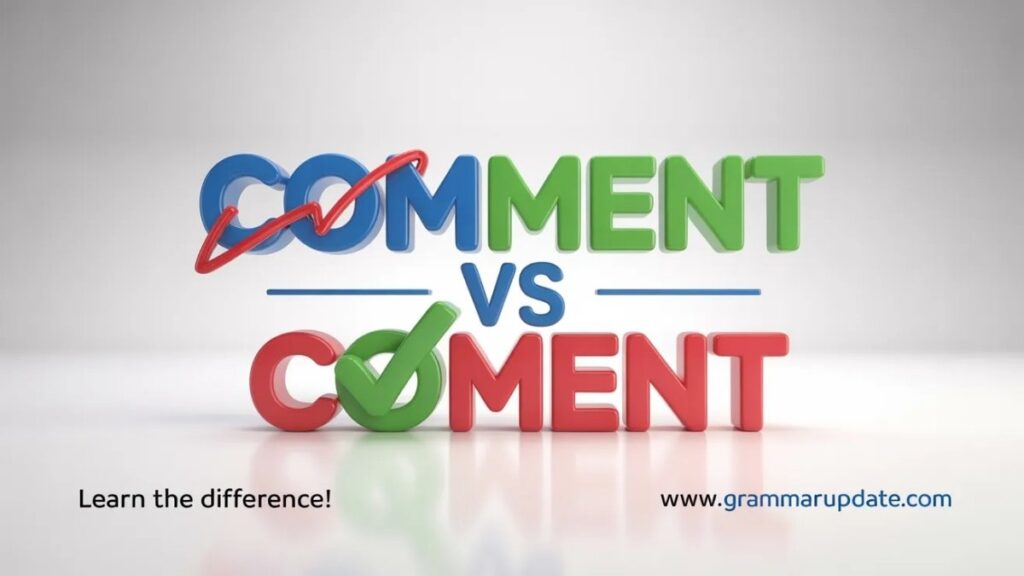
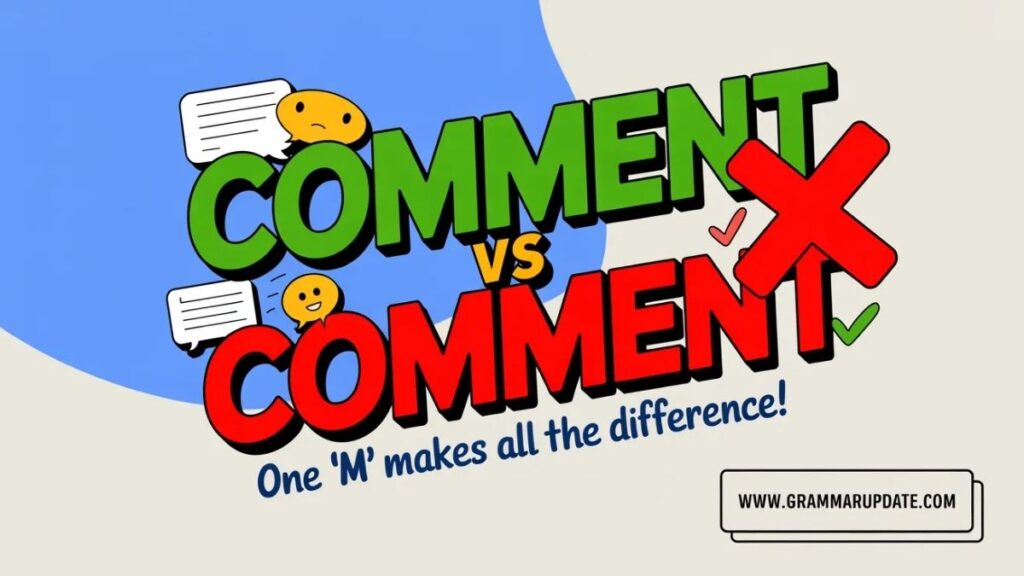
The comment vs coment difference seems minor at first glance, yet it often creates unnecessary confusion in both academic and professional writing. One missing letter can quickly raise doubts about accuracy, even when the idea itself is strong. Many writers pause and wonder, how do you spell comment correctly, especially when typing quickly or relying on memory. This small spelling issue can affect clarity, credibility, and overall presentation. In this guide, you will clearly understand the correct usage, the true comment vs coment meaning, and how to confidently apply “comment” in writing and programming without repeating common mistakes.
Comment vs Coment Meaning and Spelling

Let’s start with absolute clarity.
- “Comment” is the correct spelling in English and the only acceptable form in formal, academic, and professional writing.
- “Coment” is a misspelling that appears due to typing errors, habit, or misunderstanding of English spelling patterns.
There’s no alternative meaning. No regional exception. No hidden rule. When people search for comment vs comment meaning or comment vs comment spelling, they’re usually trying to confirm what they already suspect.
And they’re right to question it.
English can be inconsistent. Words like accommodation or necessary trip people up all the time. “Comment” falls into that same category because of the double consonant.
Here’s a clear breakdown you can trust:
| Aspect | Comment (Correct) | Coment (Incorrect) |
|---|---|---|
| Spelling Standard | Recognized in all English dictionaries | Not recognized |
| Professional Use | Required | Avoided |
| Academic Writing | Acceptable | Marked as error |
| SEO & Readability | Improves clarity and ranking | Reduces trust and quality signals |
Once you internalize this, the confusion disappears.
What Is Comment in English? A Definition That Actually Helps
If you ask ten people, “What does comment mean in text?” you’ll get ten slightly different answers. That’s because the word adapts to context.
Still, the core idea remains consistent.
- A comment is a spoken or written remark that expresses an opinion, reaction, or explanation.
- It can function as both a noun and a verb, depending on how it’s used.
But here’s where it gets interesting. A comment is not just content. It’s intent. It shapes how others interpret information.
In conversation, it can soften a point or sharpen it, In writing, it can guide readers or challenge them and In digital spaces, it can build community or spark debate.
| Context | Meaning of “Comment” | Why It Matters |
|---|---|---|
| Everyday Speech | Personal opinion or remark | Builds conversation |
| Social Media | Public response to content | Drives engagement |
| Professional | Formal statement or clarification | Maintains clarity and authority |
| Programming | Explanation ignored by compiler | Improves code readability |
Understanding this flexibility gives you control. You’re not just using a word. You’re choosing how your message lands.
Why Small Details Carry Big Weight

At first glance, the comment vs coment difference looks trivial. One letter. That’s it.
Yet in writing, small details signal larger patterns.
- Correct spelling suggests attention to detail, discipline, and credibility.
- Repeated errors suggest haste, carelessness, or lack of polish.
Readers don’t always analyze this consciously. They feel it.
Imagine reading a professional report filled with strong ideas but scattered spelling mistakes. Something feels off. You hesitate to trust it fully.
That’s the invisible cost of “coment.”
Accuracy isn’t about perfection. It’s about consistency. And consistency builds confidence in your work.
How Do You Spell Comment Correctly? Make It Automatic
You don’t want to stop mid-sentence every time you type this word. You want it to feel natural.
If you’ve ever asked, how do you spell comment correctly, here’s how to make it stick.
- Break the word into two clear units: “com” and “ment,” which naturally creates the double “m.”
- Train yourself to scan for dropped letters during proofreading, especially in frequently used words.
Here’s a simple mental shortcut:
If it feels too short, it probably is.
Your brain tends to simplify patterns. That’s why it drops one “m.” Once you become aware of that tendency, you start catching it instantly.
Over time, the correct spelling becomes automatic. No hesitation. No second-guessing.
Comment Usage in Sentences Writing That Feels Human
Knowing comment usage in sentences isn’t just about grammar. It’s about tone and flow.
You want your sentences to sound like something a thoughtful person would actually say. Not stiff. Not robotic.
- Use “comment” when expressing opinions, reactions, or observations in a natural tone.
- Vary sentence structure so your writing doesn’t feel repetitive or predictable.
Here’s how that looks in practice:
- You read the article, paused, then left a comment that added real value.
- Her comment didn’t just respond. It reframed the entire discussion.
- He chose not to comment, which made people even more curious.
Notice the rhythm. Some sentences are short and direct. Others stretch a bit, adding nuance.
That variation creates engagement. It keeps readers moving forward.
One Letter and Different Meaning
This is where things can go wrong quickly.
The difference between comment and commend is subtle in spelling but dramatic in meaning.
- “Comment” means to express an opinion or remark.
- “Commend” means to praise, approve, or formally recognize someone.
Mixing them doesn’t just look incorrect. It changes your message entirely.
| Word | Meaning | Example Sentence |
|---|---|---|
| Comment | Express an opinion | She refused to comment on the issue. |
| Commend | Praise or recommend | The director commended the team. |
That’s why precision matters. One letter can shift tone from neutral to positive.
More Confusing Words Made Simple
Nonresponsive vs Unresponsive Differences and Usage
Comment Section Meaning on Social Media More Than Just Replies
Scroll through any post and you’ll see it immediately. The comment section meaning on social media goes far beyond simple responses.
- It transforms content from one-way communication into an interactive conversation.
- It directly impacts visibility, engagement, and perceived relevance.
A post without comments feels static. A post with active discussion feels alive.
That’s why creators encourage people to “leave a comment.” They’re not just asking for feedback. They’re inviting participation.
The comment or comments section becomes a space where ideas evolve, opinions clash, and communities form.
Comment Meaning in Programming
Switch contexts, and the meaning shifts.
The comment meaning in programming has nothing to do with opinions. It’s about clarity.
- A comment in code explains logic for developers while being ignored by the compiler.
- It acts as documentation that helps others understand how and why the code works.
Here’s the key principle:
Code runs the system. Comments explain the system.
Without comments, complex code becomes difficult to maintain. With clear comments, it becomes accessible.
Comment in C Language: Structure and Practical Use
Understanding comment in C language gives you a strong foundation in programming.
C uses two main formats:
- Single-line comments for quick explanations.
- Multiline comments for more detailed descriptions.
These are essential parts of comments in C programming language, especially when writing larger programs.
More Confusing Words Made Simple
Accross vs Across, Which Is the Correct Spelling?
Single Line, Multiline, and Inline Comment Examples Explained
Different situations call for different comment styles.
- Single-line comments are concise and ideal for brief notes.
- Multiline comments allow deeper explanations without breaking structure.
Inline comments add context right next to code, making them easy to understand at a glance.
Used well, these styles improve readability. Used poorly, they create clutter.
Comment Out vs Uncomment A Tool Every Developer Uses
The idea of comment out vs uncomment is simple but powerful.
- Commenting out code disables it temporarily without deleting it.
- Uncommenting restores that code so it executes again.
This is essential during debugging and testing.
| Action | Meaning | Typical Use Case |
|---|---|---|
| Comment Out | Temporarily disable code | Testing changes or isolating issues |
| Uncomment | Re-enable code | Finalizing functionality |
Understanding this process helps you experiment safely without losing progress.
More Confusing Words Made Simple
Scoup vs Scoop Differences and Usage
Types of Comments in Programming Languages A Structured Approach
There are several types of comments in coding languages, each serving a purpose.
- Basic comments explain what the code is doing at a surface level.
- Documentation comments provide detailed explanations for functions, systems, or APIs.
You’ll also encounter:
- Inline comment examples
- Block comment syntax
- Documentation comments
Together, they create a layered explanation system that supports both beginners and experienced developers.
More Confusing Words Made Simple
Naive vs Nieve, Which Spelling Is Correct and Usage?
Comment Formatting Rules and Best Practices That Actually Work
Clear comment formatting rules make the difference between helpful notes and visual clutter.
- Focus on explaining why something exists instead of repeating what the code already shows.
- Keep comments updated so they stay accurate as code evolves.
Here’s a guiding idea worth remembering:
Good comments reduce confusion. Bad comments create it.
That’s why comment best practices matter in real-world development.
What Are Comments Used for in Coding?

When people ask, what are comments used for in coding, they’re really asking about efficiency.
- Comments improve collaboration by making logic easier to understand.
- They simplify maintenance, especially in large or long-term projects.
Without comments, developers spend more time decoding intent. With them, they focus on solving problems.
More Confusing Words Made Simple
Emersion vs Immersion Differences and Correct Usage
Practice Exercises Comment vs Coment
Practice turns knowledge into habit. The following exercises reinforce comment vs coment spelling, sharpen your understanding of comment usage in sentences, and help you apply the correct form without hesitation.
Work through each section carefully. Accuracy matters more than speed.
Fill in the Blank
Complete each sentence using the correct form: comment or coment.
- She left a thoughtful ______ on the article.
- Please don’t forget to ______ on the report.
- His ______ influenced the direction of the meeting.
- I noticed your ______ in the comments section yesterday.
- The instructor asked students to ______ on the topic.
- That ______ seemed unnecessary.
- He chose not to ______ on the controversy.
- Your ______ improved the final version significantly.
Guidance
Remember the standard rule:
The correct spelling always includes two “m” letters.
Identify Correct and Incorrect Usage
Determine whether the highlighted word is used correctly.
- She posted a coment under the video.
- I appreciate your comment on my work.
- He refused to coment during the interview.
- That comment added value to the discussion.
- Please leave a coment below.
- Her comment was clear and well structured.
Sentence Correction (Rewrite Accurately)
Each sentence contains a spelling error. Rewrite it using correct spelling and professional phrasing.
- I left a coment on your blog post.
- He didn’t coment on the issue.
- Please leave a coment in the section below.
- Her coment clarified the topic for me.
- Why didn’t you coment earlier?
Improving Sentence Quality
Refine the following sentences to sound more natural and polished.
- I made a comment about the situation.
- She made a comment that was good.
- He made a comment during the meeting.
Instruction
Enhance clarity, vary structure, and improve tone.
Meaning Based Selection
Choose the correct word: comment or commend.
- I would like to ______ on your proposal.
- The manager decided to ______ the team for their performance.
- She declined to ______ on the matter.
- They chose to ______ him for his leadership.
Programming Concepts
Fill in the blanks using appropriate terminology.
- In programming, a ______ is ignored by the compiler.
- To temporarily disable code, developers ______ it out.
- The opposite of commenting out code is to ______ it.
- In the C programming language, single-line comments begin with ______.
Answer
Review your responses after completing all exercises.
Fill in the Blank
All correct answers: comment
Identify Correct Usage
- coment — Incorrect
- comment — Correct
- coment — Incorrect
- comment — Correct
- coment — Incorrect
- comment — Correct
Sentence Correction
- I left a comment on your blog post.
- He did not comment on the issue.
- Please leave a comment in the section below.
- Her comment clarified the topic.
- Why did you not comment earlier?
Comment vs Commend
- comment
- commend
- comment
- commend
Programming Concepts
- comment
- comment
- uncomment
- //
Key Insight
Precision in language reflects clarity in thought. Once you consistently apply the correct spelling and usage of comment, errors like coment disappear from your writing entirely.
Here’s a trusted source for clear word meanings:
FAQs
How do you spell comment correctly?
The correct spelling is comment with two “m”s. The word “coment” is incorrect in standard English and is usually a typing mistake or misspelling.
Is there a plural for comment?
Yes, the plural form is comments. You simply add -s at the end when referring to more than one remark or opinion.
How are comments written in C?
In C programming, comments are written in two ways:
- Single-line:
// this is a comment - Multi-line:
/* this is a comment */
Is it comment or comment pronunciation?
The correct word is comment, and it is pronounced as COM-ment (with emphasis depending on region). “Coment pronunciation” is not a valid term since “coment” is not correct English.
What does comment mean?
A comment is a remark, opinion, or explanation about something. It can be spoken, written, or used in programming to explain code without affecting execution.
When to use commend?
Use commend when you want to praise or formally appreciate someone’s work. For example, “I commend you for your effort.” It is different from “comment,” which expresses an opinion or remark.
Is comment plural or singular?
Comment is singular. The plural form is comments.
Example: One comment → Many comments
How do you use comment in a sentence?
You use comment as a noun or verb:
- Noun: That comment was helpful.
- Verb: She refused to comment on the issue.
Is this plural correct?
Yes, comments is the correct plural form of comment. Any other variation like “coment” or “commentes” is incorrect.
How do you write comments?
Comments are written based on context:
- In writing: as opinions or remarks in sentences
- In coding: using symbols like
//or/* */depending on the programming language
Final Takeaway
By now, the comment vs coment confusion should feel a lot less intimidating and a lot more like a simple typing slip that got out of hand. It’s one of those small mistakes that sneaks in when you’re typing fast and your brain decides to drop a letter without asking permission.
Here’s the final truth: “comment” is always correct, and “coment” is just a misspelling that can quietly weaken your writing if it slips through. Nothing more complicated than that.
So next time your fingers rush ahead of your thoughts, slow down for a second. That extra “m” might be tiny, but it makes your writing look clearer, sharper, and instantly more professional.

Jhon AJS, the creative mind behind Grammar Update, is an experienced blogger passionate about simplifying English grammar. He focuses on explaining confusing word vs word differences, grammar rules, punctuation, and sentence structure in a clear and practical way. Through easy to understand guides and examples, Jhon helps readers improve their writing and communicate with confidence. With years of blogging experience, he continues to share helpful insights that make learning grammar simple, useful, and accessible for everyone.