If you have ever typed “genious” and paused for a second wondering if it looks right, you are not alone and you are definitely not the first. The confusion between genius vs genious is one of those classic English spelling traps that quietly embarrasses even confident writers. It usually happens because English is full of words ending in “-ious,” like curious, serious, and obvious, so the brain naturally tries to “fix” genius into genious. Unfortunately, English does not always follow logic. The correct spelling is genius, and “genious” is simply a common mistake that does not exist in standard grammar. This article clears up the confusion in a simple, professional, and mistake-free way so you never second-guess it again.
Quick Answer Genius vs Genious?
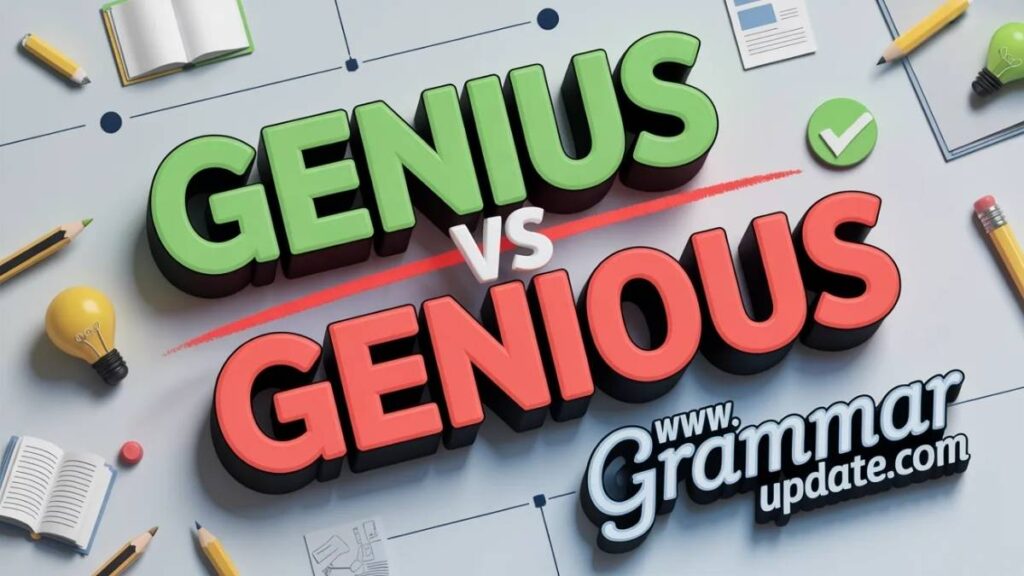
The answer is simple and direct: genius is correct, while “genious” is incorrect.
| Word | Correct or Incorrect | Meaning |
|---|---|---|
| Genius | Correct | Exceptional intelligence or talent |
| Genious | Incorrect | Misspelling of genius |
Important Facts About the Correct Spelling
- Genius is the only spelling accepted in English dictionaries
- Genious is a spelling error caused by pronunciation and spelling confusion
Example:
“She is a genius in mathematics and physics.”
The spelling “genious” should be avoided completely in academic, professional, and formal writing because it immediately appears as a grammar mistake.
What Does Genius Mean?
The genius meaning refers to extraordinary intellectual ability, creativity, originality, innovation, or natural talent. The word is widely used in education, science, technology, literature, music, art, and everyday speech.
A genius is not simply someone who is smart. The term usually describes an individual with unusually exceptional ability that stands far above average intelligence.
Main Meanings of Genius
- A person with extraordinary intellectual or creative power
- An exceptionally brilliant idea, method, or solution
Example:
“Albert Einstein is widely recognized as a scientific genius.”
Genius Definition in Simple and Professional English
The genius definition changes slightly depending on context, but it always connects to brilliance or exceptional ability.
Academic Definition of Genius
- A person with exceptional mental ability or creativity
- Someone capable of producing original and influential ideas
Example:
“The young researcher showed genius-level analytical thinking.”
Informal Definition of Genius
In casual conversation, genius is often used humorously or casually to praise a clever action.
Informal Uses of Genius
- Praising clever solutions
- Complimenting smart decisions
Example:
“Using the pizza box as a laptop stand was pure genius.”
Modern internet culture frequently uses the word in exaggerated or sarcastic ways.
Is Genious a Real Word?
No. “Genious” is not a standard English word.
Although many people type it online, dictionaries and grammar references recognize only the spelling “genius.”
| Word | Dictionary Status |
|---|---|
| Genius | Accepted |
| Genious | Incorrect |
Why People Still Write Genious
- English learners rely heavily on sound-based spelling
- Many familiar English words end with “-ious”
- Fast typing and social media increase spelling mistakes
Example:
“Writers often assume genius follows the same spelling pattern as serious or curious.”
This error is extremely common even among fluent speakers because the incorrect spelling visually feels natural.
Why the Genius vs Genious Confusion Happens
The confusion between genius vs genious is strongly connected to English spelling psychology.
The human brain naturally searches for familiar letter patterns. Since words ending in “-ious” appear very frequently in English, the brain predicts that genius should follow the same structure.
Main Causes of the Confusion
- Similarity to words like curious and serious
- Influence of the word ingenious
Example:
“The spelling structure of ingenious strongly influences the mistake genious.”
Pronunciation-Based Confusion
The pronunciation of genius also contributes to the error because the ending sound feels longer than its spelling.
Correct pronunciation:
/ˈdʒiː.ni.əs/
Spoken as:
“JEE-nee-us”
Pronunciation Problems
- The “ee-us” sound causes writers to expect “ious”
- Spoken English does not clearly reveal the actual spelling
Example:
“Many learners spell genius incorrectly because they write words exactly as they hear them.”
How to Spell Genius Correctly
The correct spelling is:
G-E-N-I-U-S
Not:
G-E-N-I-O-U-S
Simple Spelling Facts
- Genius ends with “ius”
- The spelling never includes “ous”
Example:
“The student memorized the spelling of genius after repeated practice.”
Powerful Memory Tricks to Remember Genius
Memory tricks are extremely useful for eliminating spelling mistakes permanently.
Easy Memory Trick One
Think:
“A genius does not need extra letters.”
This reminds you that “genious” contains unnecessary letters.
Easy Memory Trick Two
Compare these words carefully:
| Word | Ending |
|---|---|
| Genius | ius |
| Ingenious | ious |
Example:
“Separating genius from ingenious helps prevent spelling confusion.”
Genius vs Ingenious Understanding the Real Difference
One of the biggest reasons for the genius vs genious confusion is the existence of the word “ingenious.”
Although the words are related, they are not interchangeable.
| Word | Meaning | Part of Speech |
|---|---|---|
| Genius | Exceptionally intelligent person | Noun |
| Ingenious | Clever or inventive | Adjective |
Genius Meaning
Genius refers mainly to extraordinary people, talent, or intelligence.
Common Uses of Genius
- Describing highly intelligent individuals
- Referring to exceptional natural talent
Example:
“She is a genius in engineering.”
Ingenious Meaning
Ingenious refers to creativity, clever design, or inventive thinking.
Common Uses of Ingenious
- Describing clever systems or inventions
- Praising innovative problem-solving
Example:
“The inventor developed an ingenious machine.”
Fix common more word mistakes in English
Uncollectible vs Uncollectable and How to Use Each Word
Genius Noun or Adjective?
Another common grammar question is:
Is genius a noun or adjective?
The answer depends on context.
Genius as a Noun
This is the most standard grammatical use.
Noun Usage
- Refers to a person with extraordinary ability
- Used formally in academic and professional writing
Example:
“Marie Curie was a scientific genius.”
Genius as an Informal Adjective
Modern spoken English sometimes uses genius informally as an adjective.
Informal Adjective Usage
- Common in social media and casual speech
- Used to praise brilliant ideas humorously
Example:
“That business strategy is genius.”
Although informal, this usage has become increasingly accepted in conversational English.
Genius Meaning Beyond Intelligence
Many people incorrectly assume genius refers only to IQ or academic ability. In reality, genius can appear in many forms.
| Type of Genius | Description |
|---|---|
| Scientific Genius | Extraordinary research or discovery ability |
| Artistic Genius | Exceptional creativity and imagination |
| Musical Genius | Advanced musical skill and originality |
| Strategic Genius | Brilliant planning ability |
| Inventive Genius | Extraordinary innovation |
Genius in Creativity and Innovation
Some geniuses change entire industries or artistic movements.
Creative Forms of Genius
- Revolutionary invention
- Original artistic vision
Example:
“Steve Jobs is often described as a technological genius.”
Genius vs Intelligent Difference
The terms intelligent and genius are related but not equal.
| Intelligent | Genius |
|---|---|
| Smart and knowledgeable | Exceptionally gifted |
| Learns information efficiently | Produces original breakthroughs |
| More common trait | Rare level of ability |
Core Differences
- Intelligence involves understanding and learning
- Genius often involves transforming knowledge into innovation
Example:
“A genius may completely reshape science, technology, or art.”
Learn the difference between tricky more English words
Ally vs Allie Differences and Correct Usage
Clever vs Genius Meaning
Cleverness and genius are also very different concepts.
Cleverness
- Practical intelligence
- Fast thinking and adaptability
Genius
- Extraordinary brilliance
- Rare creativity or intellectual power
Example:
“A clever student solves problems quickly, but a genius invents entirely new methods.”
Common English Spelling Mistakes Similar to Genius
The error “genious” belongs to a broader category of confusing English spellings.
| Incorrect | Correct |
|---|---|
| Genious | Genius |
| Seperate | Separate |
| Definately | Definitely |
| Occured | Occurred |
Why These Errors Are Common
- English spelling evolved from multiple languages
- Pronunciation often differs from actual spelling
Example:
“Many English spelling mistakes come from historical language development.”
English Word Endings IUS vs IOUS
The confusion becomes easier to understand when comparing suffix patterns.
Common Words Ending in “-ious”
- Curious
- Serious
Example:
“These familiar patterns influence the incorrect spelling genious.”
Common Words Ending in “-ius”
- Genius
- Radius
Example:
“Words ending in ius are much less common in modern English.”
Learn the difference between tricky more English words
Contractor vs Contractee Usage and Differences Explained
Genius in Professional Writing
The word genius appears frequently in:
- education
- business
- technology
- entertainment
- science
Professional Writing Uses
- Describing groundbreaking innovation
- Praising exceptional ability carefully and accurately
Example:
“The researcher demonstrated genius-level innovation in medical science.”
Why Overusing Genius Is Problematic
Using the word too often weakens its meaning.
Overuse Problems
- Makes writing sound exaggerated
- Reduces the impact of true excellence
Example:
“Calling every simple idea genius can make professional writing less credible.”
Understand confusing English more words simply
Writing vs Writting which is Correct Spelling
Genius in Internet Culture and Memes
Searches such as:
- Genius or genious meme
- Genius vs genious reddit
have become increasingly popular online.
Internet Usage Trends
- Genius is often used sarcastically
- Genious sometimes appears intentionally as a joke spelling
Example:
“Someone forgetting their wallet may jokingly say, ‘I’m a genius.’”
Genius or Genious Synonyms
Several words share related meanings with genius.
| Synonym | Meaning |
|---|---|
| Prodigy | Exceptionally talented young person |
| Visionary | Innovative thinker |
| Mastermind | Brilliant strategist |
| Intellectual | Highly intelligent person |
Synonym Differences
- Some emphasize creativity
- Others emphasize intelligence or leadership
Example:
“The inventor became known as a visionary genius.”
Understand confusing English more words simply
Currier vs Courier Differences and Correct Usage
Antonyms of Genius
Opposite words help clarify meaning further.
| Antonym | Meaning |
|---|---|
| Fool | Person lacking judgment |
| Amateur | Inexperienced individual |
Opposite Concepts
- Genius represents extraordinary ability
- Antonyms represent lack of skill or understanding
Example:
“The novel contrasts a genius scientist with inexperienced assistants.”
Learn how to use confusing more words correctly
Tonite vs Tonight Difference and Which is Correct?
Genius Meaning and Sentence Examples
Examples help learners understand practical usage.
Formal Sentence Examples
- “The professor was considered a genius in chemistry.”
- “Her genius transformed modern engineering.”
Example:
“The composer’s genius influenced generations of musicians.”
Informal Sentence Examples
- “That shortcut was genius.”
- “Remembering the meeting time was genius.”
Example:
“Social media users often use genius humorously or sarcastically.”
Common Grammar Mistakes With Genius
Grammar errors usually involve spelling or incorrect word choice.
Frequent Genius Mistakes
- Writing genious instead of genius
- Confusing genius with ingenious
Example:
“Many students accidentally use ingenious when referring to a highly intelligent person.”
Learn how to use confusing more words correctly
Cubical vs Cubicle Usage and Common Mistakes
Why Even Fluent English Speakers Make This Mistake
Language studies show that the brain depends heavily on:
- familiar spelling patterns
- pronunciation memory
- visual recognition
Since “-ious” endings appear more frequently than “-ius,” the brain automatically predicts the wrong spelling.
Key Learning Factors
- Pronunciation strongly influences spelling memory
- Familiar patterns override grammatical accuracy
Example:
“Even advanced English speakers occasionally type genious by mistake.”
Fix common more word mistakes in English
Until vs Untill Which Spelling Is Correct and Difference?
Practice Session Genius vs Genious
Choose the correct word in each sentence: genius or genious.
Practice Questions
- Leonardo da Vinci was a creative ________.
- The word “________” is not accepted in standard English dictionaries.
- Her math skills are absolutely ________.
- Many English learners accidentally spell genius as ________.
- The scientist became known as a medical ________.
- “Genious” is considered a spelling ________.
- That business idea was pure ________.
- Teachers usually correct the spelling “________” in essays.
- The young inventor showed signs of ________.
- The correct spelling is always ________.
- His engineering designs were truly ________.
- Some people confuse genius with ________.
- A musical ________ can transform an entire industry.
- Dictionaries recognize the word ________.
- The spelling “genious” looks correct because of words ending in “________.”
- Her professor called her a literary ________.
- The child’s intelligence amazed everyone because he was a ________.
- “Genious” should be avoided in professional ________.
- The correct pronunciation of genius begins with a soft ________.
- The artist was praised for his creative ________.
- Many internet users jokingly type “________” online.
- The word genius describes exceptional ________.
- Students often search for “genius vs ________” online.
- The inventor’s brilliant machine was considered ________.
- Genius is the correct spelling in both American and ________ English.
Answers
- genius
- genious
- genius
- genious
- genius
- mistake
- genius
- genious
- genius
- genius
- genius
- ingenious
- genius
- genius
- ious
- genius
- genius
- writing
- G
- genius
- genious
- intelligence
- genious
- ingenious
- British
Here’s a trusted source for clear word meanings:
FAQs
What does genious or genius mean?
The correct word is genius. It refers to a person with extraordinary intelligence, creativity, talent, or natural ability. The spelling “genious” is incorrect and is considered a spelling mistake in English.
Is genious a word?
No. “Genious” is not a recognized English word. The correct spelling is always genius in formal, academic, and professional writing.
How do Americans spell genius?
Americans spell the word as genius. British English and American English both use the same spelling.
What does my genius mean?
“My genius” usually refers to someone’s natural talent, intelligence, creativity, or strongest ability in a particular field.
What is genious?
“Genious” is simply a misspelling of genius. Many people confuse the spelling because of words ending in “-ious,” such as serious or curious.
Is the G in genius hard or soft?
The “G” in genius is a soft G sound, pronounced like the letter “J.”
What IQ qualifies a genius?
An IQ score around 140 or higher is commonly associated with genius-level intelligence, although creativity and innovation also play important roles.
What is the dark side of genius?
The dark side of genius refers to challenges sometimes connected with exceptional intelligence, including stress, isolation, perfectionism, emotional pressure, or social difficulties.
What is the plural form of genius?
The plural form of genius is geniuses.
What is a fancy word for genius?
Formal alternatives for genius include words like prodigy, visionary, mastermind, intellectual, and innovator.
Why is there an O in ingenious?
The word ingenious comes from a different historical language origin than genius, which is why its spelling includes “-ious.”
What are the four types of genius?
The four common categories of genius are intellectual genius, creative genius, social genius, and practical genius.
Is a 140 IQ a genius?
Yes. An IQ score of 140 is generally considered within the genius or exceptionally gifted range.
What are the 7 types of genius?
The seven commonly discussed types include logical, linguistic, musical, spatial, interpersonal, intrapersonal, and kinesthetic genius.
What does “what a genius” mean in slang?
In slang, “what a genius” can either praise someone for being clever or sarcastically mock someone for making a foolish mistake.
Does genius decline with age?
Some mental abilities may slow with age, but knowledge, creativity, experience, and wisdom can continue developing for many years.
Is an IQ of 170 a genius?
Yes. An IQ score of 170 is considered extraordinarily high and falls well within the genius-level range of intelligence.
Fix common more word mistakes in English
Pricy vs Pricey Which Spelling Is Correct?
Conclusion
In conclusion, the confusion between genius vs genious is one of those classic English spelling traps that looks more complicated than it really is. The truth is simple: genius is the only correct and accepted spelling, while “genious” is just a repeated mistake caused by misleading spelling patterns in English. Words like curious and serious make the brain expect an “-ious” ending, but genius breaks that pattern completely.
So, whenever that extra “o” tries to sneak in, treat it like an uninvited guest and remove it confidently. Good writing is not about guessing it’s about precision. Once you remember this small rule, you’ll never second-guess the spelling again, and your English will instantly look more polished, professional, and grammatically correct.

Jhon AJS, the creative mind behind Grammar Update, is an experienced blogger passionate about simplifying English grammar. He focuses on explaining confusing word vs word differences, grammar rules, punctuation, and sentence structure in a clear and practical way. Through easy to understand guides and examples, Jhon helps readers improve their writing and communicate with confidence. With years of blogging experience, he continues to share helpful insights that make learning grammar simple, useful, and accessible for everyone.