Eying vs eyeing often creates unnecessary confusion in English writing, making many people stop and question whether they are spelling the word correctly or committing an error. This confusion is mostly visual rather than grammatical. Both forms exist in English and carry the same meaning, but usage patterns differ depending on style, region, and preference. The keyphrase eying vs eyeing captures this common uncertainty that even experienced writers sometimes face. In this article, we will remove that confusion in a clear, practical way so you can use the correct form confidently and avoid hesitation whenever this word appears in your writing.
Quick Answer Eying or Eyeing?
Which Spelling Is Correct?
Both eying and eyeing are correct spellings.
They represent the present participle form of the verb eye, which means to look at, observe, consider, or examine something carefully.
Which Spelling Should You Use?
If you are unsure, use eyeing.
It is:
- The traditional spelling
- The most widely recognized spelling
- Preferred by many dictionaries
- Common in newspapers and books
- Favored by numerous style guides
Quick Examples
Correct:
- She was eyeing the last slice of pizza.
- Investors are eyeing new opportunities in the market.
Also Correct:
- She was eying the last slice of pizza.
- Investors are eying new opportunities in the market.
The Simple Rule
Both spellings are acceptable, but eyeing remains the safer and more widely preferred choice.N.
Eying vs Eyeing Meaning Explained
What Does the Verb “Eye” Mean?
The verb eye means:
To look at something or someone carefully, closely, suspiciously, thoughtfully, or with interest.
Unlike a quick glance, the verb often implies deliberate attention.
People may eye something because they:
- Want it
- Distrust it
- Are evaluating it
- Find it interesting
- Are considering it for future action
Eyeing Meaning
Eyeing means:
- Looking at carefully
- Watching closely
- Examining with interest
- Considering something seriously
- Assessing a situation
Eying Meaning
Eying carries exactly the same meaning.
There is no difference in:
- Definition
- Pronunciation
- Grammatical function
- Usage
The distinction exists only in spelling preference.
Examples
- The company is eyeing a merger with a competitor.
- The company is eying a merger with a competitor.
Both sentences are equally correct and convey the same message.
Is Eying a Word?
Many writers ask:
Is Eying a Word?
Yes.
Eying is a legitimate English word and appears in major dictionaries.
It is not a spelling mistake.
Why Do People Think Eying Is Incorrect?
The spelling often surprises readers because it looks less familiar than eyeing.
When people see the word eye, they naturally expect the full spelling to remain visible when adding -ing.
As a result:
- Eyeing looks intuitive.
- Eying looks unusual.
This visual difference causes many people to assume that eying is incorrect when it is actually an accepted variant.
Dictionary Recognition
Most modern dictionaries recognize both forms.
However, many dictionaries list eyeing as the primary spelling because it appears more frequently in published writing.
Eying vs Eyeing: Side-by-Side Comparison
| Feature | Eyeing | Eying |
|---|---|---|
| Meaning | Same | Same |
| Pronunciation | Same | Same |
| Grammar | Correct | Correct |
| Dictionary Recognition | Yes | Yes |
| Formal Writing | Preferred | Accepted |
| Academic Writing | Preferred | Less Common |
| News Writing | Common | Less Common |
| British English | Preferred | Less Common |
| American English | Common | Common |
| Reader Familiarity | Higher | Lower |
Key Takeaway
The eying vs eyeing debate is primarily about spelling preference rather than grammar or meaning.
Why Does This Spelling Confusion Exist?
English spelling often develops through a combination of history, pronunciation, and usage patterns.
The Challenge of the Word “Eye”
The base word is:
Eye
When writers add -ing, two forms emerge:
- Eye + ing = Eyeing
- Eye + ing = Eying
Unlike many English verbs, the word contains three consecutive vowels, which creates visual complexity.
Why Eyeing Looks More Natural
Many writers prefer eyeing because it preserves the original word.
Readers can instantly recognize:
Eye → Eyeing
The connection remains obvious.
Why Eying Developed
Over time, some writers simplified the spelling by removing the extra letter.
This produced:
Eying
The pronunciation stayed exactly the same.
Language Simplification
English frequently creates shorter alternative spellings.
Examples include:
| Traditional Form | Simplified Form |
|---|---|
| Judgement | Judgment |
| Ageing | Aging |
| Catalogue | Catalog |
| Eyeing | Eying |
This tendency toward simplification explains why eying became accepted.
Which Spelling Should You Use?
In Professional Writing
Choose:
Eyeing
Most professional editors and publishers favor this spelling because readers recognize it immediately.
In Academic Writing
Universities and scholarly publishers typically prefer:
Eyeing
Using the more established spelling reduces the likelihood of editorial corrections.
In Business Writing
Business communication values clarity and consistency.
Examples include:
- Reports
- Proposals
- Marketing materials
- Corporate communications
For these situations, eyeing remains the preferred choice.
In Informal Writing
Both forms are acceptable in:
- Text messages
- Social media posts
- Personal emails
- Casual blogs
Editorial Recommendation
If consistency and professionalism matter, use eyeing throughout your document.
More Related Articles You May Find Helpful
Challenge vs Challange Which Is Actually Right?
Eying vs Eyeing in British and American English
Regional spelling preferences influence many English words.
British English
British English strongly favors:
Eyeing
Most British publications, newspapers, and style guides use this form.
American English
American English accepts both spellings.
You may encounter:
- Eyeing
- Eying
However, eyeing still appears more frequently in professional and published writing.
Common Misconception
Many people assume:
- Eyeing = British English
- Eying = American English
The reality is more nuanced.
American writers use both forms, but eyeing remains highly common and widely accepted.
Regional Preference Table
| Region | Most Common Form |
|---|---|
| United Kingdom | Eyeing |
| Australia | Eyeing |
| Canada | Eyeing |
| New Zealand | Eyeing |
| United States | Eyeing |
| Informal American Writing | Eyeing or Eying |
Practical Advice
If your audience spans multiple countries, eyeing is usually the safest option.
Eying vs Eyeing in AP Style
What Does AP Style Recommend?
The Associated Press Stylebook (AP Style) generally favors conventional spellings that readers recognize easily.
Because of its broader familiarity, editors often choose:
Eyeing
Why Journalists Prefer Eyeing
News writing prioritizes:
- Clarity
- Readability
- Consistency
- Familiarity
Since most readers encounter eyeing more often, journalists frequently select that spelling.
Common News Headlines
- Company Eyeing International Expansion
- Investors Eyeing Technology Stocks
- Team Eyeing Playoff Success
- Government Eyeing Policy Changes
These examples demonstrate how strongly eyeing dominates journalistic writing.
Fix common more word mistakes in English
Training vs Trainning Which One Is Correct?
Eyeing Up Meaning
What Does “Eyeing Up” Mean?
The phrase eyeing up means:
Looking at someone or something with interest, attention, curiosity, attraction, or evaluation.
It is particularly common in British English.
Examples of Eyeing Up
- He was eyeing up the new sports car.
- They spent the afternoon eyeing up houses in the neighborhood.
- She was eyeing up a promotion at work.
Is Eyeing Up Formal?
Generally, no.
The phrase sounds conversational and informal.
Formal alternatives include:
- Considering
- Evaluating
- Assessing
- Reviewing
- Examining
Eyeing vs Eyeing Up
| Phrase | Meaning |
|---|---|
| Eyeing | Looking at carefully |
| Eyeing Up | Looking at with particular interest or evaluation |
Although similar, eyeing up often carries a stronger sense of assessment or desire.
Fix common more word mistakes in English
Infront vs In Front? Which Is Correct?
Is “Eyeing on Something” Correct?
Many English learners search for phrases such as “eyeing on something” because they assume the verb eye works like expressions such as focus on, concentrate on, or depend on. However, this creates a common grammar mistake.
Is “Eyeing on Something” Grammatically Correct?
No. In standard English, “eyeing on something” is generally incorrect.
The verb eye already means to look at, observe, consider, or examine. Because the meaning of “looking at” is already built into the verb, adding on is unnecessary.
Incorrect Examples
- He is eyeing on the new laptop.
- She was eyeing on a promotion.
- They are eyeing on the vacant property.
- Investors are eyeing on technology stocks.
Correct Examples
- He is eyeing the new laptop.
- She is eyeing a promotion.
- They are eyeing the vacant property.
- Investors are eyeing technology stocks.
Better Alternatives
Depending on the context, you can also use:
- Looking at
- Considering
- Evaluating
- Assessing
- Examining
- Reviewing
- Watching
Why This Mistake Happens
Many learners incorrectly transfer grammar patterns from other English verbs. Remember this simple rule:
Eye something, not eye on something.
Eying vs Eyeing in Sentences
The best way to understand usage is through real-world examples.
Eyeing in a Sentence
- The company is eyeing expansion into international markets.
- She kept eyeing the last slice of cake.
- Investors are eyeing emerging technology companies.
- The coach is eyeing a championship title this season.
- He spent the afternoon eyeing luxury watches.
Eying in a Sentence
- The company is eying expansion into international markets.
- She kept eying the last slice of cake.
- Investors are eying emerging technology companies.
- The coach is eying a championship title this season.
- He spent the afternoon eying luxury watches.
Formal Writing Examples
- Analysts are eyeing economic indicators closely.
- Researchers are eyeing innovative approaches to data collection.
- Regulators are eyeing potential policy changes.
Business Writing Examples
- The startup is eyeing growth opportunities in Asia.
- Management is eyeing strategic acquisitions.
- The organization is eyeing long-term investments.
Everyday Conversation Examples
- I’m eyeing that new smartphone.
- She’s eyeing a vacation in Spain.
- They’re eyeing a larger apartment.
In every example above, eying could replace eyeing without changing the meaning.
Fix common more word mistakes in English
One Third vs One-Third Which Is Correct?
Common Expressions Using Eyeing or Eying
The verb eye appears in many popular English expressions.
Eyeing the Prize
Meaning: Staying focused on a goal or desired outcome.
Example:
- Despite setbacks, the team kept eyeing the prize.
Eyeing a Promotion
Meaning: Hoping to secure a higher position.
Example:
- She has been eyeing a promotion for months.
Eyeing the Competition
Meaning: Monitoring competitors closely.
Example:
- The company is eyeing the competition’s latest strategy.
Eyeing an Opportunity
Meaning: Considering a potentially beneficial situation.
Example:
- Investors are eyeing new opportunities in renewable energy.
Eyeing a New Home
Meaning: Thinking about purchasing or renting a property.
Example:
- The family is eyeing a larger home closer to the city center.
Eyeing a Purchase
Meaning: Considering buying something.
Example:
- He has been eyeing that motorcycle all year.
Fix common more word mistakes in English
Labelling vs Labeling Which Spelling Is Correct and Use It?
Eying vs Eyeing Synonyms
Depending on the context, several words can replace eying or eyeing.
General Synonyms
- Looking at
- Watching
- Observing
- Examining
- Inspecting
- Monitoring
- Assessing
- Evaluating
- Studying
- Considering
Context-Based Synonyms
| Context | Best Alternative |
|---|---|
| Business | Evaluating |
| Academic | Examining |
| Security | Monitoring |
| Shopping | Considering |
| Investigation | Inspecting |
| Casual Conversation | Looking at |
Example Comparisons
Original:
- She was eyeing the proposal.
Alternative:
- She was evaluating the proposal.
Original:
- He was eyeing the new car.
Alternative:
- He was considering the new car.
Using context-specific alternatives often improves clarity and precision.
Learn the difference between confusing more English words
Instalments vs Installments Which Is Correct and Use It?
Common Mistakes People Make
The eying vs eyeing debate creates several recurring mistakes.
Assuming Eying Is Incorrect
Many writers believe eying is a spelling mistake.
In reality:
- Eying is correct.
- Eyeing is correct.
- Both forms appear in dictionaries.
Assuming Eyeing Is Incorrect
Some writers think simplified spellings automatically replace traditional forms.
This is also incorrect.
Eyeing remains the dominant spelling in most professional, academic, and editorial contexts.
Mixing Both Spellings
Avoid switching between forms within the same document.
Inconsistent Example:
- The company is eyeing expansion while management is eying new investment opportunities.
Although technically correct, the inconsistency may distract readers.
Using “Eyeing On”
Incorrect:
- She is eyeing on a promotion.
Correct:
- She is eyeing a promotion.
Ignoring Audience Expectations
Readers generally encounter eyeing more frequently than eying.
For broad audiences, eyeing often feels more natural and familiar.
Real-World Examples of Eyeing and Eying
Business Journalism
Business publications frequently use headlines such as:
- Company Eyeing International Expansion
- Investors Eyeing Interest Rate Changes
- Retail Chain Eyeing New Markets
Sports Journalism
Sports writers commonly use:
- Team Eyeing Championship Success
- Club Eyeing Star Forward
- Coach Eyeing Tactical Adjustments
Real Estate
Property reports often include phrases such as:
- Buyers Eyeing Waterfront Homes
- Investors Eyeing Commercial Properties
Technology Industry
Examples include:
- Firms Eyeing Artificial Intelligence Investments
- Companies Eyeing Cloud Computing Growth
Everyday Conversation
Native speakers regularly say:
- I’m eyeing that jacket.
- She’s eyeing a trip to Italy.
- They’re eyeing a move to a bigger house.
These examples demonstrate how naturally the word appears in modern English.
More Related Articles You May Find Helpful
Sneek vs Sneak Which Spelling Is Correct and Use It?
Why Most Writers Prefer Eyeing
Although both forms are correct, eyeing remains the preferred spelling for many professional writers and editors.
Stronger Visual Connection
The spelling clearly preserves the original word:
Eye → Eyeing
Readers instantly recognize the relationship.
Greater Reader Familiarity
Most people encounter eyeing more often in:
- Books
- Newspapers
- Magazines
- Academic journals
- Business publications
Editorial Preference
Many editors choose eyeing because it reduces the chance of readers questioning the spelling.
Style Guide Support
Many publishing standards and editorial practices favor eyeing for consistency and clarity.
Practical Recommendation
If you are writing for:
- Professional audiences
- Academic audiences
- International readers
- Published media
Eyeing is usually the safest and most widely accepted choice.
Case Study Eyeing vs Eying in Published Writing
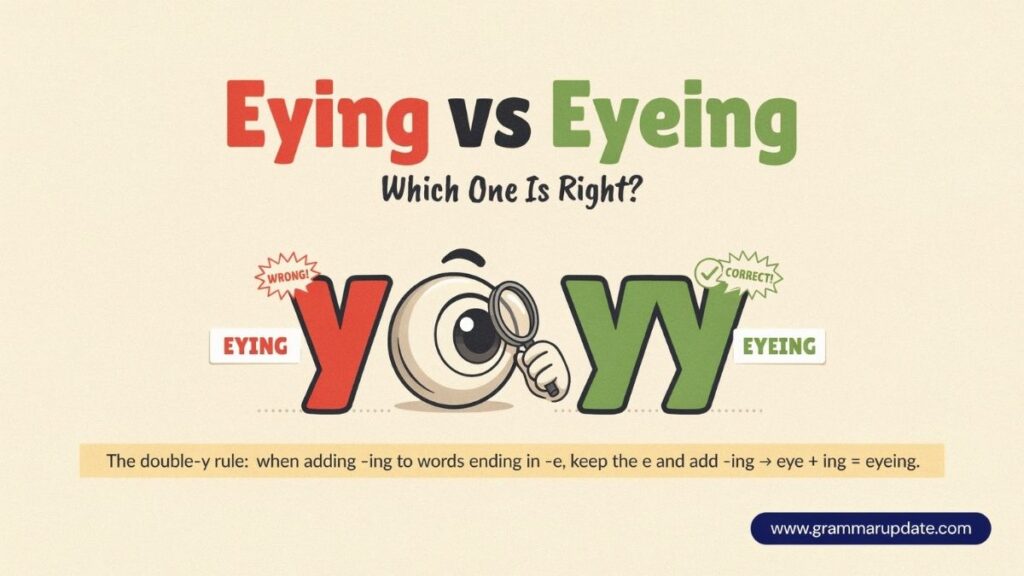
A review of modern publishing trends reveals a clear pattern.
What Published Sources Show
Across newspapers, magazines, academic journals, and corporate publications:
- Eyeing appears significantly more often.
- Eying appears less frequently but remains accepted.
Why This Matters
Readers often associate familiarity with correctness.
Although eying is legitimate, some readers may mistakenly assume it is a typo simply because they encounter it less often.
Key Lesson
If your goal is maximum clarity and reader confidence, eyeing generally delivers the best results.
Fix common more word mistakes in English
Acception vs Exception Difference and Usage?
Grammar Rules for Eyeing and Eying
Base Verb
The base form is:
Eye
Present Tense
- I eye
- You eye
- We eye
- They eye
Past Tense
Eyed
Examples:
- She eyed the proposal carefully.
- He eyed the exit suspiciously.
Present Participle
Both forms are accepted:
- Eyeing
- Eying
Past Participle
Eyed
Example:
- The opportunity was carefully eyed by investors.
Important Rule
The spelling variation exists only in the -ing form. All other verb forms remain unchanged.
Usage Tips to Avoid Spelling Errors
Choose One Spelling and Stay Consistent
Select either:
- Eyeing
- Eying
Then use the same form throughout your document.
Follow Your Style Guide
If your organization follows:
- AP Style
- Chicago Style
- MLA
- APA
- House Style
Check whether it recommends a preferred spelling.
Consider Your Audience
For international audiences, eyeing is generally the most recognizable option.
Prioritize Readability
Readers should focus on your message, not your spelling choices.
When in Doubt, Use Eyeing
Because it is the traditional and more widely recognized spelling, eyeing remains the safest choice for most situations.
More Related Articles You May Find Helpful
Connector vs Connecter Which Spelling Is Correct?
Key Takeaways
Before you leave, here are the most important points to remember about eying vs eyeing.
Both Spellings Are Correct
One of the biggest myths is that one spelling must be wrong. In reality:
Eyeing and eying are both correct spellings of the present participle of the verb “to eye.”
Eyeing Is the Traditional and Preferred Form
Most dictionaries, editors, publishers, and style guides prefer:
Eyeing
because it preserves the original spelling of the base word and looks more familiar to readers.
Eying Is an Accepted Alternative
Eying is not a typo or grammar mistake. It is a recognized alternative spelling that appears particularly often in American English.
Meaning Never Changes
Whether you choose eyeing or eying, the meaning remains exactly the same.
Consistency Matters Most
Whichever spelling you choose, use it consistently throughout your writing.
More Related Articles You May Find Helpful
Traveler vs Traveller Which Spelling Is Correct?
Practice Session Eying vs Eyeing
Complete each sentence with the correct spelling: eyeing or eying.
Tip: Both spellings are technically correct, but eyeing is the preferred and more widely used spelling in formal and professional writing.
Fill in the Blanks
- The company is ______ several expansion opportunities in Europe.
- She kept ______ the last slice of pizza during lunch.
- Investors are ______ emerging technology stocks.
- The coach is ______ another championship title.
- He spent the afternoon ______ luxury watches online.
- Buyers are ______ waterfront properties in the area.
- The retailer is ______ new locations for future stores.
- Scientists are ______ innovative solutions to the problem.
- The manager is ______ several candidates for the position.
- They were ______ the investment opportunity carefully.
- Students are ______ scholarship opportunities abroad.
- The athlete is ______ a place on the national team.
- Customers are ______ the latest smartphone release.
- The startup is ______ international expansion.
- We are ______ several options before making a final decision.
- The dog sat quietly, ______ the sandwich on the table.
- Analysts are ______ economic trends closely.
- She was ______ a beautiful dress in the display window.
- The company is ______ a strategic partnership with a global brand.
- Travelers were ______ discounted holiday packages.
- Homebuyers are ______ newly listed properties.
- The team is ______ a place in the championship game.
- Researchers are ______ new methods to improve efficiency.
- He kept ______ the clock during the lengthy meeting.
- The organization is ______ future growth opportunities.
Answers
- eyeing
- eyeing
- eyeing
- eyeing
- eyeing
- eyeing
- eyeing
- eyeing
- eyeing
- eyeing
- eyeing
- eyeing
- eyeing
- eyeing
- eyeing
- eyeing
- eyeing
- eyeing
- eyeing
- eyeing
- eyeing
- eyeing
- eyeing
- eyeing
- eyeing
Sentence Correction Practice
Each sentence contains the less common spelling eying. Rewrite the sentence using the preferred spelling eyeing.
- The company is eying new markets in Asia.
- Investors are eying renewable energy projects.
- She is eying a promotion next year.
- Buyers are eying beachfront properties.
- The coach is eying a championship run.
- Customers are eying the new product line.
- The startup is eying international investors.
- Researchers are eying new testing methods.
- Travelers are eying discounted flight deals.
- The retailer is eying additional store locations.
Correct Answers
- The company is eyeing new markets in Asia.
- Investors are eyeing renewable energy projects.
- She is eyeing a promotion next year.
- Buyers are eyeing beachfront properties.
- The coach is eyeing a championship run.
- Customers are eyeing the new product line.
- The startup is eyeing international investors.
- Researchers are eyeing new testing methods.
- Travelers are eyeing discounted flight deals.
- The retailer is eyeing additional store locations.
Challenge Round
Choose the correct option.
- The company is (eyeing / eying) a merger.
- She kept (eyeing / eying) the dessert menu.
- Investors are (eyeing / eying) new opportunities.
- The athlete is (eyeing / eying) an Olympic medal.
- Analysts are (eyeing / eying) market trends.
Answers
- eyeing
- eyeing
- eyeing
- eyeing
- eyeing
Here’s a trusted source for clear word meanings:
FAQs
Is it side eyeing or side eying?
Both spellings exist, but side eyeing is the preferred and more widely used form. The standard spelling in modern English favors eyeing rather than eying, especially in formal writing.
What does “eying someone” mean?
Eying someone means looking at a person with attention, curiosity, interest, suspicion, or evaluation. It often suggests focused observation rather than a casual glance.
Example:
She kept eying the new student during the lecture.
What does “eyeing on it” mean?
The phrase “eyeing on it” is not grammatically correct in standard English. The correct structure removes “on.”
Correct: I’m eyeing that opportunity.
Incorrect: I’m eyeing on that opportunity.
How do you use eying in a sentence?
Eying is the present participle of the verb eye, meaning to watch or consider something closely.
Examples:
- Investors are eying new markets.
- He was eying the last slice of pizza.
- She kept eying the promotion carefully.
Is eyeing or eying correct?
Both eyeing and eying are correct spellings. However, eyeing is more widely accepted, more common in publishing, and preferred in most formal contexts.
Why is she eyeing me?
If someone is eyeing you, they are looking at you with attention or interest. This may indicate curiosity, attraction, suspicion, or evaluation depending on the situation.
What is a synonym for eying?
Common synonyms include:
- Watching
- Observing
- Looking at
- Inspecting
- Examining
- Assessing
- Evaluating
- Studying
How do you pronounce eying?
eying (EYE-ing)
Eying is pronounced the same way as eyeing:
/eye-ing/
What does eyeing someone mean?
Eyeing someone means watching or noticing them closely, often with interest, evaluation, attraction, or suspicion.
What does “eying” mean?
Eying simply refers to looking at or considering something carefully. It is an alternative spelling of eyeing with the same meaning and usage.
What does “eying someone up” mean?
Eying someone up means looking at a person in a detailed or evaluative way, often to judge appearance, ability, or suitability.
Example:
The recruiter was eyeing up candidates for the role.
Is eying a valid Scrabble word?
Yes. Eying is accepted in standard Scrabble dictionaries and is considered a valid English word.
What does eying me up mean?
Eying me up means someone is looking at you closely, often with interest, curiosity, or evaluation. The tone depends on context and body language.
What does side eyeing someone mean?
Side eyeing someone means giving a sideways glance that shows skepticism, judgment, disapproval, or disbelief.
Example:
Everyone was side eyeing him after the unexpected comment.
What does it mean if someone is eyeing you?
If someone is eyeing you, they are focusing their attention on you for a reason such as:
- Interest or attraction
- Curiosity
- Suspicion
- Evaluation
- Admiration
The exact meaning depends on context and expression.
Which is correct, eying or eyeing?
Both are correct, but usage differs:
| Spelling | Usage |
|---|---|
| Eyeing | Preferred, standard, widely used |
| Eying | Accepted variant, less common |
Conclusion
Eying vs eyeing may look like a minor spelling issue, but it often creates unnecessary mistakes and confusion for writers who are unsure which form is correct. The key point is simple: neither spelling is wrong, and both carry the same meaning. Confusion arises because readers encounter two variations and assume one must be incorrect, which is not true. The real difference lies in usage preference and frequency, not grammar rules. Once you understand that eyeing is the more widely accepted and commonly used form, the confusion disappears. From this point forward, you can write with clarity, avoid hesitation, and use the word consistently in any context without second-guessing.

Jhon AJS, the creative mind behind Grammar Update, is an experienced blogger passionate about simplifying English grammar. He focuses on explaining confusing word vs word differences, grammar rules, punctuation, and sentence structure in a clear and practical way. Through easy to understand guides and examples, Jhon helps readers improve their writing and communicate with confidence. With years of blogging experience, he continues to share helpful insights that make learning grammar simple, useful, and accessible for everyone.