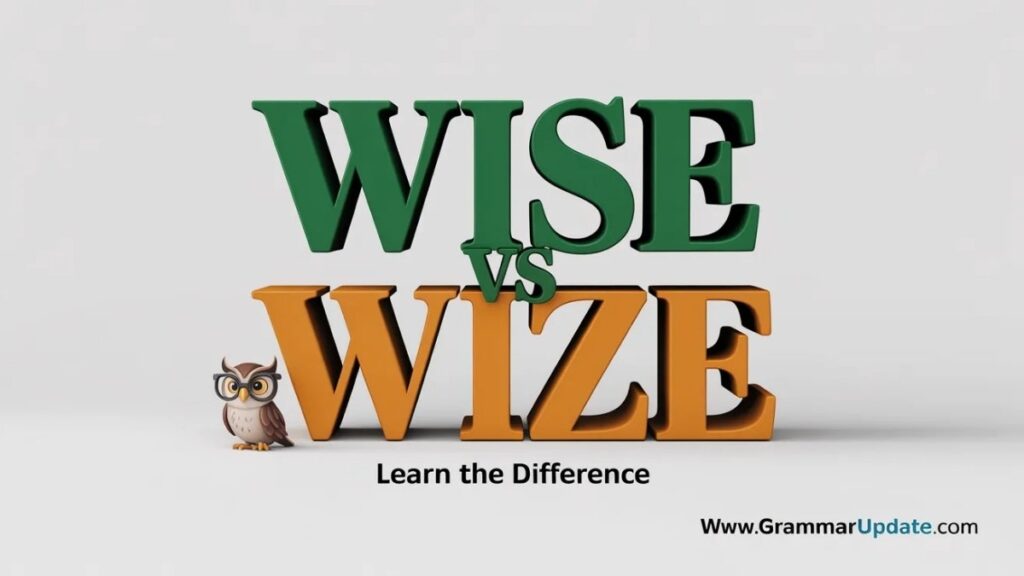
If you have ever hesitated between wise vs wize, you’re dealing with one of those deceptively simple spelling traps in English. The words sound exactly the same, which is where most of the confusion starts. As a result, many writers assume both versions are correct, even though only one follows standard English rules. In reality, one spelling is accepted in dictionaries and professional writing, while the other is a common error that can weaken clarity and credibility. In this guide, we’ll clear up the confusion, explain the true wise meaning, and show why “wize” keeps appearing despite not being correct, so you can write with confidence every time.
The Definitive Difference
The comparison between wise vs wize is not a matter of preference or regional variation. It reflects a clear distinction between correct usage and non-standard spelling. The word “wise” appears consistently across dictionaries, educational materials, and professional writing. In contrast, “wize” does not appear in authoritative sources and lacks recognition in formal language systems.
Comparison Table: Wise vs Wize
| Feature | Wise | Wize |
|---|---|---|
| Standard English spelling | Yes | No |
| Dictionary recognition | Yes | No |
| Scrabble validity | Valid | Not valid |
| Professional acceptance | High | None |
| Usage context | Formal and informal | Informal or branding |
This comparison highlights the wize vs wise spelling difference and clarifies why using the correct form matters in every context where accuracy is important.
A Complete Explanation
The meaning of wise in English goes beyond simple intelligence. It combines knowledge, experience, and sound judgment. A clear and widely accepted definition of wise is the ability to make thoughtful decisions based on understanding and practical insight.
Expanded Meaning of Wise
| Context | Explanation | Example |
|---|---|---|
| Personal quality | Demonstrates understanding and maturity | She is a wise mentor |
| Decision-making | Reflects careful thinking | That was a wise choice |
| Advice | Based on experience | He offered wise guidance |
| Behavior | Calm and balanced | A wise response avoids conflict |
This table illustrates how the wise word meaning applies across different situations, making it a versatile and valuable term in English vocabulary.
Wise Person Meaning Understanding True Wisdom
The wise person meaning involves more than academic knowledge or intellectual ability. A wise individual demonstrates the ability to interpret situations, anticipate consequences, and act with careful consideration. This combination of insight and restraint is what distinguishes wisdom from simple intelligence.
A wise person tends to evaluate circumstances before acting. Instead of reacting emotionally, they pause, reflect, and consider long-term outcomes. This approach allows them to make decisions that are not only logical but also balanced and effective. In many cases, wisdom develops through experience, which explains why it is often associated with maturity and life knowledge.
Wize Meaning Clarifying the Misconception
Many writers search for what does wize mean, assuming it might carry a distinct definition. In reality, the word has no official meaning in standard English. It appears primarily as a result of spelling errors or informal usage patterns.
Validation Table
| Criteria | Result |
|---|---|
| Dictionary inclusion | No |
| Academic acceptance | No |
| Scrabble validity | No |
| Standard English usage | Invalid |
When asking is wize a word, the answer is consistently no in formal contexts. Its presence in writing usually reflects a mistake rather than an accepted variation.
Learn the difference between everyday English mistakes
Waring vs Wearing Differences and Usage with Examples
Impact on Communication
Although both spellings may be intended to convey the same idea, only one communicates it correctly. The use of “wise” ensures clarity and aligns with standard language expectations. The use of “wize,” on the other hand, can create confusion and weaken the overall quality of writing.
Comparison Table: Correct vs Incorrect Usage
| Sentence Type | Example |
|---|---|
| Correct usage | It is wise to prepare for challenges |
| Incorrect usage | It is wize to prepare for challenges |
This distinction demonstrates how a small spelling difference can affect readability and professionalism.
Why “Wize” Is Incorrect: Linguistic Perspective
The confusion between wise or wize often arises from pronunciation. In spoken English, the “s” in “wise” produces a sound similar to “z,” which leads many writers to assume the spelling should reflect that sound. However, English spelling frequently preserves historical forms rather than following phonetic logic.
The word “wise” originates from Old English and has retained its original structure over time. This historical consistency explains why the spelling remains unchanged despite its pronunciation. As a result, “wize” is considered a phonetic error rather than an acceptable alternative.
Learn the difference between everyday English mistakes
Midday vs Mid Day Which Spelling Is Correct in Modern English?
How to Use Wise in English Effectively
Using “wise” correctly enhances both clarity and precision in writing. The word functions primarily as an adjective and can describe people, decisions, actions, or advice.
Usage Table
| Context | Example |
|---|---|
| Advice | It is wise to think before acting |
| Personality | She is regarded as a wise leader |
| Decision | That was a wise investment |
| Strategy | A wise plan considers potential risks |
These examples illustrate how to use wise in English across a range of contexts.
Learn the difference between commonly misused words
Blankie vs Blanky Difference and Explained
Wise Synonyms
Expanding your vocabulary helps avoid repetition and improves communication. Several synonyms convey similar meanings to “wise,” each with subtle differences in tone.
Synonyms Table
| Word | Meaning |
|---|---|
| Intelligent | Strong mental ability |
| Prudent | Careful and cautious |
| Sensible | Practical and reasonable |
| Insightful | Deep understanding |
| Judicious | Demonstrates sound judgment |
These alternatives can enhance writing by adding variety while maintaining clarity.
Learn the difference between commonly misused words
Sponser vs Sponsor Difference and Usage
Wise Slang Meaning and Informal Usage
The wise slang meaning introduces additional layers of interpretation. In informal contexts, the word appears in expressions that carry slightly different meanings depending on tone and usage.
For example, phrases such as “wise up” suggest becoming aware or informed, while “wise guy” often describes someone who is sarcastic or overly confident. These expressions demonstrate how language evolves in everyday communication while still maintaining its core meaning.
Learn the difference between often confused words
Useable vs Usable Difference and Correct Usage
Common Mistakes Why “Wize” Continues to Appear
The persistence of the wize spelling mistake can be traced to natural writing habits. Many people rely on sound when spelling, especially when typing quickly. This tendency leads to phonetic substitutions, where letters are chosen based on how a word sounds rather than how it is correctly written.
Mistake Overview Table
| Incorrect Form | Issue |
|---|---|
| Wize | Phonetic error |
| Wyse | Non-standard variation |
| Wice | Typographical mistake |
Understanding these patterns helps reduce errors and improves overall writing accuracy.
How to Avoid Spelling Errors
Avoiding mistakes like “wize” requires attention to detail and familiarity with standard spelling patterns. Writers benefit from reviewing their work carefully and using reliable tools to confirm uncertain words. Over time, repeated exposure to correct forms strengthens memory and reduces reliance on guesswork.
Learn the difference between often confused words
Perfer vs Prefer Usage and Common Mistakes
Context Matters Importance of Correct Spelling
Correct spelling becomes especially important in contexts where clarity and professionalism are essential. Academic writing, business communication, and formal documentation all require adherence to standard language rules. In these situations, even minor errors can affect credibility and perception.
Final Comparison Table
| Word | Correct | Meaning | Usage |
|---|---|---|---|
| Wise | Yes | Knowledgeable and sensible | All contexts |
| Wize | No | Intended same meaning | Avoid |
Learn the difference between often confused words
Finaly vs Finally Differences and Usage
Practice Sessions wise vs wize
These exercises focus on accuracy, clarity, and real-world application of wise or wize. Complete each section carefully to reinforce correct spelling and usage.
Fill in the Blanks
Complete each sentence with the correct word.
It is ______ to think before making a decision.
Answer: wise
A ______ person learns from experience.
Answer: wise
That was a very ______ choice in a difficult situation.
Answer: wise
She offered ______ advice during the meeting.
Answer: wise
Correct Spelling Recognition
Select the correct option.
Which spelling is correct in standard English?
A) Wize
B) Wise
Correct answer: B) Wise
Which word is considered a spelling mistake?
A) Wise
B) Wize
Correct answer: B) Wize
Which form is accepted in dictionaries and formal writing?
A) Wise
B) Wize
Correct answer: A) Wise
Which word is valid in Scrabble?
A) Wise
B) Wize
Correct answer: A) Wise
Context Understanding
Choose the correct spelling based on meaning.
It would be ______ to prepare for unexpected challenges.
Answer: wise
A ______ leader remains calm under pressure.
Answer: wise
Making a ______ decision requires careful thinking.
Answer: wise
Meaning and Usage
Choose the correct answer.
What does “wise” mean?
A) Careless and quick
B) Having good judgment and knowledge
C) Loud and expressive
Correct answer: B) Having good judgment and knowledge
Is “wize” a real word in standard English?
A) Yes
B) No
Correct answer: B) No
What is the main difference between wise and wize?
A) No difference
B) Wise is correct, wize is incorrect
C) Wize is formal
Correct answer: B) Wise is correct, wize is incorrect
Here’s a trusted source for clear word meanings:
FAQs
What does “wise” mean?
“Wise” means having good judgment, knowledge, and experience. It describes someone who makes thoughtful and sensible decisions.
Is “wize” a real word?
No. “Wize” is not a recognized word in standard English. It is considered a spelling mistake or informal variation.
Is wize in the dictionary?
No. “Wize” does not appear in standard English dictionaries.
Is wize a valid Scrabble word?
No. Only “wise” is accepted as a valid Scrabble word.
What is the difference between wise and wize?
“Wise” is the correct spelling. “Wize” is incorrect and should not be used in formal or professional writing.
Can you use wize instead of wise?
No. You should always use “wise” in correct English usage.
What does a wise person mean?
A wise person is someone who shows good judgment, experience, and thoughtful decision-making.
Why do people write wize instead of wise?
People often write “wize” because it sounds like it ends with a “z.” This is a common phonetic spelling mistake.
How do you spell wise correctly?
The correct spelling is W-I-S-E.
Conclusion
The confusion between wise vs wize is understandable, but once you see the rule clearly, it becomes easy to avoid. English pronunciation can be misleading here because both forms sound identical, which often leads writers to assume they are interchangeable. However, written English does not work on sound alone, it depends on standard spelling conventions.
To be precise, “wise” is the correct and accepted spelling in English, while “wize” is not recognized in formal writing. It may appear in casual messages, usernames, or branding, but it does not meet standard language rules and should be avoided in academic or professional contexts.
What makes this mistake so common is speed, not ignorance. People type quickly, trust pronunciation, and assume spelling follows sound. That’s where “wize” slips in unnoticed, creating a small but avoidable error that can affect writing clarity.
Now that the distinction is clear, the uncertainty disappears. You no longer need to hesitate or rely on guesswork. Choosing “wise” becomes automatic, which strengthens both accuracy and professionalism in your writing.
In the end, it’s a simple rule with a big impact. One spelling is correct, the other is not, and knowing the difference ensures your writing stays clear, credible, and grammatically sound every time.

Jhon AJS, the creative mind behind Grammar Update, is an experienced blogger passionate about simplifying English grammar. He focuses on explaining confusing word vs word differences, grammar rules, punctuation, and sentence structure in a clear and practical way. Through easy to understand guides and examples, Jhon helps readers improve their writing and communicate with confidence. With years of blogging experience, he continues to share helpful insights that make learning grammar simple, useful, and accessible for everyone.