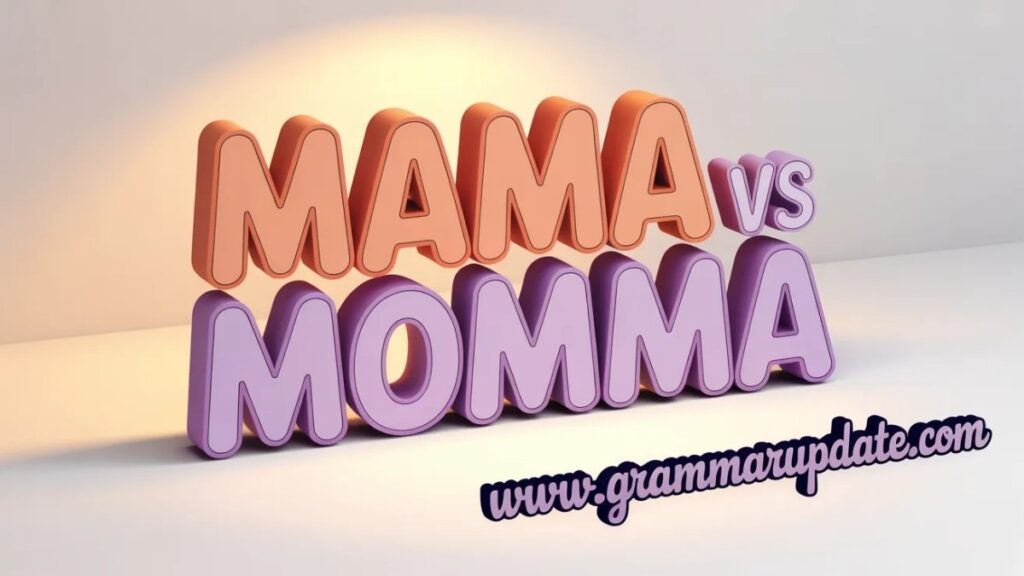
If you have ever paused while writing and wondered mama vs momma, you are not alone. This small spelling question creates confusion for many writers, families, and even autocorrect. One form feels classic and widely recognized, while the other sounds warm, personal, and full of character. The good news is that this is not a serious grammar problem. Both words can be correct depending on context, region, and tone. In this guide, mama vs momma is explained clearly through meaning, pronunciation, examples, and usage tips so you can avoid mistakes and choose the most natural spelling with confidence every single time.
Mama vs Momma Quick Answer
If you have ever wondered mama or momma, the honest answer is that both spellings are used and both commonly mean mother. The difference is not about one being absolutely right and the other being wrong. Instead, the real difference usually comes down to tone, region, culture, and personal preference.
Mama is the more common and widely recognized spelling. It appears across many English-speaking countries and in many other languages. Momma is also a valid and popular informal variant, especially in conversational English and parts of the Southern United States.
If you are asking is it mama or momma, the best answer is this: both can be correct depending on how and where you use them.
| Word | Meaning | Style | Common Use |
|---|---|---|---|
| Mama | Mother | Universal and affectionate | Global usage |
| Momma | Mother | Warm and informal | Mostly U.S. speech |
What Do These Words Really Mean?
The phrase mama or momma meaning is simple in definition but rich in emotion. Both words are affectionate terms for mother. They are usually warmer and more personal than the formal word mother.
When people say mama or momma, they often express comfort, closeness, family identity, love, or nostalgia. These are emotional words as much as they are vocabulary words.
Children often learn sounds like “ma” very early, which is one reason similar parent words appear in many cultures worldwide.
Examples
- My mama always gave wise advice.
- Her momma supported every dream she had.
- I called my mama after a long day.
These examples show that the meaning is the same, while the feeling may differ slightly.
Momma vs Mama Main Difference Explained Clearly
The discussion around momma vs mama is mostly about style and language flavor. Both terms refer to a mother, but they can create different impressions.
Mama often feels universal, soft, and timeless. It works across many audiences and is recognized globally.
Momma often feels more expressive, cozy, and regionally rooted. It appears often in storytelling, music, casual speech, and family-centered language.
Mama vs Momma Difference
| Feature | Mama | Momma |
|---|---|---|
| General Recognition | Very high | High |
| Tone | Gentle and broad | Warm and personal |
| Regional Identity | Global | Often Southern U.S. |
| Writing Feel | Neutral | Voice-rich |
Simple takeaway
Choose mama for a broad audience. Choose momma when you want personality, family warmth, or a specific voice.
Is It Mama or Momma in English?
Many people search mama vs momma in English because they want to know if one spelling is wrong. In modern English, both forms are accepted in everyday usage. However, dictionaries often list mama as the standard form, while momma may appear as a variant or informal spelling.
That means momma spelling is not automatically incorrect. It simply carries a more conversational tone.
Use mama when you want:
- A clean and common spelling
- Broad recognition
- Neutral tone
Use momma when you want:
- Family warmth
- Regional authenticity
- Character voice in dialogue
How to Spell Mama Correctly
If someone asks how to spell mama, the most common spelling is:
M-A-M-A
This is the version most widely recognized in English. However, many people also write:
M-O-M-M-A
That version is also common in informal contexts.
| Spelling | Typical Tone |
|---|---|
| Mama | Standard and universal |
| Momma | Informal and expressive |
| Mamma | Often European or stylized |
The best spelling often depends on audience and purpose.
Learn the difference between confusing word pairs
Protestors or Protesters Which Spelling Is Actually Correct?
Mama Pronunciation vs Momma
Another frequent search is mama pronunciation vs momma. In many accents, the spoken difference is very small. Sometimes there is almost no noticeable difference at all.
Mama may sound like:
MAH-mah or MAM-ah
Momma may sound like:
MOM-ah
Because pronunciation changes by region, spelling often follows family habit more than grammar rules.
Example
A child in one family may say “mama,” while another says “momma,” yet both are referring to the same person.
Learn the difference between confusing word pairs
Unenroll vs Disenroll Differences with Complete Guide
Mama vs Momma in the South
The phrase mama vs momma in the south matters because regional speech shapes vocabulary strongly.
In many Southern U.S. communities, momma is especially common. It often reflects family closeness, tradition, respect, and cultural identity.
Examples include:
- My momma raised me right.
- Ask your momma first.
- Momma always knows.
This use is not incorrect. It is part of living language shaped by community and history.
Regional Case Study
A writer from Texas may naturally choose momma, while a writer from California may prefer mama. Both choices can sound authentic.
Learn the difference between similar English words
Emaculate vs Immaculate Which One Is Correct?
Mama or Mamma Italian Connection
Many people search mama or mamma Italian after seeing multiple spellings in songs, films, or family settings.
In Italian, mamma commonly means mother or mom. It is a deeply familiar and affectionate term. English speakers often recognize this spelling through popular culture.
| Word | Language | Meaning |
|---|---|---|
| Mama | English / global | Mother |
| Momma | Informal English | Mother |
| Mamma | Italian | Mother |
This explains why several spellings feel familiar across cultures.
Momma or Mama Bear Meaning
The phrase momma or mama bear meaning refers to a fiercely protective mother figure. It describes a parent who strongly defends and supports her children.
Examples
- She became a mama bear when her child was treated unfairly.
- Every momma bear protects her family.
This phrase is common in parenting culture, social media, and everyday speech.
Learn the difference between confusing English words
Uncollectible vs Uncollectable and How to Use Each Word
Mama or Momma Examples in Real Sentences
Seeing mama or momma examples helps show natural usage.
Mama Examples
- My mama taught me kindness.
- Mama called this morning.
- I miss my mama every day.
Momma Examples
- My momma makes the best soup in town.
- Momma said to stay humble.
- Her momma supported her dream.
Mama or Momma in a Sentence
| Tone | Example |
|---|---|
| Neutral | My mama helped me study. |
| Warm | My momma never stopped believing in me. |
Mama vs Mommy vs Mom
English offers several affectionate terms for mothers.
| Word | Tone | Typical Use |
|---|---|---|
| Mother | Formal | Official or serious |
| Mom | Everyday standard | Common in U.S. |
| Mommy | Childlike and affectionate | Children |
| Mama | Warm and universal | Many cultures |
| Momma | Informal and expressive | Family / regional |
Each word carries emotional meaning beyond its dictionary definition.
Learn the difference between confusing English words
Trek vs Treck Confusion and Correct Usage
Common Mistakes with Mama or Momma
Some writers overcomplicate this topic by assuming only one spelling is acceptable.
Common mistakes include using both spellings randomly in the same article, treating momma as always wrong, or confusing momma with mamma.
A better approach is consistency. Choose the version that fits your audience and keep it steady unless quoting speech.
Why Mama Is Used Worldwide
The reason mama appears in so many languages is simple. Babies naturally make easy sounds such as “ma,” “ba,” and “da.” Over time, many cultures connected those sounds to parents.
That is why words similar to mama appear around the world. It is one of the most natural family words humans use.
Some of the oldest words in language are often the words closest to home.
Understand confusing English words simply
Shinning vs Shining Correct Spelling and Usage
Professional Writing Tip Which Should You Use?
If you are writing for a wide audience, mama is often the safest and clearest option. It feels familiar and broadly understood.
If you are writing fiction, memoir, family branding, country-style marketing, or personal dialogue, momma may sound more authentic.
| Context | Best Choice |
|---|---|
| Formal article | Mama |
| Dialogue | Momma |
| Parenting blog | Either |
| Brand with warmth | Momma |
| Broad audience content | Mama |
Mini Branding Example
Two bakeries open in the same town:
Mama’s Kitchen
Momma’s Kitchen
The first sounds classic and broad. The second sounds cozy, homemade, and personal. Same meaning. Different emotional branding.
That is the power of word choice.
Learn how to use confusing words correctly
Carrer vs Career The Correct Spelling and Difference
How Do You Spell Mama and Papa?
Many users ask how do you spell mama and papa.
The most common forms are:
- Mama
- Papa
Common informal variants include:
- Momma
- Poppa
Families often choose what feels natural rather than what feels formal.
Learn how to use confusing words correctly
Scarey vs Scary Learn the Correct Spelling
Practice Session Mama vs Momma
This practice set will help you clearly understand when to use mama or momma in real sentences. Focus on meaning, tone, and context before answering.
Fill in the Blanks
Complete the sentences using mama or momma.
- My ______ always tells me to stay kind and honest.
- In many Southern families, people say ______ instead of mother.
- I called my ______ after school to share good news.
- His ______ makes the best homemade food.
- Every child has a special bond with their ______.
- The singer sang a song about his ______.
- She learned cooking from her ______.
- A protective ______ always stands up for her children.
- He said, “My ______ raised me well.”
- Many cultures use ______ as an affectionate word for mother.
Multiple Choice
Choose the correct answer.
- Which spelling is more widely used globally?
a) momma
b) mama
c) mumma - “My ___ taught me everything I know.”
a) momma
b) mama
c) both can be correct - Which word is more informal and regional?
a) mama
b) momma
c) mother - What does “momma” usually mean?
a) father
b) mother
c) teacher - Which is correct in formal writing?
a) mama
b) momma
c) both equally formal - “She is a loving ___ bear.”
a) momma
b) mama
c) both can be used - Which word is most neutral and widely accepted?
a) momma
b) mama
c) mommy - “He misses his ___ every day.”
a) momma
b) mama
c) both can be correct depending on tone
Answer Key
Fill in the Blanks
- mama / momma
- momma
- mama / momma
- momma / mama
- mama / momma
- mama
- momma / mama
- momma / mama
- mama / momma
- mama / momma
Multiple Choice
- b
- c
- b
- b
- a
- c
- b
- c
Quick Rule to Remember
If it feels global and neutral → mama
If it feels warm, emotional, or regional → momma
That simple rule will help you never confuse mama vs momma again.
Here’s a trusted source for clear word meanings:
FAQs
Which is correct, mama or momma?
Both are correct in usage. “Mama” is more standard and widely accepted, while “momma” is informal and often used for tone or regional expression.
Is momma or mama more common?
Mama is more common globally. It appears in many languages and is widely understood, while momma is more region-specific.
What’s the correct way to say mama?
There is no single pronunciation. It is commonly said as “MAH-mah” or “MAM-ah,” depending on accent and region.
Is it baby mama or momma?
The correct informal term is “baby mama,” which refers to the mother of a person’s child outside marriage. It is slang, not formal English.
Is momma grammatically correct?
Yes, “momma” is grammatically acceptable in informal English, especially in dialogue or casual writing, but it is not preferred in formal contexts.
What is momma slang for?
“Momma” is slang for mother, often used in affectionate, emotional, or regional speech, especially in Southern American English.
Is momma a real word?
Yes, “momma” is a real informal variant of “mama” used in English, though “mama” is the more standard spelling.
Is it mama’s boy or momma’s boy?
Both are used, but “mama’s boy” is more common in general English. “Momma’s boy” is more informal and regional.
What’s a better way to say baby momma?
More respectful alternatives include “co-parent,” “child’s mother,” or “mother of my child.”
Why do people say momma?
People say “momma” because it reflects speech patterns, emotional tone, and regional dialects, especially in informal or Southern U.S. English.
How do British say “daddy”?
In British English, people commonly use “dad” or “daddy” (especially for young children). “Dad” is more standard in everyday speech.
Is momma or mama Southern?
“Momma” is more strongly associated with Southern American English, while “mama” is more universal and widely used across regions.
Conclusion
In conclusion, the debate of mama vs momma is less about strict grammar rules and more about tone, context, and cultural expression. Both terms clearly refer to a mother, and both are widely understood in English. There is no need for confusion or overthinking here.
Mama is generally the more standard and globally recognized spelling, making it suitable for formal or neutral writing. Momma, on the other hand, carries a warmer, more informal feel and is often used in regional speech, storytelling, and emotional contexts.
The key takeaway is simple: choose the spelling that matches your audience and intent. Good writing is not just about correctness it is also about clarity, consistency, and natural expression.

Jhon AJS, the creative mind behind Grammar Update, is an experienced blogger passionate about simplifying English grammar. He focuses on explaining confusing word vs word differences, grammar rules, punctuation, and sentence structure in a clear and practical way. Through easy to understand guides and examples, Jhon helps readers improve their writing and communicate with confidence. With years of blogging experience, he continues to share helpful insights that make learning grammar simple, useful, and accessible for everyone.