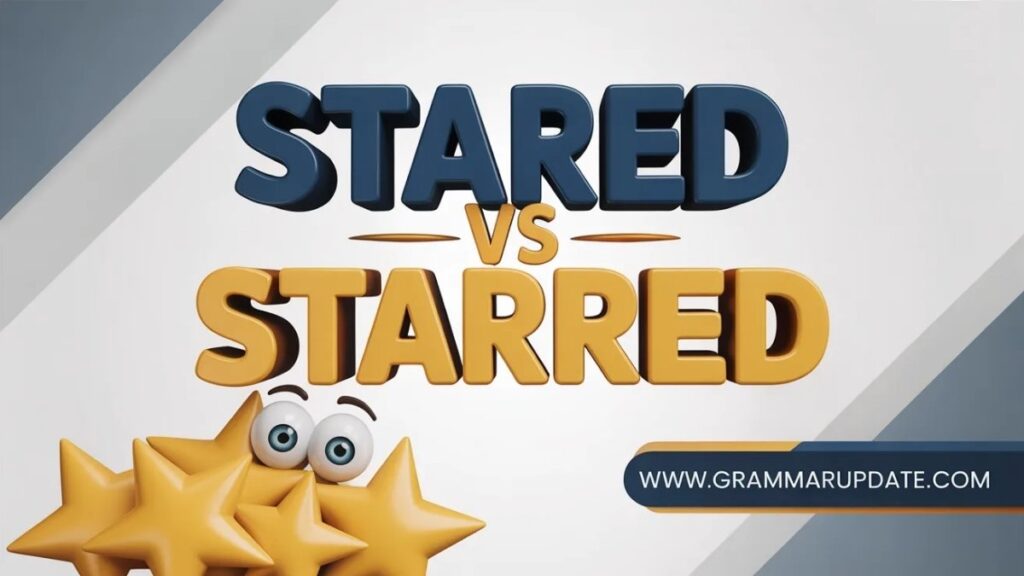
If you have ever paused while writing and asked yourself about stared vs starred, you’re dealing with one of those small but surprisingly tricky English confusions. The words sound identical when spoken, yet they carry completely different meanings, and mixing them up can change the message of your sentence in an instant. One word relates to looking at something with focus or emotion, while the other is connected to roles, recognition, or marking something important. In this guide, you’ll clearly understand the difference between stared and starred, avoid common grammar mistakes, and use each word correctly in a natural, confident way.
Difference Explained with Precision
When analyzing stared vs starred meaning, the distinction becomes clear once you link each word to its function.
“Stared” belongs to the world of observation. It describes how someone looks at something. “Starred” belongs to the world of recognition. It describes someone being featured or something being marked.
This difference is not interchangeable. Using the wrong word creates confusion because it shifts the sentence into an entirely different context.
- Example: She stared at the results in shock.
- Example: She starred in a film about scientific discovery.
Quick Comparison Table
| Feature | Stared | Starred |
|---|---|---|
| Core meaning | Looked intensely | Featured or marked |
| Context | Human reaction | Media, apps, lists |
| Function | Visual action | Role or emphasis |
| Common confusion | Acting mistake | Observation error |
Deep Explanation with Context
The stared meaning in English centers on focused visual attention. It describes a deliberate, sustained look, often driven by emotion or curiosity. Unlike casual glancing, staring suggests intention and intensity.
In literature and storytelling, “stared” is frequently used to build tension, express emotion, or reveal character reactions. It can imply shock, admiration, confusion, or even discomfort depending on context.
- Example: She stared at the letter, unable to process the news.
- Example: The audience stared at the stage, waiting for the performance to begin.
Expanded Usage Table
| Situation | Meaning | Example |
|---|---|---|
| Emotional reaction | Shock or surprise | He stared at the unexpected result |
| Curiosity | Deep interest | She stared at the strange device |
| Silence | Unspoken communication | They stared at each other |
Important Insight
“Stared” often appears with the preposition “at”, forming phrases like “stared at me,” which is one of the most common patterns in English usage.
Sponser vs Sponsor Difference and Usage
Complete Functional Understanding
The starred meaning in English relates to prominence, importance, and visibility. It can refer to acting in a leading role, being featured in a project, or marking something for attention.
In modern usage, “starred” has expanded beyond entertainment into digital environments. Emails, messages, and files can be “starred” to indicate importance or save them for later.
- Example: The actor starred in a globally successful film.
- Example: She starred the document to review it later.
Expanded Usage Table
| Context | Meaning | Example |
|---|---|---|
| Film and media | Leading role | He starred in a drama series |
| Digital tools | Marked or saved | I starred the message |
| Recognition | Highlighted importance | The report was starred |
Key Insight
“Starred” often connects with nouns like movie, show, email, message, or role, making it easy to identify when used correctly.
Blankie vs Blanky Difference and Explained
Clear Analytical Comparison
A direct comparison of stared vs starred meaning eliminates ambiguity. While both words share pronunciation, their meanings operate in entirely separate domains.
- Example: He stared at the painting for hours.
- Example: He starred in a film about art history.
Analytical Comparison Table
| Aspect | Stared | Starred |
|---|---|---|
| Category | Behavior | Status |
| Associated sense | Sight | Recognition |
| Emotional tone | Often emotional | Neutral |
| Usage frequency | Daily conversation | Media and tech |
Advanced Clarity
Using “stared” effectively requires understanding its emotional and descriptive value. It often enhances storytelling by showing rather than telling.
- Example: He stared at the empty chair, reflecting on the past.
- Example: She stared at the horizon, hoping for a sign.
Usage Table
| Context | Example |
|---|---|
| Reflection | He stared at the ocean silently |
| Shock | She stared at the broken glass |
| Curiosity | They stared at the unusual machine |
Advanced Insight
In writing, “stared” can replace weaker verbs like “looked” to create stronger imagery and emotional depth.
Wise vs Wize Usage and Mistakes Explained
How to Use “Starred” in a Sentence
“Starred” is often used in structured, factual, or professional contexts. It conveys involvement, importance, or selection.
- Example: The actor starred in multiple award-winning productions.
- Example: I starred the important emails for quick access.
Usage Table
| Context | Example |
|---|---|
| Entertainment | She starred in a documentary |
| Work tools | He starred the task |
| Recognition | The event starred top performers |
Advanced Insight
In digital communication, “starred” has become a functional term used in productivity tools, making it highly relevant in modern English.
Common Mistakes in Stared vs Starred Grammar
Mistakes occur when writers ignore context and rely solely on sound. This leads to sentences that are grammatically incorrect and confusing.
- Example: Incorrect → He starred at the teacher
- Example: Correct → He stared at the teacher
Error Analysis Table
| Error Type | Explanation | Correction |
|---|---|---|
| Role confusion | Acting vs looking | Replace with correct verb |
| Context mismatch | Wrong situation | Adjust based on meaning |
Why People Confuse Stared and Starred
The confusion between stared or starred is rooted in linguistic patterns. Both words are homophones, meaning they share pronunciation but differ in spelling and meaning.
Additionally, modern typing habits and digital communication increase the likelihood of such errors. Writers often prioritize speed over accuracy, leading to frequent misuse.
- Example: Writing quickly and choosing the wrong spelling
- Example: Misinterpreting context in a sentence
Confusion Factors Table
| Factor | Impact |
|---|---|
| Homophones | Same sound |
| Visual similarity | One-letter difference |
| Typing speed | Reduced accuracy |
Trek vs Treck Confusion and Correct Usage
Context Matters The Key to Accuracy
Understanding context eliminates confusion entirely. If the sentence involves vision, “stared” is correct. If it involves roles or marking, “starred” is correct.
- Example: He stared at the clock during the exam.
- Example: He starred in a film about education.
Context Table
| Situation | Correct Word |
|---|---|
| Looking | Stared |
| Acting | Starred |
| Highlighting | Starred |
Staring vs Starring Extended Clarification
The confusion extends to present forms as well. “Staring” and “starring” follow the same logic as their past tense forms.
- Example: She is staring at the screen.
- Example: She is starring in a new series.
Comparison Table
| Word | Meaning |
|---|---|
| Staring | Looking intensely |
| Starring | Acting or featuring |
Synonyms and Related Vocabulary Expansion
Understanding related words strengthens comprehension and usage.
- Example: He gazed at the sunset peacefully.
- Example: She featured in the production.
Synonym Table
| Word | Alternatives |
|---|---|
| Stared | Gazed, glared, observed |
| Starred | Featured, highlighted, headlined |
Pronunciation
Both words share nearly identical pronunciation in conversational English. This similarity causes writers to rely on phonetics rather than spelling rules.
- Example: Both sound like “staird” in casual speech
- Example: Only context reveals correct usage
Pronunciation Table
| Word | Pronunciation |
|---|---|
| Stared | /stɛrd/ |
| Starred | /stɑːrd/ |
Worshipped vs Worshiped Difference and Usage
Memory Technique Retain the Difference Easily
Simple associations improve recall.
- Example: “Stare” connects to eyes and looking
- Example: “Star” connects to fame or marking
Memory Table
| Word | Association |
|---|---|
| Stared | Vision |
| Starred | Recognition |
Parents’ vs Parent’s Differences and Correct Usage
Practice Exercises Stared vs Starred
Strengthen your understanding of stared vs starred with these carefully structured exercises. Focus on context, meaning, and correct grammar usage.
Fill in the Blanks
Complete each sentence with the correct word: stared or starred.
He ______ at the screen in complete silence.
Answer: stared
She ______ in a critically acclaimed film last year.
Answer: starred
The child ______ at the magician in amazement.
Answer: stared
The actor ______ in several international productions.
Answer: starred
They ______ at each other, unsure of what to say next.
Answer: stared
He ______ in a documentary about climate change.
Answer: starred
Multiple Choice Questions
Select the correct option for each sentence.
Which sentence is correct?
A) He starred at me in confusion
B) He stared at me in confusion
Correct answer: B
Choose the correct sentence:
A) She stared in a movie last year
B) She starred in a movie last year
Correct answer: B
Which word fits best?
The audience ______ at the performance in awe.
A) starred
B) stared
Correct answer: B
Select the correct option:
He ______ the important email for later review.
A) stared
B) starred
Correct answer: B
Which sentence is grammatically correct?
A) They starred at the strange object
B) They stared at the strange object
Correct answer: B
Context Based Practice
Choose the correct word based on meaning.
The teacher noticed that the student ______ at the clock repeatedly.
Answer: stared
The actress ______ in a popular television series.
Answer: starred
He ______ at the unexpected result, completely shocked.
Answer: stared
She ______ the file so she could find it quickly later.
Answer: starred
live
Here’s a trusted source for clear word meanings:
FAQs
What is the difference between stared and starred?
“Stared” means looking at something or someone for a long time with focus or emotion. “Starred” means being featured in something, such as a movie, or marking something important.
How do you spell starred or stared?
Both spellings are correct, but they are used in different contexts. “Stared” relates to looking, while “starred” relates to being featured or highlighted.
What does starred mean?
“Starred” means to play a main role in a film, show, or performance, or to mark something with a star for importance or reference.
What does “stared” mean?
“Stared” means to look fixedly at something, often with strong attention, surprise, or curiosity.
Is it spelled staring or starring?
Both are correct. “Staring” means looking intensely, while “starring” means acting in or being featured in something.
What is a starred?
“Starred” is the past tense of “star.” It describes someone who acted in a leading role or something that has been marked or highlighted.
What’s a better word for stared?
Depending on context, alternatives include gazed, glared, observed, or looked intently.
How to use starred in a sentence?
You can use “starred” to describe acting or highlighting. For example: She starred in a popular movie, or I starred the important message to read later.
Conclusion
The confusion between stared vs starred is very common, but once you understand it, it becomes easy to avoid. The problem happens because both words sound the same, yet their meanings are completely different. This leads to frequent grammar mistakes, especially in fast writing or casual communication.
“Stared” always refers to looking at something with focus, attention, or emotion. It describes an action connected to the eyes. In contrast, “starred” is used when someone is featured in a film, show, or role, or when something is marked as important.
Most errors come from relying on sound instead of meaning. When words are pronounced the same, writers often choose the wrong spelling without realizing it. This is why sentences like “he starred at me” appear, even though they are incorrect.
Now the confusion should be clear. If it involves looking, use stared. If it involves acting, highlighting, or importance, use starred. Keeping this simple rule in mind will help you avoid mistakes and write with confidence every time.

Jhon AJS, the creative mind behind Grammar Update, is an experienced blogger passionate about simplifying English grammar. He focuses on explaining confusing word vs word differences, grammar rules, punctuation, and sentence structure in a clear and practical way. Through easy to understand guides and examples, Jhon helps readers improve their writing and communicate with confidence. With years of blogging experience, he continues to share helpful insights that make learning grammar simple, useful, and accessible for everyone.