The confusion between infront vs in front is one of those small but persistent grammar issues that quietly slips into everyday writing. It often appears in messages, emails, and social media posts where speed replaces accuracy, leading many writers to assume both forms are correct. However, English does not treat them equally. The correct form is in front, written as two separate words, while “infront” is considered a spelling error in standard usage. This article explains the difference in a clear, structured, and practical way so you can avoid common mistakes, improve writing accuracy, and use the phrase confidently in both formal and informal contexts.
Quick Answer Infront vs In Front
The correct form is in front. The incorrect form is infront.
This is not a preference or style choice. It is a grammar rule based on how English builds phrases. “In front” is a prepositional phrase, and prepositional phrases are not merged into single words unless they become officially accepted compounds.
English keeps these parts separate because each word contributes meaning.
| Form | Status | Explanation |
|---|---|---|
| in front | Correct | Standard prepositional phrase |
| infront | Incorrect | Spelling mistake, not accepted in formal English |
The mistake usually appears when people type quickly or rely on how the phrase sounds instead of how it is structured.
Example: The car stopped in front of the house, not “infront of the house.”
Is “Infront” a Word?
The question is infront a word appears often because people encounter it in informal writing and assume it is acceptable. However, in standard English, “infront” is not a recognized word in dictionaries or grammar references.
It is best described as a misspelling created by word merging.
You will still see it in:
- social media posts
- casual chats
- fast typing environments
- autocorrect-generated text
But none of these make it correct in formal writing.
| Context | Acceptable? | Reason |
|---|---|---|
| Academic writing | No | Requires standard grammar |
| Business writing | No | Professional accuracy needed |
| Social media | Sometimes used | Informal habits |
| Dictionaries | No | Not recognized |
Example: “He stood infront of me” is incorrect and should always be written as “He stood in front of me.”
In Front Meaning Explained
The in front meaning refers to a position that is ahead of something in space, direction, or order. It is a prepositional phrase used to describe spatial relationships clearly.
In simple terms, it tells you where something is located relative to something else.
It can be used in three main ways:
First, it describes physical position.
Second, it describes visibility or exposure.
Third, it can describe focus or attention in a figurative sense.
| Type | Meaning | Example |
|---|---|---|
| Physical | ahead in space | in front of the house |
| Visual | visible position | in front of the camera |
| Social | exposure or attention | in front of an audience |
Example: The bicycle is parked in front of the house.
In Front Definition in Grammar
The in front definition in grammar refers to a fixed prepositional phrase used to show that something is positioned ahead of another object or person.
The structure is always the same:
in + front + of + noun
Each word plays a role, and removing one breaks the structure.
| Word | Function |
|---|---|
| in | preposition |
| front | noun |
| of | connector |
This structure is why merging the words into “infront” is grammatically incorrect.
English treats this phrase as a multi-word unit, not a single lexical item.
Example: The mirror is placed in front of the bed.
In Front of Meaning in Real Use
The phrase in front of meaning is widely used in real-life communication because it clearly shows position or placement.
In literal usage, it describes physical location. In figurative usage, it describes visibility or attention.
For example, speaking in front of people means being seen and heard by others.
| Usage Type | Meaning |
|---|---|
| Literal | physical position ahead |
| Figurative | public attention |
Example: She spoke confidently in front of a large audience.
This phrase is especially common in instructions, directions, and explanations because it removes ambiguity.
Example: The sign is placed in front of the building.
In Front of You Meaning
The phrase in front of you meaning is commonly used in teaching, instructions, and everyday conversation.
It refers to something that is physically visible or immediately accessible. It can also suggest that something obvious is being overlooked.
This phrase is often used to redirect attention in a simple and direct way.
Example: The answer is right in front of you.
It can also be used metaphorically when someone misses something obvious.
Example: The solution was always in front of you, even if you did not notice it.
In Front Grammar Rule Explained
The grammar rule behind “in front” is simple but strict. It must always remain two words because it is a prepositional phrase, not a compound word.
English maintains this separation across similar expressions.
Examples include:
- in line
- in time
- in place
These are never written as single words because each part contributes to meaning.
| Phrase | Rule |
|---|---|
| in front | must stay separate |
| in line | same rule |
| in time | same rule |
Example: English grammar depends on spacing to maintain clarity and meaning.
In Front vs Other Similar Phrases
The phrase in front is often confused with other directional expressions, but each has a different function in English.
“In front” refers to physical position. “Ahead of” refers to progress or timing. “Before” refers to order or sequence.
Understanding this difference prevents incorrect substitution.
Example: She stood in front of the building while he arrived before the meeting started.
| Phrase | Meaning |
|---|---|
| in front of | physical position |
| ahead of | progress or time |
| before | sequence |
Each phrase is correct but used in different contexts.
In Front Examples in Sentences
The phrase in front is used in many real-life situations involving direction and position.
Examples:
The teacher stood in front of the class during the lesson.
A tree is planted in front of my house.
The audience sat in front of the stage.
The guard stood in front of the entrance.
These examples show how consistently the phrase is used in English.
| Context | Example |
|---|---|
| Classroom | in front of the class |
| Home | in front of the house |
| Public | in front of audience |
Example: The car was parked in front of the store.
Learn the difference between confusing more English words
Tapping vs Taping Difference and Correct Usage
In Front of vs In Front
The difference between in front of vs in front comes down to completeness.
“In front” alone is incomplete in most cases because it needs “of” to connect it to an object.
“In front of” the full grammatical structure used in normal English.
| Form | Status |
|---|---|
| in front | incomplete alone |
| in front of | complete phrase |
Example: Correct grammar requires “in front of the door,” not “in front the door.”
Learn the difference between confusing more English words
One Third vs One-Third Which Is Correct?
Common Mistakes with In Front
One of the most frequent mistakes is writing “infront” as one word. This happens mostly due to fast typing habits and informal digital communication.
Another mistake is dropping “of,” which breaks grammatical structure and creates incomplete sentences.
| Mistake | Incorrect | Correct |
|---|---|---|
| spelling | infront | in front |
| structure | infront of | in front of |
Example: Incorrect: He stood infront of me. Correct: He stood in front of me.
Learn the difference between confusing more English words
Goodmorning vs Good Morning Which Is Correct?
In Front Synonyms and Alternatives
Depending on context, several alternatives can replace “in front” while preserving meaning.
Common options include “ahead of,” “before,” “facing,” and “at the front of.” Each carries slightly different nuance depending on whether the context is physical, temporal, or directional.
Example: She stood ahead of the group during the event.
| Synonym | Usage |
|---|---|
| ahead of | progress or position |
| before | time or order |
| facing | direction |
| at the front of | location |
Learn how to use confusing more words correctly
In Line vs Inline Which One Is Correct and Usage
In Front Spelling Rule and Memory Trick
A simple way to remember the correct form is to treat “in front” as a phrase, not a word.
A useful test is to see whether another word can fit between “in” and “front.” If it can, the phrase must remain separated.
Example: “in the front” shows that spacing is required.
| Test | Result |
|---|---|
| insert word | in the front works |
| merge words | incorrect |
Example: If “the” fits naturally, the phrase must stay two words.
Learn how to use confusing more words correctly
Half Day vs Half-Day Which is correct and Usage
In Front in Digital and Social Media Usage
In informal digital communication, “infront” spreads easily because users prioritize speed over correctness. Social media platforms, texting habits, and autocorrect tools often allow this mistake to continue unchecked.
However, in professional writing, the impact is different. Incorrect spelling can reduce credibility and make writing appear careless.
| Context | Effect of “infront” |
|---|---|
| social media | common but informal |
| emails | unprofessional |
| academic writing | incorrect |
Example: A resume containing “infront” may appear unpolished to employers.
Stigmatism vs Astigmatism Difference and Usage
Practice Sessions infront vs in front
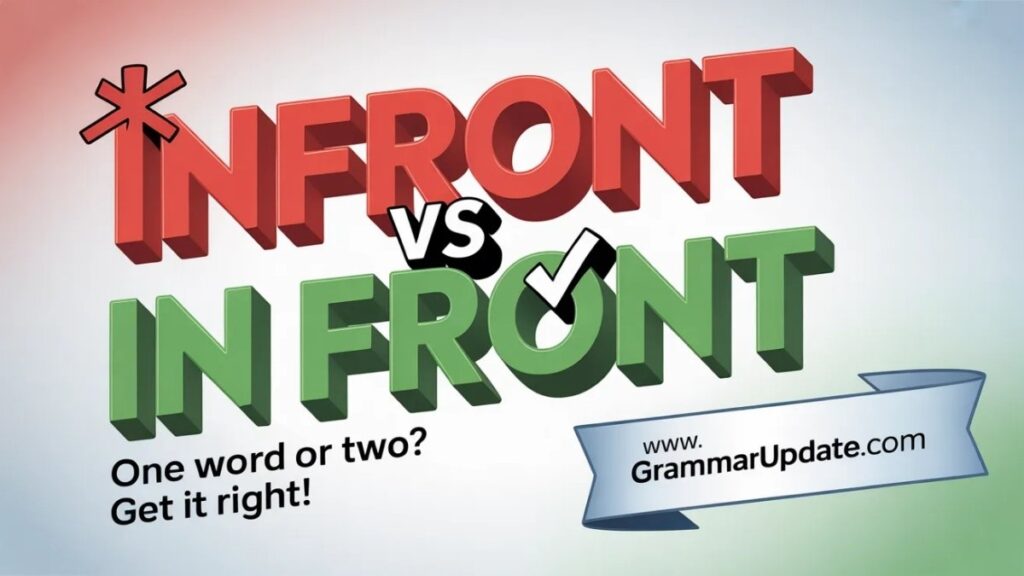
These exercises will help you master correct usage of “in front” and avoid the common mistake “infront.”
Fill in the Blanks
Fill in each blank with the correct form: in front / infront
- The teacher stood ______ of the class.
Answer: in front
Explanation: Use “in front” to show position ahead of something.
- The car is parked ______ of the house.
Answer: in front
Explanation: “In front” shows spatial location.
- He waited ______ of the gate.
Answer: in front
Explanation: Prepositional phrase requires two words.
- She placed the chair ______ of the desk.
Answer: in front
Explanation: Correct grammar always separates the phrase.
- The dog sat ______ of me.
Answer: in front
Explanation: “Infront” is incorrect in English.
- The shop is ______ of the school.
Answer: in front
Explanation: Standard spatial expression.
- He stood ______ of the mirror.
Answer: in front
Explanation: Prepositional structure remains unchanged.
- The bike is ______ of the building.
Answer: in front
Explanation: Never combine into one word.
- They lined up ______ of the stage.
Answer: in front
Explanation: Used for physical position.
- The bus stopped ______ of the station.
Answer: in front
Explanation: Correct grammatical usage.
- The children played ______ of the house.
Answer: in front
Explanation: Shows location clearly.
- The bench is ______ of the tree.
Answer: in front
Explanation: Always two words.
- She stood ______ of her friend.
Answer: in front
Explanation: “Infront” is a spelling mistake.
- The screen is placed ______ of the audience.
Answer: in front
Explanation: Proper phrase usage.
- The guard stood ______ of the entrance.
Answer: in front
Explanation: Correct prepositional phrase.
Multiple Choice infront vs in front
Choose the correct option.
1. Which is correct?
A) infront
B) in front
C) in-front
Answer: B
Explanation: Only “in front” is grammatically correct.
2. Choose correct sentence
A) He stood infront of me
B) He stood in front of me
C) He stood in-front me
Answer: B
Explanation: “of” and spacing are required.
3. “In front of” is a:
A) Verb
B) Prepositional phrase
C) Adjective
Answer: B
Explanation: It shows spatial relationship.
4. What does “in front of” show?
A) Time
B) Position
C) Quantity
Answer: B
Explanation: It indicates location.
5. Correct spelling is:
A) infront
B) in front
C) infront of
Answer: B
Explanation: Standard English separates words.
6. Which is wrong?
A) in front of
B) infront of
C) both B and A
Answer: B
Explanation: “infront of” is incorrect.
7. Opposite of “in front”:
A) beside
B) behind
C) above
Answer: B
Explanation: “Behind” is opposite direction.
8. Choose correct sentence:
A) The cat is infront the door
B) The cat is in front of the door
C) The cat in front door
Answer: B
Explanation: Grammar requires full phrase.
9. “In front” is:
A) One word
B) Two words
C) Hyphenated
Answer: B
Explanation: Always two separate words.
10. Correct usage:
A) infront of me
B) in front of me
C) in-front of me
Answer: B
Explanation: Standard English rule.
11. “In front of you” means:
A) Behind you
B) Ahead of you
C) Inside you
Answer: B
Explanation: It shows something visible ahead.
12. Which sentence is correct?
A) She stood infront mirror
B) She stood in front of mirror
C) She stood in front of the mirror
Answer: C
Explanation: Full grammatical structure needed.
13. “Infront” is:
A) Correct word
B) Informal slang
C) Spelling mistake
Answer: C
Explanation: Not accepted in English grammar.
14. Which is correct?
A) The shop is infront of the park
B) The shop is in front of the park
C) The shop infront park
Answer: B
Explanation: Correct phrase usage.
15. “In front” belongs to:
A) Verb phrases
B) Prepositional phrases
C) Nouns
Answer: B
Explanation: It shows position using a preposition.
Here’s a trusted source for clear word meanings:
FAQs
Is infront a single word?
No, “infront” is not a single word in standard English. English grammar does not recognize it as correct. Writers always separate it into “in front.”
What is meant by “infront”?
“Infront” does not have an official meaning in English. People use it as a misspelling of “in front.” It appears mostly in informal writing, but grammar rules do not support it.
How do you use infront in a sentence?
You should not use “infront” in correct English writing. Instead, you replace it with “in front.”
Incorrect: He stood infront of the door.
Correct: He stood in front of the door.
Is “in front of” grammatically correct?
Yes, “in front of” is grammatically correct. English uses it as a prepositional phrase to show position or direction.
Example: The car stopped in front of the house.
What is correct in front vs infront?
The correct form is “in front.”
“Infront” is a spelling mistake and does not follow English grammar rules.
When do we use in front?
We use “in front” when we describe something positioned ahead of another object or person.
Example: The teacher stood in front during the lesson.
Do I use a or an in front of office?
You use “an” before office because the word starts with a vowel sound.
Example: She works in an office near the station.
What is the opposite of in front?
The opposite of “in front” is “behind.”
Example: The car is parked behind the building.
How to use in front of in a sentence?
You use “in front of” to show location or direction.
Example: The students waited in front of the school gate.
When to use “in front of” in a sentence?
You use it when you want to describe the exact position of something ahead of another object.
Example: The statue stands in front of the museum.
Is “in front” hyphenated or not?
No, “in front” is never hyphenated. English always writes it as two separate words.
Correct: in front
Incorrect: in-front
When do we use “a” in front of a word?
We use “a” before words that start with consonant sounds.
Example: a book, a car, a university
Where do we use in front of?
We use “in front of” when describing position, direction, or visibility in everyday English.
Example: The café is in front of the park.
How do we use fronts in a sentence?
The word “fronts” is the plural of “front” and can refer to edges, positions, or weather systems.
Example: Cold fronts are moving across the region.
Conclusion
The confusion between infront vs in front comes down to one simple but important grammar rule: English does not merge prepositional phrases into single words. While “infront” may appear in informal writing due to fast typing or habit, it is not accepted in standard English usage. The correct and grammatically accurate form is always “in front,” written as two separate words.
Once this rule is clearly understood, the mistake becomes easy to avoid. Proper spacing ensures clarity, improves professionalism, and aligns your writing with standard English conventions. In short, precision matters, and using “in front” correctly is a small detail that makes a significant difference in writing quality.

Jhon AJS, the creative mind behind Grammar Update, is an experienced blogger passionate about simplifying English grammar. He focuses on explaining confusing word vs word differences, grammar rules, punctuation, and sentence structure in a clear and practical way. Through easy to understand guides and examples, Jhon helps readers improve their writing and communicate with confidence. With years of blogging experience, he continues to share helpful insights that make learning grammar simple, useful, and accessible for everyone.