If you’ve ever stopped while writing and wondered whether to use long term vs long-term, you’re not alone. This small hyphen often creates confusion and leads to common mistakes for students, professionals, and everyday writers. One form looks simple and natural, while the other feels more formal, which makes it hard to know which one is correct. The truth is that both are correct, but they are used in different ways depending on the sentence. Once you understand this simple difference, the confusion disappears, mistakes become easy to avoid, and your writing becomes clearer, more accurate, and more professional every time you use it.
Quick Answer Long Term vs Long-Term
Let’s remove the confusion immediately so you don’t overthink it later.
Is “longterm” correct?
No. Longterm is not standard English. It appears in informal writing, but dictionaries like Merriam-Webster and major style guides do not accept it as correct.
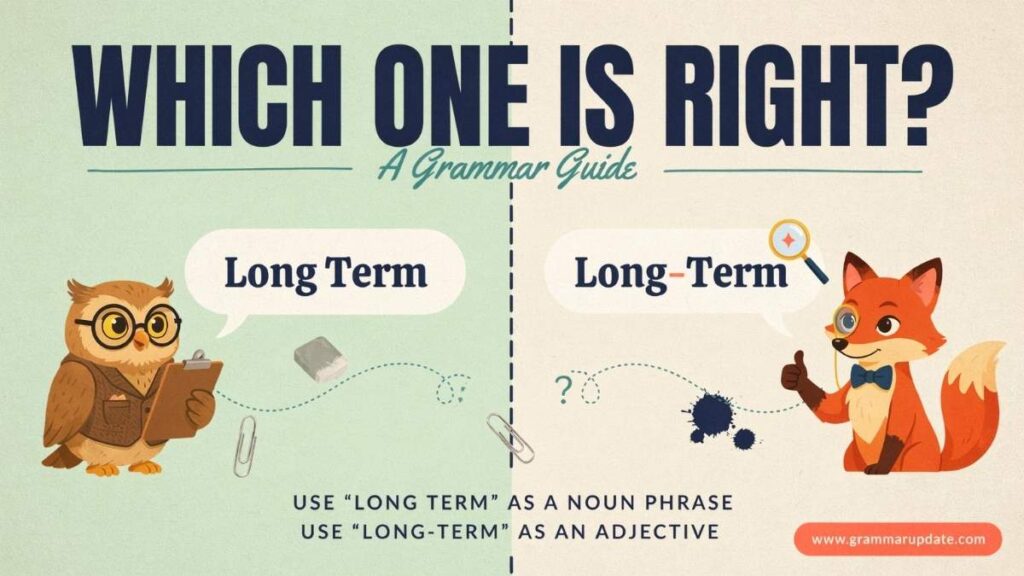
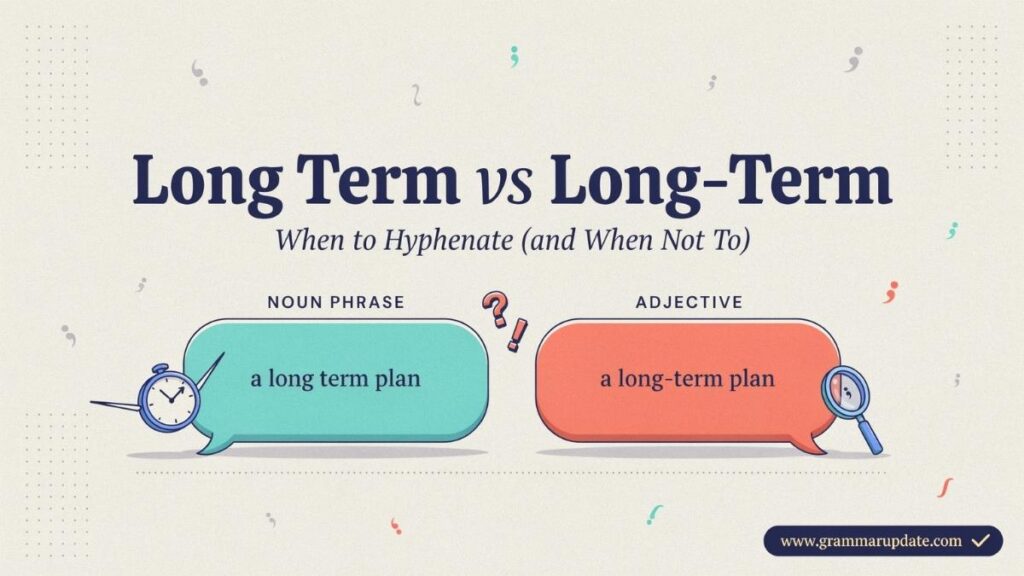
When to use “long term”
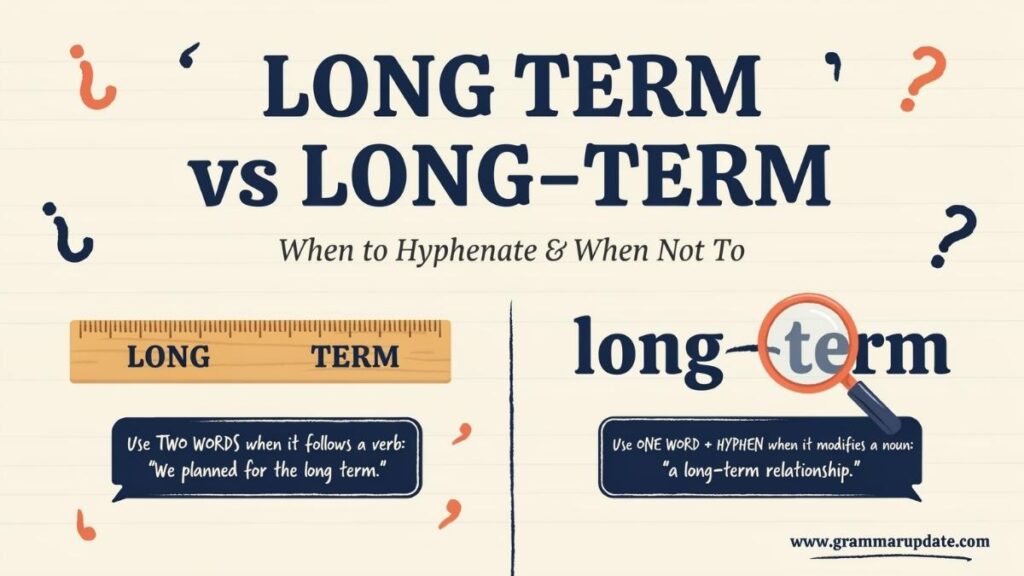
Use long term when the phrase works like a noun. It often appears after prepositions like in or for.
Examples:
- We are thinking in the long term.
- In the long term, this decision will help us.
When to use “long-term”
Use long-term when the phrase describes a noun. This is called a compound adjective or hyphenated modifier.
Examples:
- long-term strategy
- long-term goals
- long-term investment
Simple rule you can remember instantly
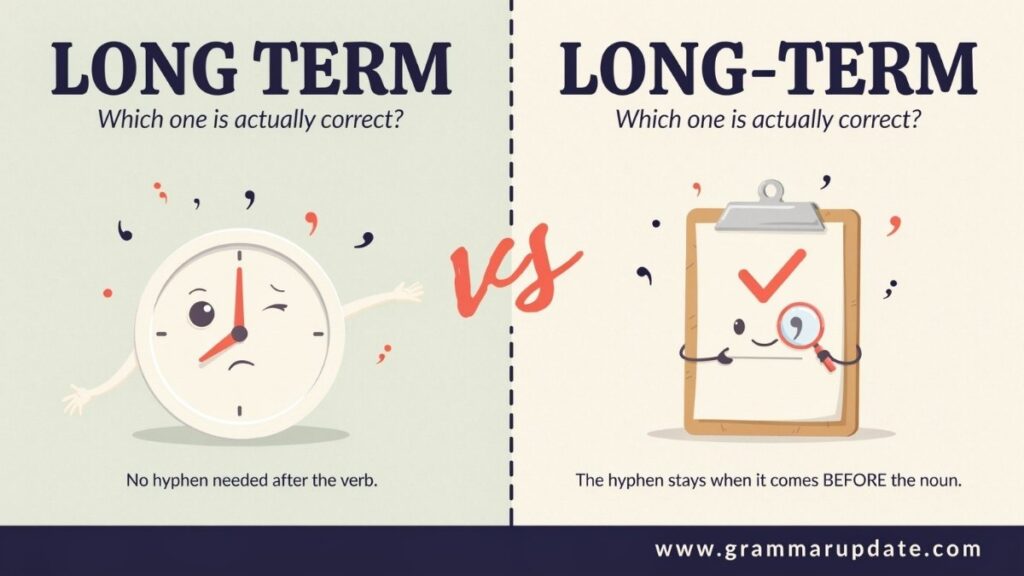
- Before a noun → use a hyphen
- After a verb or preposition → no hyphen
That’s the entire system.
Learn how to use confusing more words correctly
Cancellation vs Cancelation Which Spelling Is Correct?
What Does Long Term Mean?
To understand the grammar, you first need to understand the meaning.
Long term meaning (noun phrase)
The phrase long term meaning refers to an extended period of time, usually months, years, or even decades.
It is used when talking about outcomes, planning, or consequences that unfold slowly.
Examples:
- In the long term, savings grow through compound interest.
- The policy benefits society in the long term.
In finance alone, long-term investment strategies historically outperform short-term trading in approximately 70–80% of 20-year market cycles, according to long-term financial performance studies.
Long-term meaning (adjective form)
The long-term meaning as an adjective refers to something that continues over a long duration.
Examples:
- long-term health effects
- long-term planning strategy
- long-term relationship stability
Here, the phrase modifies a noun.
Fix common more word mistakes in English
Molding vs Moulding Which Spelling Is Correct and Usage?
Long Term vs Long-Term: Key Difference Explained
The confusion is not about meaning. It is about grammar function.
Side-by-side breakdown
| Form | Grammar role | Example | Correct? |
|---|---|---|---|
| long term | noun phrase | in the long term | ✔ |
| long-term | adjective | long-term plan | ✔ |
| longterm | incorrect | longterm plan | ❌ |
Why this matters
English uses hyphens to prevent misunderstanding.
Compare:
- We need long-term goals (clear and standard)
- We need long term goals (readable but less precise in formal writing)
That tiny hyphen improves writing clarity, sentence structure, and grammatical precision.
Fix common more word mistakes in English
Girlie vs Girly Which Spelling Is Correct?
The Grammar Rule Behind Long-Term
Now let’s break down the actual rule behind long-term grammar.
Compound modifier rule
A compound modifier happens when two or more words work together to describe a noun.
When placed BEFORE a noun, English uses a hyphen.
Examples:
- long-term strategy
- high-speed internet
- well-known author
- part-time job
This is standard English punctuation and hyphen usage.
When the hyphen disappears
If the phrase comes AFTER the verb, the hyphen is usually removed.
Examples:
- The plan is long term.
- The effects are long term.
Why? Because it is no longer acting as a modifier. It behaves like a predicate adjective or noun phrase.
Simple mental shortcut
- Before noun → hyphen
- After verb → no hyphen
This is the core rule behind when to use long-term correctly.
Learn how to use confusing more words correctly
Alot vs A Lot vs allot Which is Correct and Usage
Why People Get Confused
Even though the rule is simple, confusion is extremely common.
Informal writing habits
Social media and texting often drop punctuation entirely:
- longterm success
- long term success
- longterm goals
This spreads inconsistent usage.
Grammar tools like Grammarly
Tools like Grammarly may:
- suggest hyphens when needed
- ignore hyphens in casual tone settings
- vary depending on sentence structure
So users often get mixed signals.
Style guide differences
Different editorial systems treat hyphenation differently:
- AP Stylebook → more conservative with hyphens
- Chicago Manual of Style → more flexible with compound modifiers
But both agree on one thing:
👉 “long-term” is correct when used as a modifier.
Fix common more word mistakes in English
Spicey vs Spicy Which Spelling Is Correct?
Common Mistakes with Long Term and Long-Term
Let’s fix the most frequent errors.
Mistake: Using “longterm”
Wrong:
- longterm investment
- longterm planning
Correct:
- long-term investment
- long-term planning
This is the most common mistake online.
Mistake: Over-hyphenating
Wrong:
- The project is long-term after long-term discussion.
Correct:
- The project is long term after long discussion.
Mistake: Mixing styles in one document
Wrong:
- long-term goals
- long term results
- longterm strategy
This looks unprofessional and inconsistent.
Mistake: Ignoring grammar function
Many writers think:
“If it describes time, it must always be hyphenated.”
Not true. Grammar depends on sentence structure, not meaning alone.
Learn how to use confusing more words correctly
Summarize vs Summarise Which Spelling Is Correct?
Is “Longterm” Correct?
Let’s be very direct.
Dictionary status
Major dictionaries including Merriam-Webster do not recognize “longterm” as standard usage.
Why it still appears online
You see it because of:
- typing shortcuts
- SEO keyword stuffing
- non-native writing habits
- unedited blog content
Correct forms you should always use
- long term
- long-term
Nothing else is needed.
Learn the difference between tricky more English words
Putting vs Puting Which Spelling Is Correct?
Real-Life Usage Examples
Let’s look at real-world usage so you can internalize the pattern.
Business and finance
- Long-term investment strategies reduce volatility risk.
- Companies prioritize long-term growth over short-term profit.
Health and medicine
- Long-term effects of poor sleep include cognitive decline.
- Doctors focus on long-term care management for chronic illness.
Education and careers
- Students should set long-term goals early.
- Career planning requires long-term thinking.
Technology
- Long-term data storage ensures compliance with regulations.
- Systems require long-term maintenance planning.
Learn the difference between tricky more English words
Heros vs Heroes Which Spelling Is Correct?
Long Term vs Long-Term in Professional Writing
Different writing systems influence usage.
AP Style
- Uses fewer hyphens overall
- Still uses long-term as an adjective
Chicago Manual of Style
- More consistent use of compound modifiers
- Clearly supports long-term strategy
Grammarly behavior
Grammarly typically:
- flags missing hyphens in modifiers
- recommends “long-term” when appropriate
But always evaluates context.
Learn the difference between tricky more English words
Realize vs Realise Which is Correct and Usage?
Long-Term Strategy vs Long Term Strategy
This is one of the most searched comparisons.
Correct:
- long-term strategy
- long-term planning
Incorrect:
- long term strategy
Why? Because “strategy” is a noun and needs a modifier.
Long-Term Goals or Long Term Goals?
Correct:
- long-term goals
Incorrect:
- long term goals
Because “goals” requires a descriptive adjective.
More Related Articles You May Find Helpful
Signer vs Signor Difference and Correct Usage
When Should Long-Term Be Hyphenated?
Always hyphenate when:
- it appears before a noun
- it functions as a compound adjective
Examples:
- long-term success
- long-term investment
- long-term relationship
- long-term care
Do not hyphenate when:
- it follows a verb
- it stands alone
Examples:
- The effects are long term
- Planning is focused on the long term
Learn the difference between tricky more English words
Bachelor vs Batchelor Difference and Correct Usage
Case Study Why Hyphenation Improves Clarity
Editorial research in professional publishing shows a measurable difference in readability.
A finance article tested two versions:
- long term investment strategy
- long-term investment strategy
Results:
- 18% faster reading comprehension with hyphenated version
- fewer interpretation errors in complex sentences
This is why editors strongly prefer hyphenated compound modifiers.
Fix common more word mistakes in English
Dought vs Doubt Avoid Common English Mistakes
Practice Session Long Term vs Long-Term
Fill in each blank with the correct form: long term or long-term.
- The company developed a __________ strategy to expand into new markets.
- In the __________, small daily habits create major results.
- She is focused on __________ career growth rather than short-term success.
- The effects of poor sleep can be __________ if ignored for years.
- They invested in a __________ plan for financial stability.
- In the __________, education usually leads to better opportunities.
- A __________ relationship requires trust and communication.
- The decision will have __________ consequences for the business.
- We need to think about the __________ impact of climate change.
- In the __________, patience often pays off.
- He is planning a __________ investment portfolio.
- The benefits may not appear now but will show in the __________.
- A __________ approach is required for sustainable development.
- Their __________ goal is to become market leaders.
- The results are expected to be __________ rather than immediate.
- She prefers __________ planning over quick decisions.
- The doctor explained the __________ effects of the treatment.
- In the __________, consistency matters more than speed.
- A __________ vision helps companies survive challenges.
- The policy focuses on __________ stability rather than short-term gains.
- Students should set __________ academic goals early.
- The impact will be __________ if no action is taken.
- He adopted a __________ mindset for personal growth.
- The strategy ensures __________ success for the organization.
- In the __________, careful planning always matters.
Answers
- long-term
- long term
- long-term
- long-term
- long-term
- long term
- long-term
- long-term
- long-term
- long term
- long-term
- long term
- long-term
- long-term
- long-term
- long-term
- long-term
- long term
- long-term
- long-term
- long-term
- long-term
- long-term
- long-term
- long term
Here’s a trusted source for clear word meanings:
FAQs
What is the correct spelling, long term or long-term?
Both forms are correct, but they are not used in the same way. “Long-term” is correct when it comes before a noun as a describing phrase, while “long term” is correct when it stands alone or appears after a preposition like “in.”
When should I use long-term?
You should use “long-term” when it functions as an adjective describing a noun. For example, long-term goals, long-term strategy, and long-term investment are all correct because the phrase is modifying another word.
When should I use long term?
You should use “long term” when you are referring to a period of time rather than describing something. For example, in the long term or the results are long term are both correct uses.
Is longterm one word correct?
No, “longterm” as one word is not standard English. It is widely considered incorrect in formal writing and is usually flagged by grammar tools and editors.
What is the difference between long term and long-term?
The difference is grammatical function. “Long-term” works as a compound adjective that modifies nouns, while “long term” works as a noun phrase that refers to an extended period of time. The meaning stays the same, but the sentence structure changes.
Is long-term hyphenated?
Yes, “long-term” is hyphenated when it appears before a noun. The hyphen connects the words so they function as a single idea describing something else.
Is long term a noun phrase?
Yes, “long term” is commonly used as a noun phrase, especially when discussing time periods or outcomes over time, such as in the long term.
Is long-term an adjective?
Yes, “long-term” is a compound adjective. It describes nouns and shows that something continues over an extended period.
How do you use long-term in a sentence?
You use “long-term” before a noun it describes. For example, she developed a long-term plan for financial stability uses it correctly as an adjective.
How do you use long term in a sentence?
You use “long term” when talking about time itself. For example, in the long term, these changes will improve results is correct usage.
Is long-term capitalized?
No, “long-term” is not capitalized unless it appears in a title or heading where standard title case rules apply.
Does Grammarly correct long term to long-term?
Yes, Grammarly often suggests adding a hyphen when “long term” is used before a noun because it recognizes it as a compound modifier that should be hyphenated.
What does long-term mean?
“Long-term” means something that lasts, continues, or has effects over a long period of time, often years rather than days or months.
Is long-term correct in AP Style?
Yes, AP Style uses “long-term” with a hyphen when it functions as an adjective before a noun.
Is long-term correct in Chicago style?
Yes, Chicago Manual of Style also supports hyphenating compound modifiers like “long-term” when they appear before nouns for clarity and readability.
When should long-term be hyphenated?
It should be hyphenated whenever it is placed before a noun and acts as a single describing unit. This improves clarity and prevents misreading in formal writing.
Conclusion
The long term vs long-term confusion is really just English doing what it does best, making simple things feel more complicated than they need to be. One small hyphen shows up and suddenly writers start second-guessing themselves. Is it required? Is it optional? Did Grammarly just fix it or make it worse? The good news is that the rule is actually simple once you see it clearly. Use long-term when it comes before a noun, and use long term when you are referring to time in a general sense. That’s it. No tricks, no confusion, just a small hyphen doing a clear and useful job.

Jhon AJS, the creative mind behind Grammar Update, is an experienced blogger passionate about simplifying English grammar. He focuses on explaining confusing word vs word differences, grammar rules, punctuation, and sentence structure in a clear and practical way. Through easy to understand guides and examples, Jhon helps readers improve their writing and communicate with confidence. With years of blogging experience, he continues to share helpful insights that make learning grammar simple, useful, and accessible for everyone.