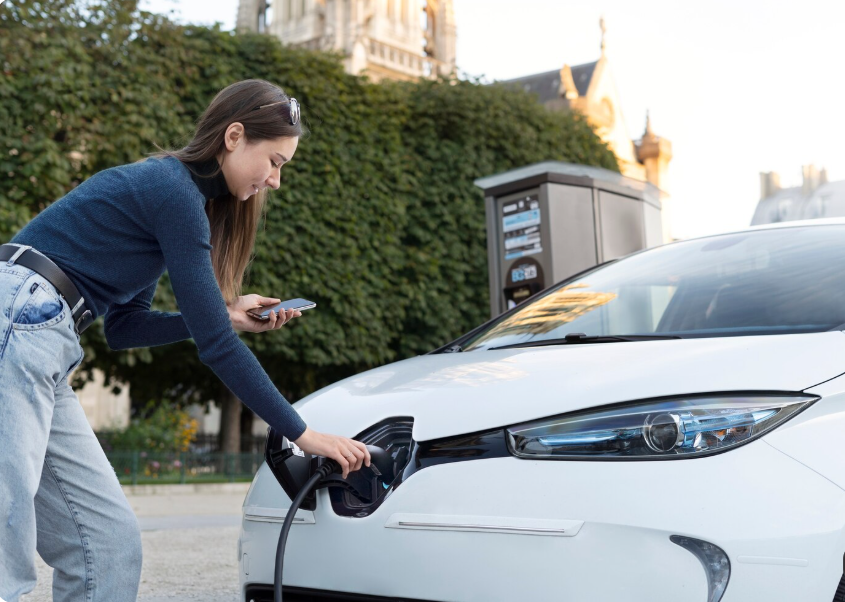
Electric cars came with a whole new vocabulary. People say charger, charging station, plug and EVSE as if they all mean the same thing. Sellers talk about kW, while your utility bill talks about kWh. Then there are levels, connectors and networks, each with its own set of letters.
Mixing up these words is easy, and it can cause real problems. A property manager who asks for “a few chargers” may get a quote for the wrong equipment. A driver who confuses kW with kWh may expect a charge to take half the time it really does.
This glossary explains the most common EV charging terms in plain English. Each entry says what the word means, how to use it correctly and which nearby word people often confuse it with.
The Basic Words
EV charger. The everyday name for the box on the wall or the post in the parking lot that sends power to the car. It is the term most people know, so it is fine for everyday writing.
EVSE. Short for electric vehicle supply equipment. This is the technical name for the same box. Engineers prefer it because, for most everyday charging, the real charger sits inside the car. The wall unit mainly supplies power safely and tells the car how much it can draw. Use EVSE in specs and contracts, and “EV charger” everywhere else.
Charging station. A location with one or more chargers, such as a row of spaces in a garage or a site off the highway. A single wall unit in one parking space is usually called a charger, not a station.
Port and connector. The port is the place where a cable plugs in. The connector is the plug at the end of the cable. One charging station can have several ports, so “10 ports” and “10 stations” are not the same claim.
Charging Levels
Level 1. Charging from a standard 120-volt household outlet. It is slow, often adding only a few miles of range per hour, so it suits cars that sit parked overnight and drive short distances.
Level 2. Charging at 208 or 240 volts, the kind used in most garages, offices, apartment buildings and shopping centers. It can add around 20 to 30 miles of range per hour, depending on the car and the charger. This is the level most people mean when they talk about charging at home or at work.
DC fast charging. Charging that sends direct current straight to the battery, skipping the car’s onboard charger. It can take many cars from low to around 80 percent in under an hour. You will often see it called “Level 3,” but that is an informal label. In careful writing, “DC fast charging” is the clearer term.
If you are planning a road trip, our guide on what to check before taking your car on a long journey covers the basics of preparing any vehicle for long distances.
Power and Speed Words
kW (kilowatt). A measure of power, or how fast energy flows. A 7 kW charger delivers energy faster than a 3 kW one. Think of it as the width of a water pipe.
kWh (kilowatt-hour). A measure of energy, or how much has been delivered in total. Battery size and your electricity bill both use kWh. If kW is the width of the pipe, kWh is the amount of water in the bucket.
The two are easy to swap by mistake. “A 60 kW battery” is wrong; batteries are rated in kWh. “A 60 kWh charger” is also wrong; chargers are rated in kW.
Amps. The amount of electrical current a charger draws. Amps matter most during planning, because every charger has to fit within what the building’s electrical panel can safely supply.
Installation Words
EV charger installation. The full job of putting a charger in place and making it work. It covers more than mounting the unit. A complete EV charger installation usually includes a site assessment, permits, electrical work, the charger itself, activation and testing. When you read a quote, check which of these steps are included and which are extra.
Site assessment. A visit to review the parking layout, the distance to the electrical panel and how much spare power the building has. It is the step that shapes everything after it.
Load calculation. A check of how much electricity the building already uses and how much is left for chargers. It answers the question “how many chargers can we add?”
Panel upgrade. Replacing or expanding the electrical panel when the building does not have enough capacity. It is often the most expensive part of a project, so it is worth asking about early.
Load management. Software or hardware that shares the available power between chargers, so more of them can run without a panel upgrade. It is common in garages and parking lots with many spaces.
Permits and inspection. Most areas require a permit before electrical work starts and an inspection once it is done. A qualified installer usually handles both.
Connector and Network Words
J1772. The standard plug for Level 2 charging on most electric cars sold in North America in recent years.
CCS. Short for Combined Charging System. It adds two large pins below a J1772-style plug so the same port can take DC fast charging.
NACS. Short for North American Charging Standard, now published as SAE J3400. It is a smaller plug that handles both Level 2 and DC fast charging, and many carmakers are moving to it. Write it as NACS, all capitals, with no periods.
Networked charger. A charger connected to the internet so its owner can set prices, control who can use it, track sessions and spot faults remotely. Most shared chargers in offices, apartments and parking lots are networked.
Non-networked charger. A charger that simply delivers power with no software connection. It is cheaper and simpler, but offers no billing or usage reports.
OCPP. Short for Open Charge Point Protocol, a common language that lets chargers talk to management software. A charger that supports OCPP is not locked to one software provider.
Common Word Mistakes to Avoid
- Saying “charging station” for one charger. A station is a site. One wall unit is a charger.
- Mixing up kW and kWh. Chargers are rated in kW. Batteries and bills use kWh.
- Treating “Level 3” as an official name. It is common in speech, but “DC fast charging” is the accurate term.
- Writing “Electric Vehicle” with capitals in the middle of a sentence. It is a common noun, so write “electric vehicle,” and spell it out before using “EV” on its own in formal writing.
- Calling installation “just plugging it in.” For any shared or commercial site, installation includes planning, permits and electrical work.
Final Thoughts
Use “EV charger” in everyday writing and “EVSE” in technical documents. Keep kW for power and kWh for energy. Say “DC fast charging” instead of “Level 3” when accuracy matters, and treat installation as a full project rather than a single step.
Clear words lead to clearer quotes, fewer surprises and better decisions. And if you want your car to stay on the road for years after the charger goes in, our tips on smart ways to extend the life of your vehicle are a good next read.
Read More: Sleeve vs Sleave difference and Which Is Correct?

Jhon AJS, the creative mind behind Grammar Update, is an experienced blogger passionate about simplifying English grammar. He focuses on explaining confusing word vs word differences, grammar rules, punctuation, and sentence structure in a clear and practical way. Through easy to understand guides and examples, Jhon helps readers improve their writing and communicate with confidence. With years of blogging experience, he continues to share helpful insights that make learning grammar simple, useful, and accessible for everyone.