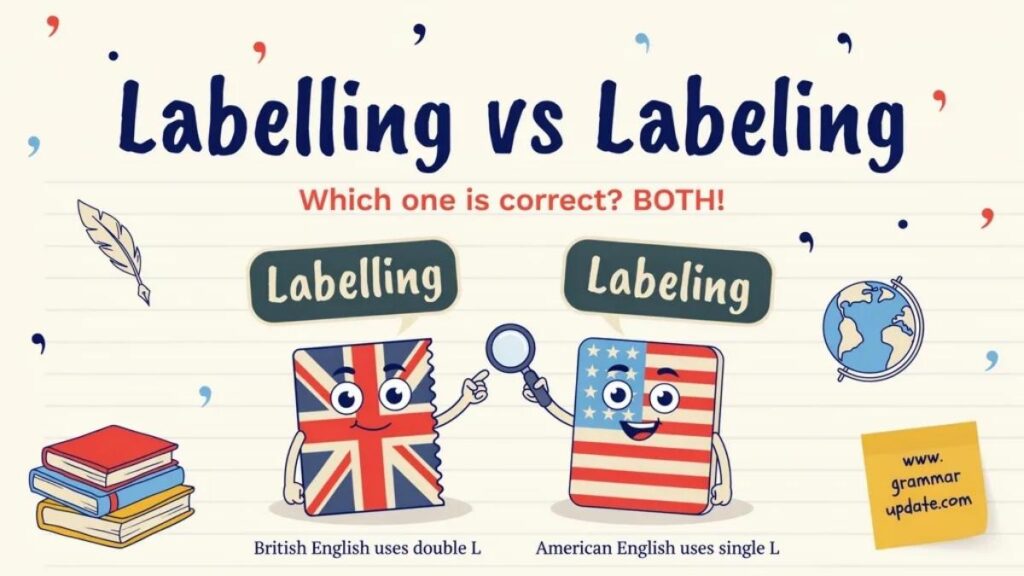
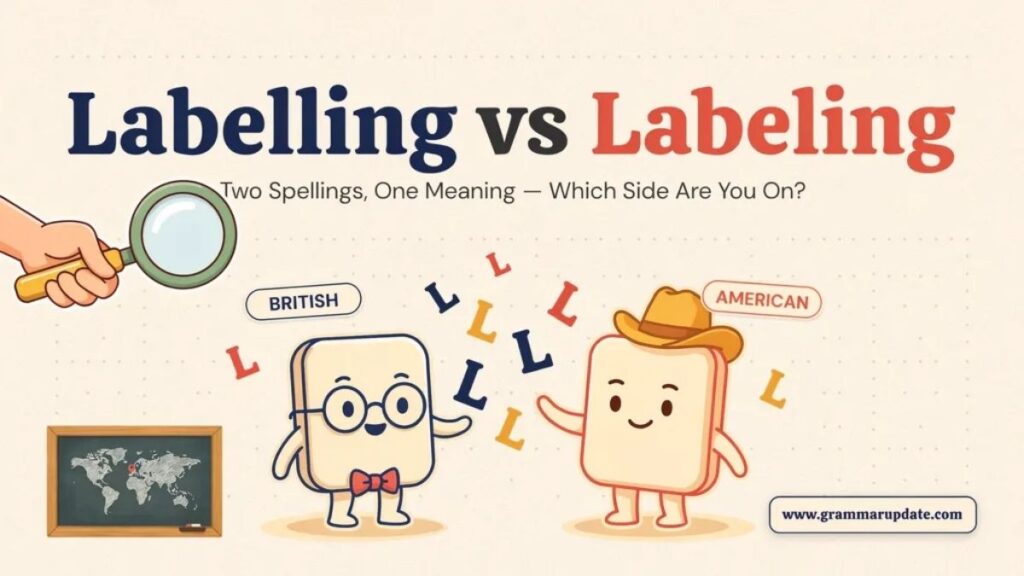
The labelling vs labeling debate confuses countless writers because both spellings appear correct at first glance. One website uses labelling, another uses labeling, and suddenly a simple word creates unnecessary doubt. Many people assume one version must be a spelling mistake, but that is not the case. The difference comes from British and American English spelling conventions rather than grammar or meaning. Labelling is the preferred spelling in British English, while labeling is the standard form in American English. Understanding when and where to use each version helps you avoid common writing errors, maintain consistency, and communicate more professionally. This guide explains the meanings, grammar rules, examples, and correct usage of both spellings.
Quick Answer Labelling or Labeling?
Which Spelling Is Correct?
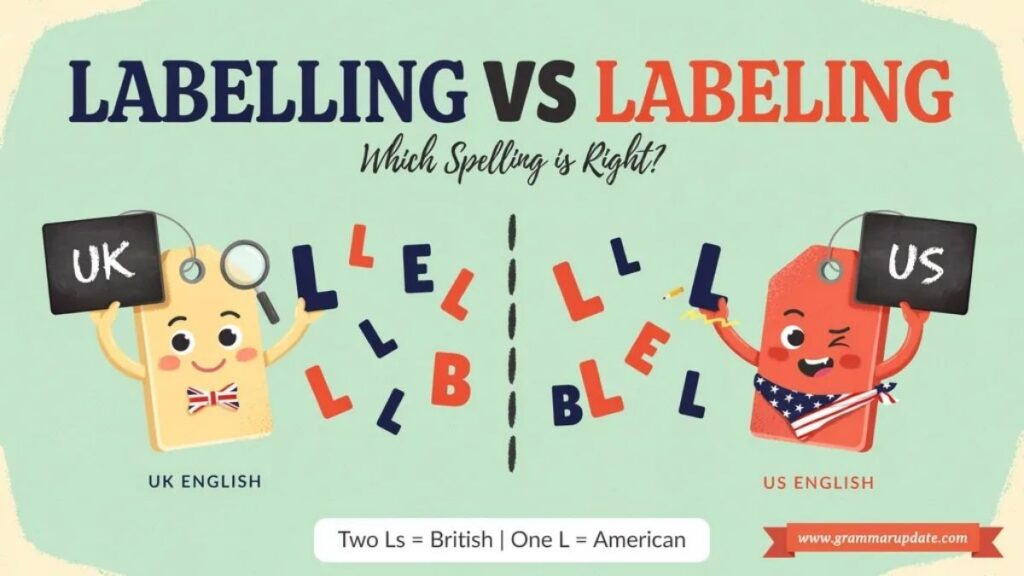
Both spellings are correct:
- Labelling is the preferred spelling in British English.
- Labeling is the preferred spelling in American English.
Are Both Accepted by Dictionaries?
Yes. Major dictionaries recognize both forms, although they often identify one as the preferred spelling for a specific region.
The Rule You Should Remember
Use labelling when writing for a British, Australian, or Commonwealth audience.
Use labeling when writing for an American audience.
Quick Examples
British English
- The company is labelling all products before shipment.
- Proper labelling helps customers identify allergens.
American English
- The company is labeling all products before shipment.
- Proper labeling improves product safety and compliance.
Labelling vs Labeling at a Glance
| Feature | Labelling | Labeling |
|---|---|---|
| Meaning | Same | Same |
| British English | Preferred | Less Common |
| American English | Rare | Preferred |
| Grammar Status | Correct | Correct |
| Professional Writing | UK Style | US Style |
| Dictionary Recognition | Accepted | Accepted |
Key Takeaway
The difference between labeling and labelling is purely a matter of regional spelling preference. The meaning, pronunciation, and grammatical function remain identical.
Fix common more word mistakes in English
Focussed vs Focused Which Spelling Is Correct?
What Does Labelling or Labeling Mean?
Labeling Meaning
Labeling refers to the act of attaching, assigning, identifying, naming, or categorizing something through the use of labels.
Labelling Meaning
Labelling carries exactly the same meaning. The only distinction is the spelling convention used in a particular variety of English.
Labeling Definition
A common labeling definition is:
The process of identifying, classifying, or describing something by attaching a label or assigning a category.
Labelling Definition
A common labelling definition is:
The act of marking, naming, categorizing, or identifying an item through labels or classifications.
Everyday Examples
People use labels to:
- Identify products
- Organize files
- Categorize information
- Mark packages
- Classify scientific samples
- Describe social groups
In every case, the purpose of labeling is to provide information or improve organization.
Fix common more word mistakes in English
Traveler vs Traveller Which Spelling Is Correct?
Understanding the Label Verb Meaning
The label verb meaning is straightforward:
To attach a name, description, category, or identifying mark to a person, object, product, or concept.
Examples
- The warehouse staff label every package before shipping.
- Scientists label samples before conducting experiments.
- Teachers label classroom materials for easy identification.
- Retailers label products with prices and barcodes.
The verb can refer to both physical labels and figurative classifications.
Fix common more word mistakes in English
Connector vs Connecter Which Spelling Is Correct?
Label Meaning in Everyday English
The word label functions as both a noun and a verb.
Label as a Noun
A label can be:
- A sticker
- A tag
- A product identifier
- A classification
- A descriptive term
Examples:
- Read the label before using the medicine.
- The clothing label lists washing instructions.
Label as a Verb
Examples:
- Please label the storage boxes.
- The company labels every product before distribution.
The Key Difference
Labelling in British English
British English generally follows a spelling convention that doubles the final L before adding suffixes such as -ing or -ed.
Examples:
| Base Word | British Form |
|---|---|
| Travel | Travelling |
| Cancel | Cancelling |
| Model | Modelling |
| Label | Labelling |
Labeling in American English
American English often simplifies this pattern by keeping a single L.
Examples:
| Base Word | American Form |
|---|---|
| Travel | Traveling |
| Cancel | Canceling |
| Model | Modeling |
| Label | Labeling |
Why the Meaning Never Changes
Whether you write labelling or labeling, the action remains exactly the same:
- Identifying something
- Categorizing something
- Attaching a descriptive marker
The spelling changes, but the meaning does not.
Learn how to use confusing more words correctly
Acception vs Exception Difference and Usage?
Why Do British and American English Spell It Differently?
Many writers ask:
Is Labeling or Labelling Correct?
The answer depends entirely on the audience and spelling standard you follow.
Historical Development of English
British and American English gradually evolved different spelling conventions after the eighteenth and nineteenth centuries. Over time, each variety standardized certain spelling patterns.
Language Standardization
As dictionaries and style guides developed, each region adopted its own preferred spellings.
Common Examples of Similar Differences
| British English | American English |
|---|---|
| Labelling | Labeling |
| Labelled | Labeled |
| Travelling | Traveling |
| Cancelled | Canceled |
| Jewellery | Jewelry |
| Modelling | Modeling |
These examples demonstrate broader patterns in American vs British spelling rather than isolated spelling changes.
Learn how to use confusing more words correctly
Sneek vs Sneak Which Spelling Is Correct and Use It?
The Grammar Rule Behind Labelling vs Labeling
Understanding the label grammar rules makes the difference easier to remember.
Present Participle Formation
Both labelling and labeling are present participles formed from the verb label.
British English Rule
British English frequently doubles a final L before adding suffixes.
Example:
- Label → Labelling
- Travel → Travelling
- Cancel → Cancelling
American English Rule
American English often avoids doubling the final L.
Example:
- Label → Labeling
- Travel → Traveling
- Cancel → Canceling
The Double-L Spelling Rule
The double l spelling rule is one of the most recognizable differences between British and American spelling conventions.
Why It Matters
Understanding this pattern helps improve:
- Writing accuracy
- Proofreading skills
- Professional communication
- Academic writing consistency
Labeling Spelling vs Labelling Spelling
Labeling Spelling
The Labeling spelling is preferred in:
- The United States
- American publications
- US government documents
- American universities
- Most American businesses
Labelling Spelling
Labelling spelling is preferred in:
- The United Kingdom
- Australia
- New Zealand
- Ireland
- Many Commonwealth countries
Professional Recommendation
Choose the spelling that matches your audience and remain consistent throughout your document.
Learn how to use confusing more words correctly
Instalments vs Installments Which Is Correct and Use It?
Label Word Forms and Related Spellings
Understanding related word forms helps maintain consistency.
| Form | British English | American English |
|---|---|---|
| Base Verb | Label | Label |
| Noun | Label | Label |
| Plural Noun | Labels | Labels |
| Present Participle | Labelling | Labeling |
| Past Tense | Labelled | Labeled |
| Past Participle | Labelled | Labeled |
| Agent Noun | Labeller | Labeler |
What Is the Past Tense of Label?
One of the most common grammar questions concerns the label past tense.
British English
The past tense is:
Labelled
Example:
The products were labelled according to safety regulations.
American English
The past tense is:
Labeled
Example:
The products were labeled according to safety regulations.
Difference Between Labeled and Labelled
The difference follows the same regional pattern seen in labeling vs labelling.
| British English | American English |
|---|---|
| Labelled | Labeled |
| Labelling | Labeling |
Both forms are grammatically correct.
Labeled in a Sentence
Examples of labeled in a sentence include:
- The teacher labeled every folder before the semester began.
- The shipment was labeled for international delivery.
- The manufacturer labeled the package with safety warnings.
- The researcher labeled each specimen carefully.
Labelled in a Sentence
Examples of labelled in a sentence include:
- The laboratory samples were labelled correctly.
- Every storage container was labelled clearly.
- The equipment was labelled according to maintenance procedures.
- The boxes were labelled by destination.
More Related Articles You May Find Helpful
Half Day vs Half-Day Which is correct and Usage
Label Usage in Professional Communication
Correct label usage plays a vital role across many industries.
Business
Companies use labeling systems to improve organization and inventory management.
Education
Teachers label classroom resources to simplify learning and storage.
Healthcare
Hospitals label medicines, patient samples, and medical equipment.
Logistics
Warehouses depend on accurate package labeling to avoid delivery errors.
Manufacturing
Factories label products, parts, and components throughout production.
Proper labeling reduces mistakes, improves efficiency, and supports regulatory compliance.
Product Labeling and Why It Matters
One of the most common applications of the word appears in product labeling.
What Is Product Labeling?
Product labeling refers to the information attached to a product that helps consumers identify, understand, and use it safely.
Information Commonly Found on Product Labels
- Product name
- Ingredients
- Instructions
- Safety warnings
- Expiration dates
- Manufacturer details
- Nutritional information
Why Product Labeling Is Important
Effective product labeling:
- Protects consumers
- Supports legal compliance
- Builds trust
- Communicates brand information
- Helps customers make informed decisions
For many industries, proper labeling is not optional it is a legal requirement.
Labeling Sticker Meaning
A labeling sticker is a sticker designed to identify, categorize, or provide information about an item.
Common examples include:
- Barcode stickers
- Shipping labels
- Price labels
- Warning labels
- Inventory tags
Businesses use sticker labeling systems to streamline operations and improve accuracy.
Labeling Items and Labeling Categories
Organizations often develop structured labeling systems.
Labeling Items
Examples include:
- Office files
- Inventory boxes
- Laboratory samples
- School supplies
- Electronic equipment
Labeling Categories
Examples include:
- Product groups
- Research classifications
- Customer segments
- Content topics
- Data types
Effective labeling systems make information easier to organize, locate, and manage.
Label Meaning in Relationships
The word label is not limited to products, packages, or documents. People also use it when discussing personal relationships.
What Does Label Mean in a Relationship?
In relationship discussions, a label refers to the name or status assigned to a relationship. It helps define what the relationship means and what expectations come with it.
Common relationship labels include:
- Friend
- Best friend
- Boyfriend
- Girlfriend
- Partner
- Fiancé
- Spouse
When someone asks, “Should we put a label on this relationship?” they are asking whether the relationship should be officially defined.
Why Relationship Labels Matter
Relationship labels often provide:
- Clear expectations
- Better communication
- Emotional security
- Defined boundaries
- Shared understanding
Examples
- After several months of dating, they decided to label the relationship as exclusive.
- Neither person felt ready to put a label on their relationship.
- The conversation about relationship labels helped clarify their future plans.
In this context, labeling means identifying or defining a social connection rather than attaching a physical tag.
More Related Articles You May Find Helpful
In Line vs Inline Which One Is Correct and Usage
Label Meaning in Science
The concept of labeling plays a crucial role in scientific research and education.
What Does Label Mean in Science?
In science, a label identifies, names, or describes an object, specimen, structure, variable, or piece of data.
Scientists use labels to:
- Organize information
- Identify samples
- Record observations
- Prevent errors
- Improve research accuracy
Scientific Labeling Examples
Biology
Researchers label specimens, cells, organs, and diagrams.
Chemistry
Scientists label chemical containers with names, formulas, and hazard information.
Physics
Graphs contain labeled axes that identify measurements and units.
Medicine
Laboratories label blood samples, test tubes, and medical records.
Environmental Science
Field researchers label collected samples to track locations and conditions.
Why Scientific Labeling Matters
Accurate labeling:
- Prevents confusion
- Supports reproducibility
- Improves data management
- Enhances research reliability
A simple labeling mistake can compromise an entire experiment.
What Is Labelling Theory?
One of the most important academic uses of the word appears in sociology.
Labelling Theory Meaning
Labelling Theory is a sociological perspective suggesting that the labels society assigns to individuals can influence how they see themselves and how others treat them.
Origins of Labelling Theory
The theory became prominent in the twentieth century through research into social behavior, deviance, and identity formation.
Core Principle
The central idea is that labels can shape behavior and social interactions.
For example:
- A student repeatedly labeled as “disruptive” may begin to identify with that description.
- A child consistently labeled as “gifted” may feel pressure to maintain exceptional performance.
Real-World Example
Imagine two students making the same mistake in class.
One receives the label:
“Troublemaker.”
The other receives the label:
“Curious learner.”
Although the behavior is identical, the different labels can influence how teachers, parents, and peers respond to each student.
Applications of Labelling Theory
The theory has influenced studies in:
- Sociology
- Criminology
- Education
- Psychology
- Social work
Criticisms of Labelling Theory
Critics argue that:
- Labels do not completely determine behavior.
- Personal choices still matter.
- Social influences are more complex than labels alone.
Despite these criticisms, Labelling Theory remains an important framework for understanding social identity and perception.
Labelling vs Labeling in Academic Writing
Academic writing demands consistency, precision, and adherence to established language standards.
University Style Guides
Most universities require students to use a single variety of English throughout an assignment.
Examples:
- British universities typically prefer labelling.
- American universities generally prefer labeling.
Research Papers
Researchers should avoid mixing spelling styles within the same document.
Incorrect
- The study examined labeling systems and labelling practices.
Correct (American English)
- The study examined labeling systems and labeling practices.
Correct (British English)
- The study examined labelling systems and labelling practices.
Theses and Dissertations
Examiners often look for consistency in spelling.
Maintaining a single spelling convention demonstrates:
- Attention to detail
- Professionalism
- Academic accuracy
Labelling vs Labeling in Business Writing
Professional communication benefits from consistent spelling choices.
Corporate Documents
Businesses often establish internal style guides that specify whether employees should use British or American English.
Marketing Materials
Marketing teams maintain consistency across:
- Websites
- Brochures
- Product catalogs
- Advertisements
- Social media content
International Organizations
Many multinational companies choose one spelling standard and apply it across all markets to strengthen brand consistency.
Why Consistency Matters
Consistent spelling:
- Enhances credibility
- Improves readability
- Creates a professional image
- Strengthens brand identity
A document that alternates between labelling and labeling can appear poorly edited.
Learn how to use confusing more words correctly
Goodmorning vs Good Morning Which Is Correct?
Product Labeling in Retail and Manufacturing
Retail Labeling
Retail businesses use labels to communicate essential information, including:
- Product names
- Prices
- Discounts
- Barcodes
- Promotional messages
Package Labeling
Shipping and packaging labels typically include:
- Sender details
- Recipient information
- Tracking numbers
- Handling instructions
- Delivery requirements
Manufacturing Labels
Manufacturers label:
- Components
- Machinery
- Safety equipment
- Finished products
- Inventory items
Accurate labeling helps businesses maintain efficiency and comply with regulations.
Labeling Shipments and Logistics Operations
Modern logistics systems rely heavily on precise labeling.
Why Labeling Shipments Matters
Accurate shipment labeling:
- Improves delivery accuracy
- Reduces lost packages
- Supports tracking systems
- Speeds warehouse operations
- Minimizes costly errors
Labeling Shipments Example
A shipping label often contains:
- Recipient name
- Delivery address
- Tracking barcode
- Package identification number
- Carrier information
Even a minor labeling error can cause delays, misdeliveries, or additional costs.
Learn how to use confusing more words correctly
Unenroll vs Disenroll Differences with Complete Guide
Common Mistakes People Make With Labelling and Labeling
Many writers become confused because both spellings are correct in different contexts.
Mixing British and American English
One of the most common mistakes is using both spellings in the same document.
Incorrect
- The products were labelled and are now ready for labeling.
Correct (British English)
- The products were labelled and are now ready for labelling.
Correct (American English)
- The products were labeled and are now ready for labeling.
Using the Wrong Style for the Audience
A British publication should generally use:
- Labelling
- Labelled
An American publication should generally use:
- Labeling
- Labeled
Inconsistent Editing
Documents often become inconsistent when multiple writers or editors contribute to the same project.
Proofreading helps identify and correct these issues.
Real Sentence Corrections Labelling vs Labeling
Incorrect Example
- The company is labelling products and later labeling them for export.
Correct British English Version
- The company is labelling products and later labelling them for export.
Correct American English Version
- The company is labeling products and later labeling them for export.
Why the Corrections Work
Each corrected sentence follows a single spelling convention, improving consistency and professionalism.
More Related Articles You May Find Helpful
Protestors or Protesters Which Spelling Is Actually Correct?
Everyday Examples of Labelling and Labeling
Business Example
- Accurate labeling improves inventory management and product tracking.
Education Example
- Teachers spend time labelling classroom resources and learning materials.
Science Example
- Scientists label specimens before conducting experiments.
Retail Example
- Product labeling helps customers compare products and understand features.
Logistics Example
- Proper package labeling reduces shipping errors and delivery delays.
These examples demonstrate how labeling appears in everyday professional and personal situations.
Similar British and American Spelling Differences
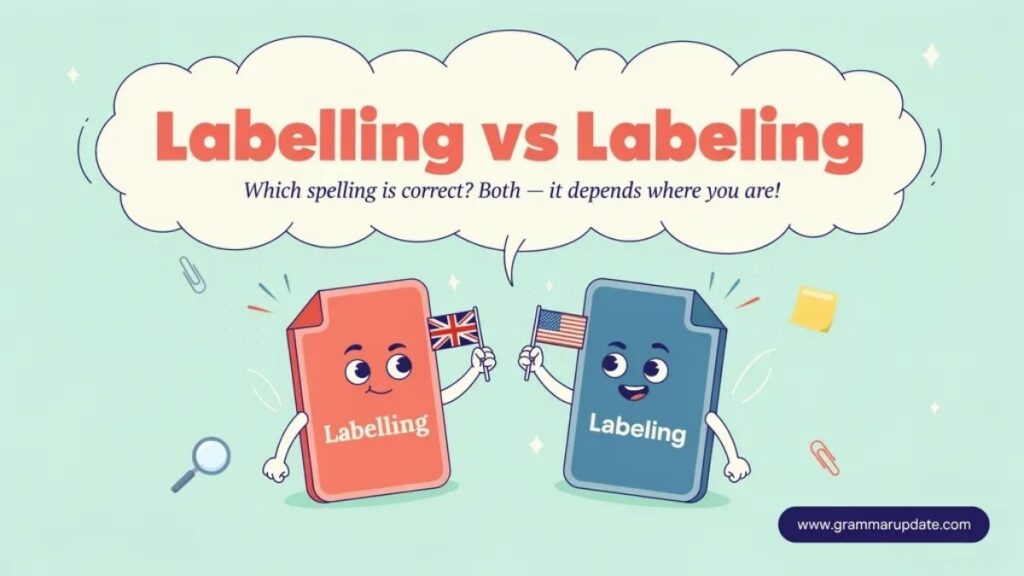
The difference between labelling and labeling follows a broader pattern found throughout English.
| British English | American English |
|---|---|
| Labelling | Labeling |
| Labelled | Labeled |
| Travelling | Traveling |
| Cancelled | Canceled |
| Modelling | Modeling |
| Fuelled | Fueled |
| Jewellery | Jewelry |
| Counselling | Counseling |
Recognizing these patterns makes it easier to understand regional spelling differences.
Why Grammar Checkers Flag One Spelling
Many writers wonder why grammar tools sometimes mark one version as incorrect.
Grammarly
Grammarly follows the language setting selected by the user.
Microsoft Word
Microsoft Word checks spelling according to the chosen language:
- English (United States)
- English (United Kingdom)
- English (Australia)
Why This Happens
Grammar tools are not claiming that the alternative spelling is wrong. They simply enforce consistency based on the selected language variety.
Memory Tricks for Remembering Labelling vs Labeling
The British English Pattern
British English often doubles the final L before adding -ing.
Examples:
- Travelling
- Cancelling
- Modelling
- Labelling
The American English Pattern
American English typically uses a single L.
Examples:
- Traveling
- Canceling
- Modeling
- Labeling
Easy Memory Trick
Think of these pairs:
- Travelling → Labelling (British English)
- Traveling → Labeling (American English)
If one uses a double L, the other usually does too.
More Related Articles You May Find Helpful
Copys or Copies Which Is Correct?
Practice Session Labelling vs Labeling
Choose the correct form: labelling (UK) or labeling (US).
- The factory is ______ all products before shipping.
- Proper ______ helps customers understand product details.
- The warehouse staff are ______ boxes for delivery.
- In American English, ______ is the preferred spelling.
- British English uses ______ with two Ls.
- Incorrect ______ can cause confusion in logistics.
- The company follows strict product ______ rules.
- Scientists are ______ all laboratory samples carefully.
- Clear ______ improves inventory management.
- The team is ______ items according to category.
- Food ______ must include ingredients and expiry dates.
- The system for ______ shipments reduces errors.
- Teachers are ______ classroom materials for students.
- Retail ______ helps identify prices and details.
- The manager checked the ______ before dispatch.
- Proper ______ is required by law in many industries.
- The data shows inconsistent ______ across departments.
- The organization is ______ all new stock today.
- Product ______ improves customer trust.
- The lab technician is ______ test samples.
- Incorrect ______ may lead to shipping delays.
- The company improved its ______ system last year.
- Packaging ______ must follow safety regulations.
- The workers are ______ goods for export.
- Effective ______ reduces workplace confusion.
Answers
- labeling / labelling
- labeling / labelling
- labeling / labelling
- labeling
- labelling
- labeling / labelling
- labeling / labelling
- labeling / labelling
- labeling / labelling
- labeling / labelling
- labeling / labelling
- labeling / labelling
- labeling / labelling
- labeling / labelling
- labeling / labelling
- labeling / labelling
- labeling / labelling
- labeling / labelling
- labeling / labelling
- labeling / labelling
- labeling / labelling
- labeling / labelling
- labeling / labelling
- labeling / labelling
- labeling / labelling
Here’s a trusted source for clear word meanings:
FAQs
What is correct labeling or labelling?
Both are correct. “Labelling” is used in British English, while “labeling” is standard in American English.
Is labelling one L or two?
It depends on region: two Ls in British English (labelling) and one L in American English (labeling).
What is the difference between label and labelling?
Label is the base noun/verb, while labelling/labeling is the -ing form that describes the action of attaching or assigning a label.
What do you mean by labelling?
Labelling means identifying, naming, or categorizing something using a label or classification system.
How do you spell labelling or labeling in the US?
In US English, the correct spelling is labeling with a single L.
What is an example of labeling?
Example: “The warehouse is labeling all packages before dispatch.”
What is the American spelling?
American English uses labeling, labeled, and labeler.
Why is label not spelled label?
It is spelled label. Confusion appears only when adding suffixes like -ing or -ed due to regional spelling differences.
How do you write labelling?
In British English: labelling. In American English: labeling.
What are the 4 types of labelling?
Common types include:
- Product labeling
- Descriptive labeling
- Branding labels
- Warning labels
What is another word for labelling?
Synonyms include:
- Tagging
- Marking
- Categorizing
- Identifying
What are some common labeling mistakes?
- Mixing British and American spelling in one document
- Missing or unclear information on labels
- Incorrect placement of labels
- Inconsistent formatting across items
What is simple labelling?
Simple labelling means adding basic identifiers such as names, numbers, or categories to items for clarity.
What is labelling someone?
It means assigning a descriptive identity or category to a person, often based on perception or behavior.
Is it labelling or labeling in English?
Both are correct. The choice depends on regional usage:
- UK English: labelling
- US English: labeling
Which is correct: labelling or labeling?
Both are correct, but usage depends on whether you follow British or American English conventions.
What is an example of labeling someone?
Example: “Calling a student ‘lazy’ is an example of labeling someone.”
Why is American spelling different from British spelling?
American English simplified several British spellings over time for consistency and easier usage.
What is labeling?
Labeling is the process of assigning names, categories, or descriptions to objects, people, or concepts.
What is labeling yourself?
It means defining your own identity using descriptive terms such as roles, traits, or categories.
What is sample labelling?
Sample labelling refers to marking test or research samples for proper identification in laboratories or studies.
Why did Americans drop the U in words?
American English simplified many spellings to create more standardized and efficient written forms.
How do British say water?
It is pronounced similarly, but often with a softer “t” sound, sounding like “wa-ter” or “waw-tuh” depending on region.
What are 20 tricky words to spell?
Common examples include:
- Labeling / Labelling
- Traveling / Travelling
- Canceling / Cancelling
- Jewelry / Jewellery
- Color / Colour
- Center / Centre
- Organize / Organise
- Analyze / Analyse
- Apologize / Apologise
- Theater / Theatre
(And many more depending on regional variation)
Do you write labeling or labelling?
Use labeling for American English and labelling for British English.
Who are the big 3 labels?
In the music industry, the major labels are:
- Universal Music Group
- Sony Music Entertainment
- Warner Music Group
What is the correct spelling of table?
The correct spelling is table in all English varieties.
Is it labeling or labelling?
Both are correct. The difference depends only on regional spelling standards.
What is an example of labelling?
Example: “Proper labelling helps customers quickly identify product information.”
What does labelling mean?
Labelling means attaching names or categories to identify or organize something clearly.
What are the four major labels?
In general classification contexts, labels often include:
- Product labels
- Warning labels
- Brand labels
- Information labels
What are the 5 basic care labels?
Common clothing care labels include:
- Washing instructions
- Bleaching instructions
- Drying instructions
- Ironing instructions
- Dry cleaning instructions
Conclusion
The labelling vs labeling confusion is less a grammar problem and more a spelling style difference wearing a disguise. Both forms carry the same meaning, and neither one is more “correct” than the other in a universal sense. The real mistake happens when writers mix both versions in the same document and unintentionally create inconsistency. Once you remember that labelling belongs to British English and labeling belongs to American English, the uncertainty disappears. So the next time this word tries to confuse you, choose your audience, stay consistent, and write with confidence like a properly labeled professional.

Jhon AJS, the creative mind behind Grammar Update, is an experienced blogger passionate about simplifying English grammar. He focuses on explaining confusing word vs word differences, grammar rules, punctuation, and sentence structure in a clear and practical way. Through easy to understand guides and examples, Jhon helps readers improve their writing and communicate with confidence. With years of blogging experience, he continues to share helpful insights that make learning grammar simple, useful, and accessible for everyone.