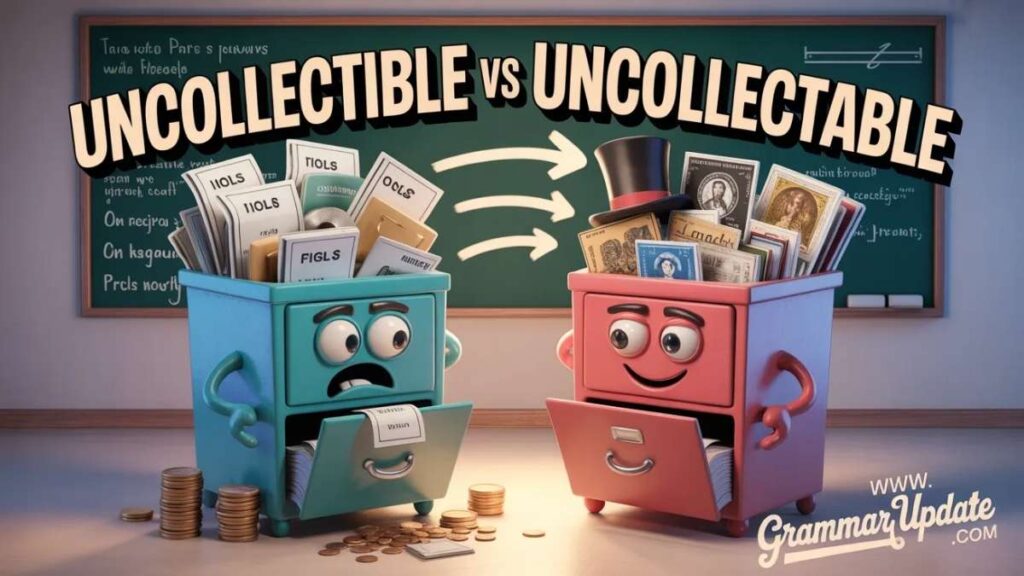
English spelling can be confusing, especially when two words look almost the same but make you stop and think. A great example is uncollectible vs uncollectable. At first glance, the words seem identical. They sound exactly alike when spoken. So it’s easy to wonder: is it uncollectible or uncollectable, and which one is actually correct? Many writers run into this confusion when talking about unpaid bills, debts, or money that cannot be recovered. The tiny difference between -ible and -able endings often causes hesitation. In this guide, we’ll clear up the confusion, explain the real difference between uncollectible and uncollectable, and show you how to use each word correctly.
Quick Comparison Uncollectible vs Uncollectable
The simplest way to understand uncollectible or uncollectable is to compare them side by side.
| Feature | Uncollectible | Uncollectable |
|---|---|---|
| Meaning | Cannot be collected, often referring to debt | Cannot be collected |
| Common context | Accounting and finance | General English |
| Usage frequency | Very common | Less common |
| Professional writing | Preferred spelling | Rare |
| Dictionary status | Standard spelling | Accepted but uncommon |
The difference between uncollectible and uncollectable is mostly about usage and convention rather than meaning.
Key takeaway:
In professional contexts especially financial accounting terms the correct spelling is usually “uncollectible.”
Uncollectible Meaning and Definition
Uncollectible Definition
According to dictionaries, uncollectible means something that cannot be collected often referring to unpaid debts or accounts written off by companies.
In financial contexts, the word describes money owed to a business that will likely never be recovered.
Examples include:
- unpaid invoices
- overdue customer balances
- debts from bankrupt clients
- accounts with unreachable customers
In simple terms, uncollectible debt meaning refers to money that businesses no longer expect to receive.
Uncollectible in Accounting and Finance
The term appears frequently in financial accounting terms and financial reporting.
Companies extend credit to customers through accounts receivable. When customers fail to pay after multiple attempts, the balance may become debt considered uncollectible.
Accountants must then decide whether to:
- continue attempting debt recovery, or
- record a bad debt write-off
What Are Uncollectible Accounts?
The phrase uncollectible accounts meaning refers to receivables that cannot realistically be collected.
Example:
A retail company sells products on credit. If customers fail to pay after months of reminders, those balances become uncollectible accounts receivable.
These accounts eventually appear as bad debt expenses in financial statements.
When Is Debt Considered Uncollectible?
Businesses follow certain guidelines before declaring a debt unrecoverable.
| Scenario | Why the Debt Becomes Uncollectible |
|---|---|
| Customer bankruptcy | Legal protection prevents collection |
| Business closure | Debtor company disappears |
| Long overdue payments | Recovery becomes unlikely |
| Invalid contact information | Debtor cannot be reached |
Once accountants determine recoverable vs unrecoverable debt, they may write off uncollectible debt.
What Does Uncollectible Mean in Accounting?
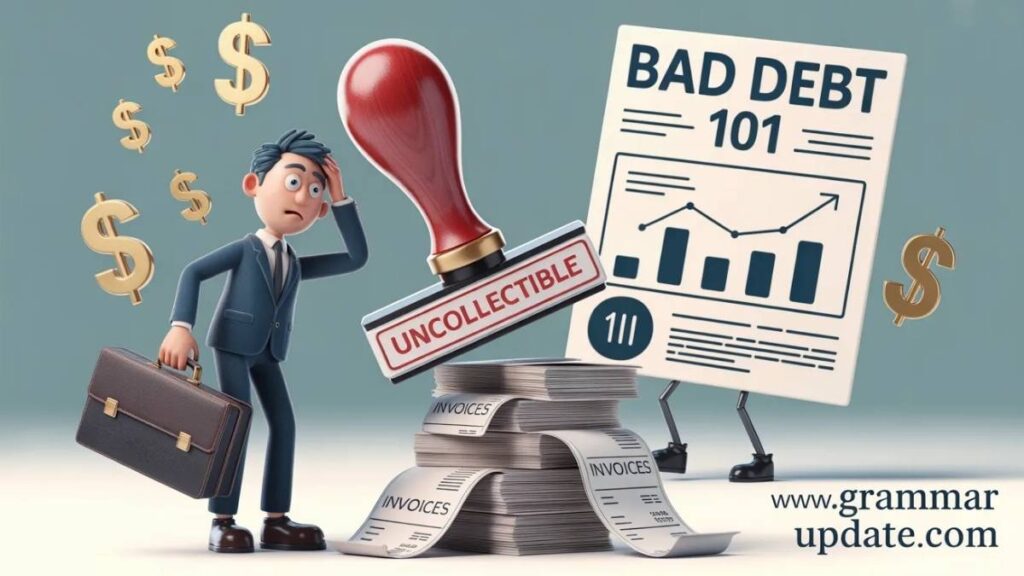
In accounting, the term has a very specific meaning.
Uncollectible accounts receivable definition:
Money owed to a company that cannot realistically be collected and must be removed from accounts receivable.
The Debt Write Off Accounting Process
When companies recognize bad debt uncollectible, they record an accounting entry called an accounts receivable write-off.
Example process:
- Customer fails to pay invoice.
- Company attempts debt collection process.
- After repeated failures, the balance becomes unpaid debt.
- Accountant records bad debt write-off.
Example Accounting Entry
| Account | Debit | Credit |
|---|---|---|
| Bad Debt Expense | $5,000 | |
| Accounts Receivable | $5,000 |
This entry removes uncollectible bills from the company’s assets.
Uncollectable Meaning and Definition

Uncollectable Definition
The uncollectable meaning is almost identical to the other spelling.
It also refers to something that cannot be collected.
However, this version appears less frequently in professional writing.
Examples:
- uncollectable donations
- uncollectable taxes
- uncollectable payments
Both spellings describe the same concept. The difference mainly comes from English spelling conventions.
Is Uncollectable a Correct Spelling?
Yes, uncollectable is a correct spelling. Many dictionaries list it as a variant form.
However:
- uncollectible appears far more often in finance and accounting
- uncollectable appears more in general language
For clarity in professional writing, most experts recommend using uncollectible.
Which Spelling Is Correct?
A common question is:
“Why is it spelled uncollectible not uncollectable?”
The answer lies in English adjective suffix rules.
Spelling Difference Able vs Ible
English adjectives often end in -able or -ible.
Both suffixes mean “capable of” or “able to be.”
Examples:
| Word | Ending |
|---|---|
| readable | able |
| washable | able |
| visible | ible |
| responsible | ible |
The correct spelling uncollectible follows historical usage patterns.
Many words derived from Latin verbs use -ible endings.
English Spelling Rules Able vs Ible
Although English has no perfect rule, some patterns help.
Use -able when:
- the base word stands alone (read → readable)
- the root is easily recognizable
Use -ible when:
- the root is Latin-based
- the base word changes spelling
The word collectible / uncollectible historically developed with the -ible form.
More Confusing Words Made Simple
Emersion vs Immersion Differences and Correct Usage
Examples of Uncollectible in Sentences
Here are practical examples of uncollectible in sentences.
- The accountant classified the balance as uncollectible debt.
- Several invoices became uncollectible accounts receivable after the company closed.
- The bank wrote off thousands of dollars in uncollectible bills.
- The firm recorded an accounts receivable write-off in its financial report.
These examples show why the word appears often in financial reporting terms.
Examples of Uncollectable in Sentences
Although less common, the alternate spelling still appears in everyday language.
Examples:
- Some pledges from the charity event proved uncollectable.
- The damaged records made certain taxes uncollectable.
- Flooding caused water storage systems to become uncollectable.
These examples demonstrate the general use of the spelling outside formal accounting.
A Small Business Facing Uncollectible Debt
Consider a small wholesale company that sells products to retailers.
Scenario
A retailer orders $12,000 in goods on credit. The invoice terms require payment within 30 days.
However:
- the retailer experiences financial trouble
- payments stop after several reminders
- the company files bankruptcy
Accounting Decision
After consulting legal and financial advisors, the wholesaler determines the balance is debt considered uncollectible.
The accountant records a bad debt write-off.
Financial Impact
| Item | Amount |
|---|---|
| Original invoice | $12,000 |
| Amount recovered | $0 |
| Uncollectible balance | $12,000 |
This scenario illustrates uncollectible debt meaning in accounting.
Common Grammar Confusion With Uncollectible

The pair uncollectible vs uncollectable creates confusion because:
- both spellings look correct
- both appear in dictionaries
- pronunciation is identical
This leads to frequent grammar confusion uncollectible in writing.
Common Spelling Mistakes in English
The confusion belongs to a larger group of spelling challenges.
Examples include:
- accessible vs accessable
- collectible vs collectable
- reversible vs reversable
These mistakes often involve adjective ending able vs ible.
Uncollectible Pronunciation
Both spellings share the same pronunciation.
/ˌʌn.kəˈlek.tə.bəl/
Breakdown:
- un → prefix meaning “not”
- collect → base word
- ible → adjective suffix
The pronunciation remains identical regardless of spelling.
More Confusing Words Made Simple
Ally vs Allie Differences and Correct Usage
What Is the Difference Between Collectible and Collectable?
A related spelling question appears with the words collectible vs collectable.
Although they look similar, they have slightly different meanings.
| Word | Meaning |
|---|---|
| Collectible | Item valued by collectors |
| Collectable | Something capable of being collected |
Examples:
- rare coins are collectibles
- rainwater may be collectable
This distinction partly explains why uncollectible became the preferred spelling.
Tips to Remember the Correct Spelling
A few simple tricks help avoid confusion.
Rule 1: Use Uncollectible in Finance
If discussing debt, accounting, or financial reporting, choose uncollectible.
Rule 2: Remember Professional Usage
Accountants and financial analysts almost always use uncollectible accounts receivable.
Rule 3: Think About Debt Write Offs
If the topic involves bad debt write-off, the word should be uncollectible.
Practice Exercises
Try these short exercises to reinforce the correct usage.
Fill in the Blank
- The accountant marked the invoice as ______.
- Several donations proved ______ after the fundraiser.
Correct answers:
- uncollectible
- uncollectable
Multiple Choice
Which sentence uses the correct accounting term?
A. The company wrote off several uncollectible accounts.
B. The company wrote off several uncollectable accounts.
Correct answer: A
Key Takeaways: Uncollectible vs Uncollectable
The difference between uncollectible and uncollectable is small but important.
Here are the main points to remember.
- Both words mean something that cannot be collected.
- Uncollectible is the preferred spelling in accounting terminology.
- Businesses often use the term when discussing unpaid debt and bad debt write-offs.
- Uncollectable appears occasionally in general English but is less common.
When in doubt, choose uncollectible. It’s the spelling used most often in financial reporting, accounting textbooks, and professional communication.
Mastering this subtle spelling difference helps avoid confusion and improves your confidence in both English grammar and financial terminology.
FAQs
What is the difference between uncollectible and uncollectable?
The difference between uncollectible and uncollectable is mainly spelling and usage. Both words mean something that cannot be collected. However, uncollectible is the preferred spelling in accounting and professional writing, while uncollectable appears less often in everyday English.
What does “uncollectible” mean?
The uncollectible meaning refers to something that cannot be recovered or collected. In finance, it usually describes unpaid debt or accounts receivable that a company cannot recover. Businesses often record these as bad debt write-offs in their financial statements.
Why is the issue of uncollectible accounts so important?
Uncollectible accounts directly affect a company’s financial health. When customers fail to pay invoices, businesses lose revenue and must record a bad debt expense. Managing uncollectible accounts receivable helps companies control credit risk and maintain accurate financial reports.
What is another word for uncollectible?
Several words can be used as synonyms for uncollectible, depending on context. Common alternatives include unrecoverable, unpaid, irrecoverable, or bad debt. In financial contexts, the term written-off debt is also frequently used.
Reference Cambridge Dictionary Definitions
Here’s a trusted source for clear word meanings:
Conclusion
In the end, the debate over uncollectible vs uncollectable turns out to be much simpler than it looks. Both words carry the same basic meaning. The real difference lies in how often each spelling is used. In most cases especially in accounting and business writing uncollectible is the preferred choice.
Think of it like overdue invoices. Some payments eventually come through. Others quietly become uncollectible and are written off the books. Spelling confusion can feel a bit like that too.
The good news? This particular grammar puzzle is now settled. You know the difference between uncollectible and uncollectable, and that means one less confusing word pair to worry about.

Jhon AJS, the creative mind behind Grammar Update, is an experienced blogger passionate about simplifying English grammar. He focuses on explaining confusing word vs word differences, grammar rules, punctuation, and sentence structure in a clear and practical way. Through easy to understand guides and examples, Jhon helps readers improve their writing and communicate with confidence. With years of blogging experience, he continues to share helpful insights that make learning grammar simple, useful, and accessible for everyone.