Introduction
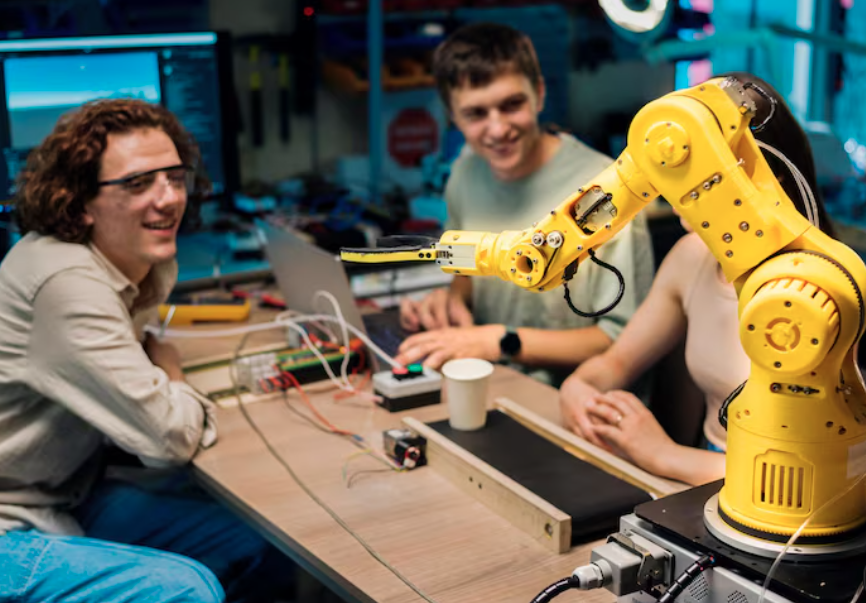
The relationship between humans and robots is evolving rapidly as technology becomes increasingly sophisticated. Robots are no longer limited to performing repetitive tasks behind safety barriers in manufacturing facilities. Today, collaborative robots, commonly known as cobots, are designed to work alongside people, assisting with complex operations and improving overall efficiency.
The future of human-robot collaboration promises significant changes across industries, including healthcare, manufacturing, agriculture, logistics, and education. By combining human creativity and decision-making with robotic precision and automation, businesses can create safer, more productive, and innovative working environments.
1. Human-Robot Collaboration in Manufacturing
Manufacturing is one of the leading industries adopting collaborative robotics. Traditional industrial robots often operate in isolated spaces, while modern cobots can share workspaces with human employees when appropriate safety measures are implemented.
These robots assist workers with assembly, packaging, quality inspections, and material handling. By managing physically demanding and repetitive activities, robots allow employees to focus on tasks requiring creativity, problem-solving, and technical expertise.
In the future, intelligent robotic systems could adapt more effectively to changing production requirements, helping manufacturers increase flexibility while maintaining product quality.
2. Transforming Healthcare Services
Healthcare is another industry where human-robot collaboration offers promising opportunities. Robotic technologies already support certain surgical procedures, rehabilitation programs, hospital logistics, and laboratory operations.
Robotic surgical systems allow trained surgeons to perform delicate procedures with enhanced control and precision. Meanwhile, rehabilitation robots can assist patients in rebuilding physical strength and mobility under professional supervision.
Future developments may introduce more sophisticated robotic assistants capable of helping healthcare professionals with routine activities, transporting medical supplies, and supporting patient monitoring.
However, human judgment, empathy, and medical expertise will remain essential in delivering quality healthcare.
3. Improving Agricultural Productivity
Agriculture faces growing challenges involving labor shortages, resource management, and sustainable food production. Collaborative robots can help farmers address these issues by supporting planting, harvesting, crop monitoring, and equipment operations.
Advanced robotic systems equipped with cameras and artificial intelligence can identify crop conditions, detect certain plant diseases, and assist with precision farming.
Farmers can use the information collected by these technologies to make better decisions about irrigation, fertilization, and crop protection.
As agricultural robotics continues developing, human workers and machines could collaborate to improve productivity while reducing unnecessary resource consumption.
4. Revolutionizing Logistics and Warehousing
The logistics industry increasingly relies on automation to manage growing demand and complex supply chains. Collaborative robots can support warehouse employees by transporting inventory, sorting packages, and assisting with order fulfillment.
Autonomous mobile robots can move goods between storage areas and packing stations, reducing the physical workload of employees.
In future warehouses, robotics systems may become better at understanding changing environments, recognizing obstacles, and coordinating tasks with human workers.
These developments could improve delivery efficiency, reduce operational errors, and create more organized distribution networks.
5. Expanding Opportunities in Education
Human-robot collaboration could also transform education by introducing new approaches to interactive learning.
Educational robots can help students understand programming, engineering, mathematics, and scientific concepts through practical activities.
Some robotic systems can support language practice, demonstrate technical processes, and provide interactive exercises.
In the future, teachers may use intelligent robotic assistants to support classroom activities and offer additional learning opportunities.
Nevertheless, robots should complement rather than replace educators, whose emotional understanding, communication skills, and mentorship remain essential for student development.
6. Enhancing Workplace Safety
One of the most important benefits of human-robot collaboration is the potential to improve workplace safety.
Industries such as construction, mining, chemical processing, and heavy manufacturing involve hazardous environments and physically demanding tasks.
Robots can assist with activities involving dangerous materials, repetitive movements, heavy lifting, and inspections in difficult-to-reach locations.
By reducing direct human exposure to certain hazards, collaborative technologies can contribute to safer working conditions.
However, organizations must also conduct risk assessments, provide employee training, and establish appropriate safety procedures before introducing robotic systems.
7. The Role of Artificial Intelligence
Artificial intelligence will play an increasingly important role in advancing human-robot collaboration.
AI-powered robots can process sensor information, recognize objects, interpret certain instructions, and respond to changes in their surroundings.
Machine learning may allow future robotic systems to improve performance through experience and adapt to different working environments.
Natural language interfaces could also make communication between humans and robots easier, reducing the need for specialized programming knowledge.
These improvements may enable more flexible cooperation between employees and intelligent machines.
8. Challenges and Future Considerations
Despite the advantages, human-robot collaboration presents several challenges.
Businesses must consider implementation costs, cybersecurity risks, employee training, maintenance requirements, and workplace safety.
There are also concerns about job displacement as automation becomes more widespread.
Organizations can address these challenges by investing in workforce development and helping employees gain skills in robotics, digital technology, and system management.
The most successful workplaces will likely be those that use technology to strengthen human capabilities rather than focusing exclusively on replacing human labor.
Conclusion
The future of human-robot collaboration offers exciting opportunities across multiple industries. From manufacturing and healthcare to agriculture and education, intelligent robotic systems have the potential to improve productivity, safety, and operational efficiency.
As robotics and artificial intelligence continue advancing, cooperation between humans and machines will become increasingly important. By combining technological capabilities with human intelligence, creativity, and ethical judgment, industries can build a more innovative, adaptable, and sustainable future.
Read more : Exploring the Impact of Quantum Computing on Future Innovation

Jhon AJS, the creative mind behind Grammar Update, is an experienced blogger passionate about simplifying English grammar. He focuses on explaining confusing word vs word differences, grammar rules, punctuation, and sentence structure in a clear and practical way. Through easy to understand guides and examples, Jhon helps readers improve their writing and communicate with confidence. With years of blogging experience, he continues to share helpful insights that make learning grammar simple, useful, and accessible for everyone.