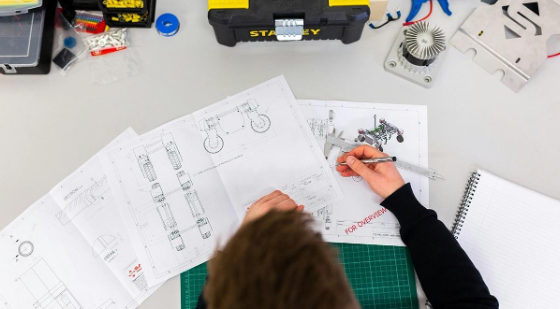
In contract machining, the price of a job is fixed the moment the quote is sent. A common way of building that price makes small shops lose money on one-off parts and lose orders on larger batches.
A machine shop wins an order for a single replacement part. The price looked reasonable, the customer accepted it and the part went through the workshop without trouble. Only when the hours are added up does the owner see that the job made no money: preparing the machine took longer than cutting the metal. A few weeks later the same shop loses a 200-piece order to a competitor with a lower price per part. These look like two separate problems. They are one. The margin on a job is decided when the quote is sent, and the way many small shops build their quotes undercharges small orders and overcharges large ones.
The quote is where the margin is decided
Contract machining is a business of small companies. Eurostat counted about 2.2 million manufacturing enterprises in the EU in 2023, employing more than 30 million people, and its enterprise statistics by size class show that around 2.09 million of them had fewer than 50 persons employed. In firms of that size the person who prices new work is usually the owner, a production manager or one experienced engineer.
Once a customer accepts a quote, the price is frozen. If the job takes longer than expected, if the material costs more or if an outside supplier charges a minimum fee, the shop absorbs the difference. Each quote is therefore a financial decision, not paperwork: a small fixed-price contract, and a busy shop signs dozens of them a week.
At MetronQ, where we build CNC quoting software for machine shops, the first question we hear from owners is rarely about speed. It is about whether the price can be trusted, and that depends less on how quickly a quote is produced than on what it leaves out.
One accounting error, two symptoms
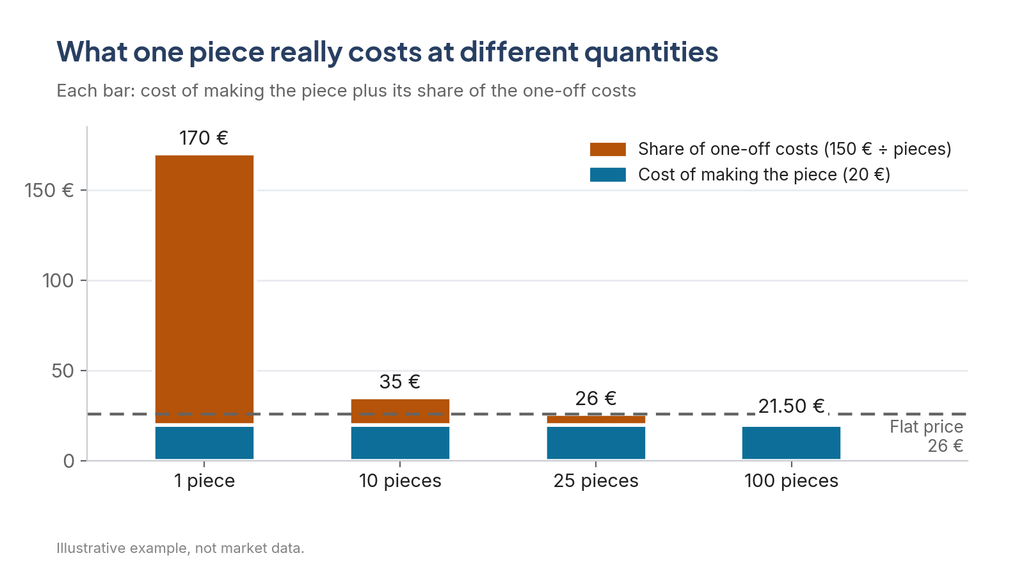
Every machined part carries two kinds of cost. Some are paid once per order, whatever the quantity: programming the machine (writing the instructions it follows, usually in CAM software), the setup (mounting the workholding and tools, then making and measuring the first part) and the minimum quantity of material the supplier will sell. Others are paid for every piece: machine time, tooling wear and inspection. The real cost of one piece is the variable cost plus the one-off costs divided by the number of pieces in the order.
A simple illustration, not market data, shows what follows. Suppose the one-off costs of an order are 150 euros and each piece costs 20 euros to make. A single piece then really costs 170 euros, ten pieces cost 35 euros each and a hundred pieces cost 21.50 euros each.
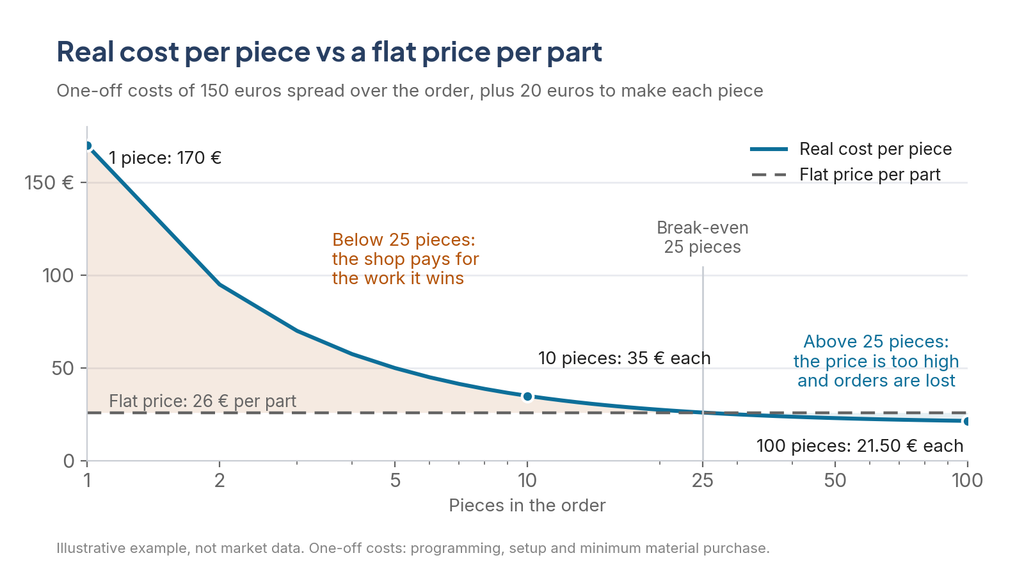
Many shops do not price this way. The setup and programming time is absorbed into a single hourly rate, and the quote comes out at, say, 26 euros per part regardless of quantity. On a single piece that shop loses 144 euros. On ten pieces it loses 9 euros on every part. On a hundred pieces it is 4.50 euros, or about 21%, dearer than a competitor who prices correctly, and it loses the order. In this example the break-even point is 25 pieces. Below it, the shop pays for the work it wins. Above it, the shop loses the work it could have made money on.
Neither symptom looks like an accounting problem from the inside. One looks like bad luck with small jobs, the other like an aggressive competitor.
What the spreadsheet does not show
Most small shops price in a spreadsheet built over years by someone who knows the business. The sheet is usually right about what it contains. The trouble lies in what it does not contain.
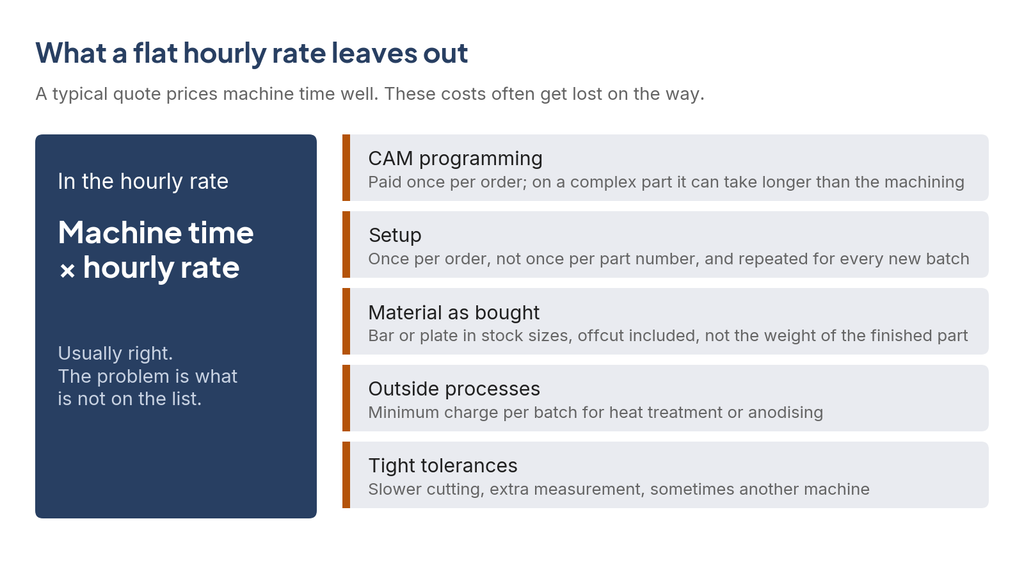
Programming a complex part can take longer than machining it, but if the sheet has no line for programming, that time disappears into the hourly rate. Setup is often entered once per part number rather than once per order. Material is calculated from the weight of the finished part, while the stockist sells bar and plate in fixed lengths and sizes, and the offcut is paid for too. Outside processes such as heat treatment or anodising usually carry a minimum charge per batch, which on a small order can exceed the cost of the part itself. Tight tolerances mean slower cutting, more measurement and sometimes an extra machine.
An experienced engineer knows all of this and corrects for it. The difficulty is that such people are scarce. The European Labour Authority’s 2025 report on labour shortages lists metal working machine tool setters and operators as a shortage occupation in 15 of 28 European countries, and the engineers who can price a part well are usually the same people needed on the shop floor. Enquiries wait, and when the queue grows, the quotes themselves get less attention.
What changes when the price is calculated from the 3D model
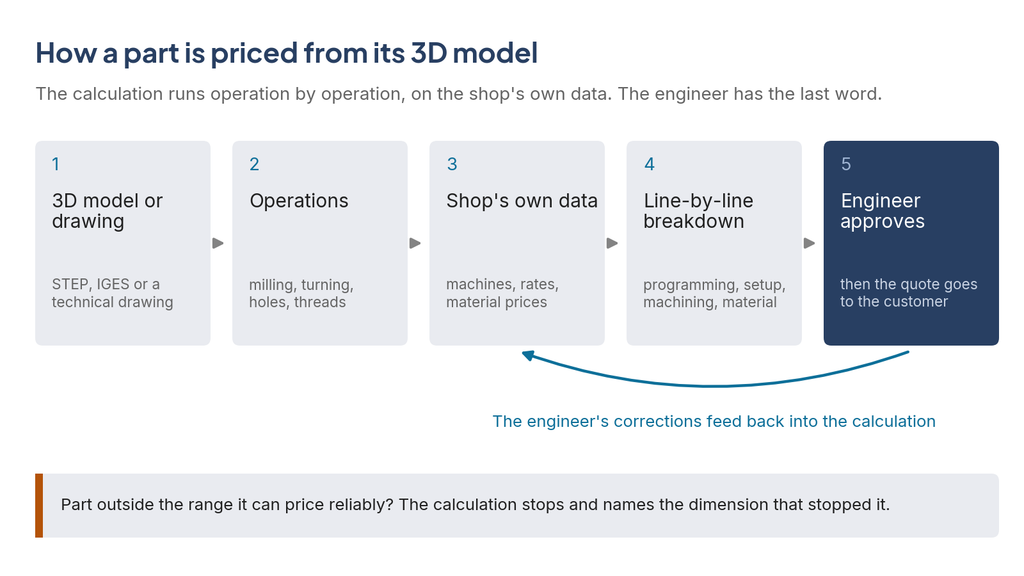
A different approach starts from the part’s 3D model or technical drawing and calculates the cost operation by operation, using the shop’s own machines, hourly rates and material prices. Machining time comes from the geometry: the surfaces to be milled or turned, the holes, the threads. Setup is added once per order. Material is priced as the bar or plate the shop will actually buy from its stockist, not as the weight of the finished part.
Two things follow. First, the same file and the same price list give the same price, whoever prepares the quote. In our case this is a deterministic calculation: there is no generative AI or language model in the pricing path, and customers’ files are not sent to outside AI providers. Second, the price arrives as a breakdown, line by line: programming, setup, machining, material and outside processing. When a customer asks why one part costs 170 euros while a hundred cost 21.50 euros each, the shop has an answer it can show and defend.
Where automation should stop
A pricing engine is only as reliable as its rules, and it should know its limits. When a part falls outside the range it can price reliably, it should refuse and say which dimension stopped it, rather than produce a confident number. The price should leave the building only after someone at the shop has approved it: the engineer gets the full breakdown and decides. When the engineer corrects a line, for example because a particular alloy machines more slowly on an older machine, that correction should feed back into the calculation, so the next quote starts from the shop’s real experience. The software’s job is to make sure no cost is forgotten, not to replace the judgement of the people who know the machines. It does the arithmetic, and the engineer still owns the price.
What to ask before buying any quoting tool
For an owner looking at quoting systems, a few plain questions reveal more than a demonstration:
- How many hours of programming go into the price of a single piece, and where can I see them?
- Is setup charged once per order, or hidden in the hourly rate?
- What does the quote do when the part is 80 mm long and the stockist sells the bar by the metre?
- Does the same file give the same price next month, and can every line be explained to a customer?
- Who approves the price before it leaves the building?
The cost of such tools has moved into small-shop territory. MetronQ’s subscription, for example, starts at 95 euros a month excluding VAT when billed yearly, with no annual contract (metronq.com/en/pricing).
The margin on a machined part is not lost on the shop floor. It is decided at the desk, before the first chip is cut. A shop that treats one-off costs as one-off costs stops subsidising single parts and stops overpricing series, and that one correction pays twice.
Sources: Eurostat, Businesses in the manufacturing sector (Statistics Explained, 2023 data) and enterprise statistics by size class (dataset sbs_sc_ovw); European Labour Authority, EURES Report on labour shortages and surpluses 2025.
About the author
Marcin Łętowski is a co-founder of MetronQ, a Polish company that develops software for pricing CNC machining in contract manufacturing shops. MetronQ calculates the cost of milled and turned parts from 3D models and drawings, using each shop’s own machines, hourly rates and material prices.
Read more: 6 Best Tree Trimming Companies in Farmington Hills, MI

Jhon AJS, the creative mind behind Grammar Update, is an experienced blogger passionate about simplifying English grammar. He focuses on explaining confusing word vs word differences, grammar rules, punctuation, and sentence structure in a clear and practical way. Through easy to understand guides and examples, Jhon helps readers improve their writing and communicate with confidence. With years of blogging experience, he continues to share helpful insights that make learning grammar simple, useful, and accessible for everyone.