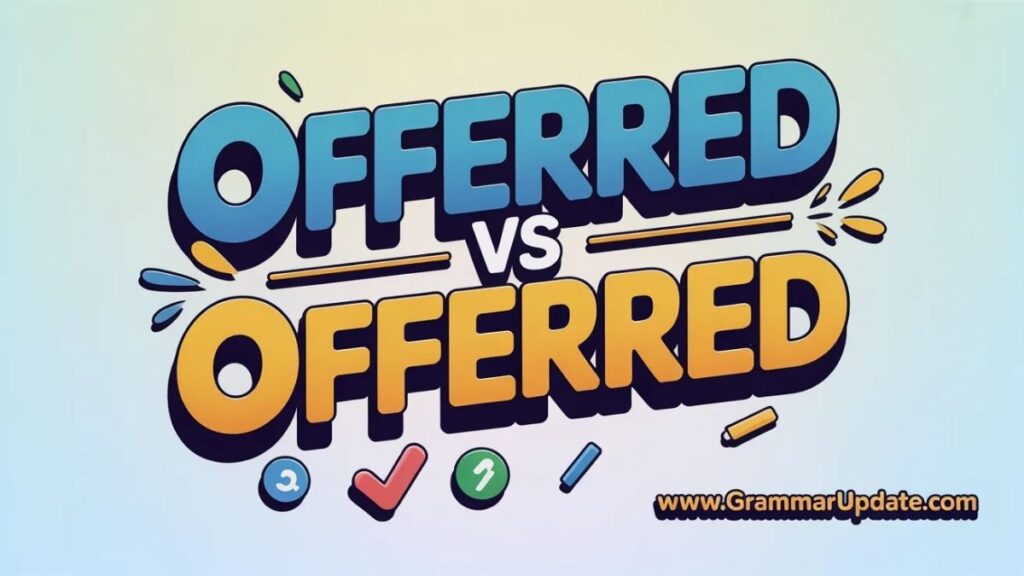
You know that awkward moment when you confidently type “offerred,” hit send, and then your brain whispers, “Wait… was that right?” Welcome to the surprisingly dramatic world of offered vs offerred. One extra “r” doesn’t just change the spelling, it quietly sabotages your credibility like a typo ninja. The worst part? It looks so convincing that even careful writers pause and second guess themselves. So what’s actually correct, and why does English love playing these little tricks on us? Don’t worry. By the end of this, you’ll spot the mistake instantly and never fall for it again. Let’s clear the confusion once and for all today.
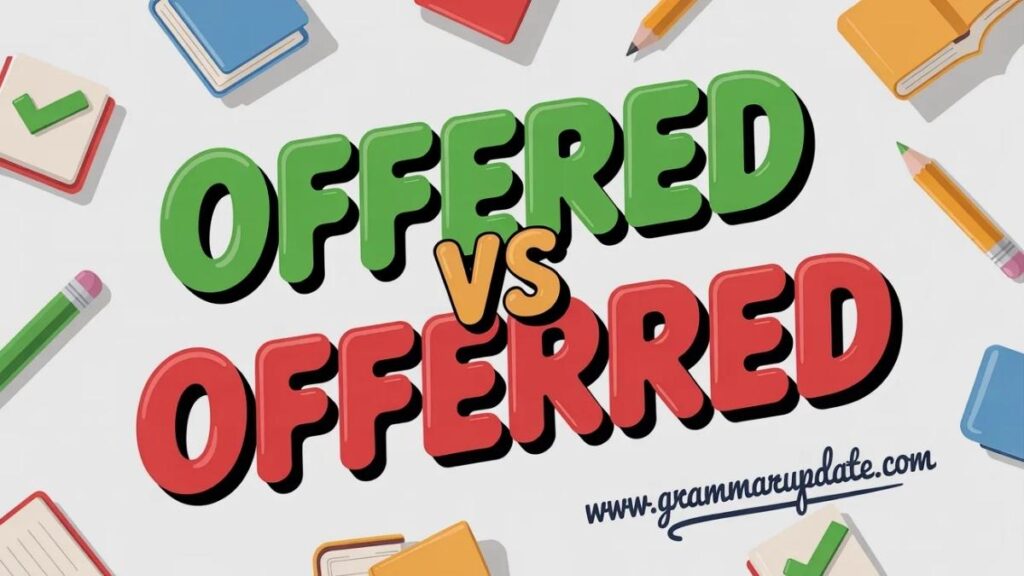
Offered vs Offerred The Simple and Final Answer
Let’s clear the confusion right away.
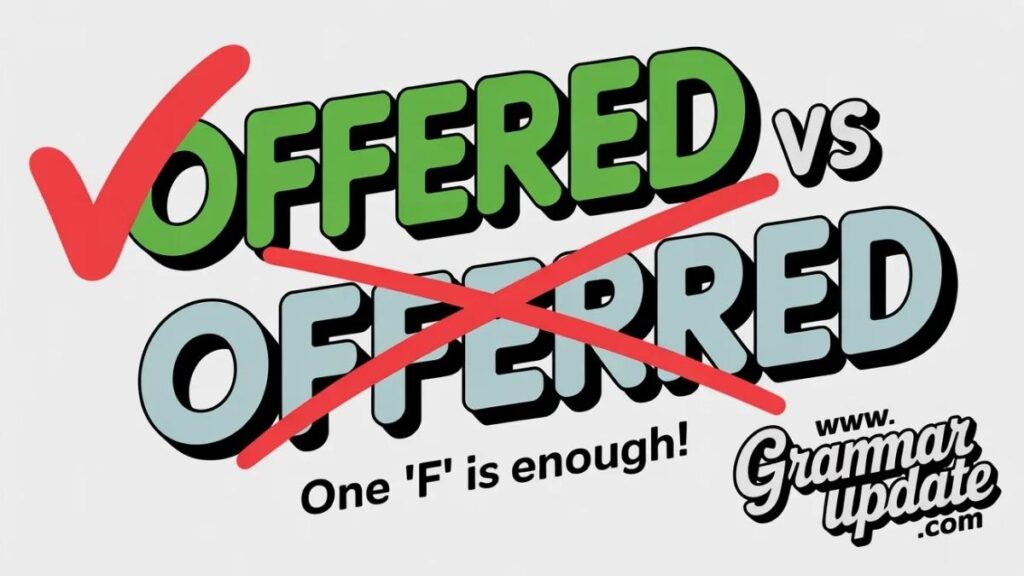
- ✅ Correct spelling: offered
- ❌ Incorrect spelling: offerred
If you’ve ever asked:
- offerred or offered?
- is offerred correct spelling?
Here’s the truth:
“Offerred” is not a real word in the English language.
No dictionary recognizes it. No grammar guide supports it.
Offered Meaning (Clear and Practical Explanation)
To understand usage, you need a solid definition.
Offered Definition and Examples
“Offered” is the past tense of the verb “offer.”
It means:
- To give something willingly
- To present an opportunity
- To propose an idea or service
Examples
- She offered help when no one else did.
- The company offered him a promotion.
- He offered a solution to the problem.
In every case, something is being given, suggested, or presented.
Offer Verb Forms (Understand the Structure Once and For All)
English becomes easier when you understand patterns.
Here’s the full verb conjugation of offer:
| Form | Example |
|---|---|
| Base form | offer |
| Present tense | offers |
| Past tense | offered |
| Present participle | offering |
👉 This is a regular verb, meaning it follows standard grammar rules for past tense verbs.
Why Is Offerred Incorrect? (The Real Reason)
Now let’s address the confusion directly.
Why Is Offerred Incorrect?
Because it breaks a basic English spelling rule.
Still, many people write it. Why?
The Psychological Trap
Your brain sees patterns like:
- refer → referred
- occur → occurred
So you assume:
“offer → offerred must be correct too”
That assumption feels logical.
But English doesn’t always reward logic.
The Rule Behind It: Double R Spelling Rules in English

Let’s simplify this once and for all.
When Do You Double a Consonant?
You double the final consonant when:
- The word has one syllable
- OR the stress falls on the last syllable
Examples That Follow the Rule
- stop → stopped
- plan → planned
- refer → referred
Why “Offer” Doesn’t Follow This Rule
Break the word down:
- of-fer (two syllables)
- Stress is on the first syllable, not the second
That changes everything.
No stress at the end → no doubling
So:
- ❌ offer → offerred
- ✅ offer → offered
Offered Spelling vs Offerred (Visual Comparison Table)
| Word | Correct? | Explanation |
|---|---|---|
| offered | ✅ Yes | Correct past tense of “offer” |
| offerred | ❌ No | Misspelling |
| offering | ✅ Yes | Present participle |
How to Spell Offered (A Trick That Actually Works)
Here’s a simple rule you can apply instantly:
If the stress is not on the last syllable, don’t double the consonant.
So when you wonder:
👉 how to spell offered
Just think:
- Stress = beginning
- Result = one “r”
How to Use “Offered” in a Sentence (With Depth and Variety)
Understanding usage is what builds confidence.
Everyday Conversation
- She offered me coffee before I even asked.
- He offered to fix the issue himself.
Professional and Business Context
- The company offered a competitive benefits package.
- They offered flexible working hours to employees.
Academic and Formal Writing
- The research offered valuable insights into human behavior.
- The report offered a detailed analysis of market trends.
Case Study: Why This One Mistake Matters
Let’s compare two real-world examples.
Example 1 (Incorrect)
The company offerred me a job.
Example 2 (Correct)
The company offered me a job.
Now imagine these appear in:
- A resume
- A job application
- A professional email
The first version feels careless. The second feels polished.
👉 Spelling affects perception more than you think.
More Confusing Words Made Simple
Copys or Copies Which Is Correct?
Common Mistakes in Offered vs Offerred
Let’s fix the patterns that cause trouble.
Mistake 1: Doubling the “r”
- ❌ offerred
- ✅ offered
Mistake 2: Confusing Past and Present
- “offered” = completed action
- “offering” = ongoing action
Example:
- She offered help yesterday
- She is offering help now
Mistake #3: Applying the Wrong Rule
People often apply rules from other words without checking stress.
That leads to common grammar mistakes.
Offered vs Offering (Quick but Crucial Difference)
| Word | Meaning |
|---|---|
| offered | Past action |
| offering | Present or ongoing action |
Example Pair
- He offered assistance last week
- He is offering assistance today
Offered vs Proffered (Subtle but Important)

These two confuse many writers.
Key Difference
| Word | Tone |
|---|---|
| offered | Neutral |
| proffered | Formal or legal |
Examples
- She offered help
- He proffered evidence in court
👉 Use “proffered” only in formal contexts.
More Confusing Words Made Simple
Protestors or Protesters Which Spelling Is Actually Correct?
Context Changes Meaning (But Not Spelling)
The meaning of “offered” shifts depending on context.
Business Context
- The company offered a deal
Social Context
- She offered her seat
Creative Writing
- The sunset offered a breathtaking view
Same word. Different tone. Always correct.
Pronunciation Guide (Spelling vs Pronunciation)
Understanding sound helps reinforce spelling.
How to Pronounce “Offered”
- /ˈɔː-fərd/
- Stress on the first syllable
👉 That stress pattern confirms:
No need to double the “r”
More Confusing Words Made Simple
Unenroll vs Disenroll Differences with Complete Guide
Synonyms of “Offered” (Use With Care)
Common Alternatives
- gave
- presented
- proposed
- provided
Important Note
Not all synonyms work in every context.
Example:
- “offered help” → natural
- “presented help” → awkward
👉 Always prioritize proper word usage over variety.
How to Avoid Spelling Errors Like Offerred

Want to eliminate mistakes like this?
Practical Writing Tips
- Proofread your work slowly
- Use grammar tools as a backup
- Learn patterns, not isolated words
- Build awareness of English vocabulary mistakes
Quick Editing Checklist
Before publishing, ask yourself:
- Does this follow verb past tense rules?
- Does it look natural?
- Would I say this out loud?
Common Spelling Errors in English (Beyond Offerred)

“Offerred” is just one example of a bigger issue.
Other Frequent Mistakes
- occur → occurr ❌
- admit → admited ❌
- refer → refered ❌
👉 These happen because of confusion around double letter rules.
More Confusing Words Made Simple
Emaculate vs Immaculate Which One Is Correct?
Mini Practice Section (Lock It In)
Fill in the Blank
- She ______ to help me
- They ______ a new opportunity
👉 Correct answer: offered
Correct the Sentence
- He offerred his support
✔ Correct:
He offered his support
Rewrite for Clarity
- The company offerred new services
✔ Better:
The company offered new services
Reference Cambridge Dictionary Definitions
Here’s a trusted source for clear word meanings:
FAQs
Is offerred correct or incorrect?
It’s incorrect. It’s a common spelling error.
Why is offered spelled with one r?
Because the stress is on the first syllable, so no doubling occurs.
What is the past tense of offer?
The past tense of offer is offered.
How do you use offered in a sentence?
Example:
She offered assistance immediately.
Why do people confuse offered and offerred?
Because of inconsistent English spelling rules and pattern assumptions.
Is offerred a correct word in English?
No. It does not exist in standard dictionaries.
Conclusion
So after all that confusion around offered vs offerred, here’s the funny part it was never that complicated. English just did a great job making it feel complicated. You don’t need to second-guess yourself or add extra letters “just in case.”
Stick with “offered” one “r,” no drama.
Think of “offerred” like that unnecessary extra topping you didn’t ask for. It doesn’t improve anything, it just makes things messy.
Now, the next time you write it, you won’t pause or panic. You’ll get it right instantly. And honestly, that small win? It feels pretty good.

Jhon AJS, the creative mind behind Grammar Update, is an experienced blogger passionate about simplifying English grammar. He focuses on explaining confusing word vs word differences, grammar rules, punctuation, and sentence structure in a clear and practical way. Through easy to understand guides and examples, Jhon helps readers improve their writing and communicate with confidence. With years of blogging experience, he continues to share helpful insights that make learning grammar simple, useful, and accessible for everyone.