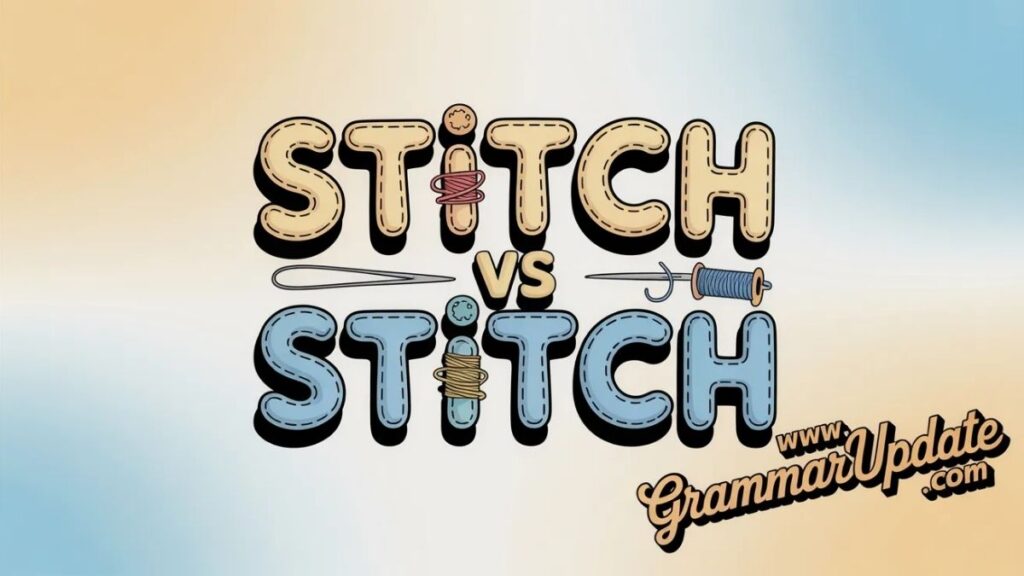
Ever paused mid sentence and wondered, “is it Stich vs Stitch?” That tiny missing or extra letter might seem trivial, but it can completely change meaning and make your writing look sloppy. From sewing and knitting to medical sutures, side pains, or even laughing in stitches at a comedy show, using the correct spelling matters more than you think. And yes, Disney’s blue alien might sneak into your memory as a helpful reminder! In this guide, we’ll clear up the confusion between stich vs stitch, explain proper usage in every context, and make sure your writing stays precise, professional, and maybe even a little fun.
What Does “Stich” Mean?
“Stich” is rarely used in modern English. Historically, it appeared in some early English texts to describe:
- A line, row, or sequence
- A narrative section or verse in poetry
- Sometimes as an alternate spelling of “stitch” in handwritten manuscripts
Example from historical text:
“The tailor wound the wool in careful stiches along the seam.”
Notice the double “s” at the end and the single “t.” While this is fascinating for linguists, in contemporary English, stich meaning is practically obsolete. Modern readers and dictionaries do not recognize it as correct.
Is Stich Correct in Modern English?
No. Using stich incorrect spelling in emails, articles, or professional writing is considered a mistake. Both Oxford and Merriam-Webster dictionaries confirm that the only accepted modern spelling is stitch.
Quick rule: If you see “stich” outside of historical texts, it’s almost always wrong.
What Does “Stitch” Mean?
Unlike “stich,” stitch meaning is versatile, appearing in multiple contexts: sewing, knitting, medicine, idioms, and even physical sensations.
Stitch as a Noun
- Sewing and Fabric Work: A stitch is a single loop of thread used to join fabrics.
Examples:
“Use a backstitch to secure the seam.”
“The decorative stitches on the quilt added a charming touch.”
- Knitting and Crochet: In knitting, a stitch refers to a loop formed on a needle or hook.
Examples:
“Cast on 20 stitches to begin your scarf.”
“This pattern alternates knit and purl stitches.”
- Medical Stitches (Sutures): Stitches close wounds or surgical incisions.
Examples:
“The patient needed five stitches after the cut.”
“Sutures help wounds heal faster and prevent infection.”
- Pain (Side Stitch): A sharp pain in the side, common in runners.
Example:
“I got a stitch after running the 400-meter sprint.”
- Idiomatic Expression: “In stitches” means laughing uncontrollably.
Example:
“The comedian had the audience in stitches.”
Stitch as a Verb
- Sewing or Knitting:
“She stitched the torn hem carefully.”
- Medical:
“The nurse stitched the cut with precision.”
- Figurative/Idiomatic:
“They stitched together a plan for the project.”
Stich vs Stitch Key Differences Explained
Here’s a clear comparison to eliminate confusion:
| Feature | Stich | Stitch |
|---|---|---|
| Correctness | Rare, obsolete | Modern English standard |
| Context | Historical texts | Sewing, knitting, medical, idioms |
| Usage | Extremely limited | Universal in English writing |
| Example | “He wound wool in stiches.” | “She stitched the quilt carefully.” |
Key takeaway: When writing today, always use stitch.
Why People Confuse Stich and Stitch
Several factors contribute to this common mistake:
- Phonetic similarity: Both words sound nearly identical.
- Historical influence: Old English texts used “stich.”
- Typing errors: One missing “t” can slip by unnoticed.
- Pop culture references: The Disney character Stitch sometimes reinforces the idea that “stich” might be correct.
More Confusing Words Made Simple
Developed vs Developped Difference and Correct Usage
Common Mistakes and How to Avoid Them
- Using stich instead of stitch in sewing, knitting, or medical writing.
- Confusing idioms: “in stiches” → always “in stitches.”
- Misunderstanding stitch vs sew.
Quick Rules to Remember
- Always use stitch in modern writing.
- Stich is only acceptable in historical contexts.
- Double-check idioms and pop culture references.
Examples in Sentences
Sewing:
“Use a running stitch to attach the buttons.”
Medical:
“The surgeon stitched the wound with precision.”
Pain:
“A stitch in my side made running difficult.”
Idiomatic:
“The joke had everyone in stitches.”
Knitting:
“The pattern requires alternating knit and purl stitches.”
Stitch vs Sew Explained Simply
| Feature | Stitch | Sew |
|---|---|---|
| Meaning | A single loop/thread work | Joining fabric in general |
| Usage | Countable (one stitch, ten stitches) | General action (I sew every weekend) |
| Example | “Add five stitches along the seam.” | “She sewed the hem.” |
Tip: Stitch = individual unit; Sew = the overall process.
More Confusing Words Made Simple
Comprable vs Comparable Which Spelling Is Correct?
Pop Culture Spotlight
Everyone loves the mischievous blue alien from Lilo & Stitch. But why is he called Stitch?
- Real name: Experiment 626
- Created by Dr. Jumba Jookiba as a genetic experiment for destruction.
- Later transformed by friendship and family (“ohana”).
Fun fact: The name “Stitch” reflects how he was literally stitched together from different genetic parts by a scientist.
- Trivia: Stitch has appeared in multiple Disney spin-offs, merchandise, and even theme park attractions, reinforcing the spelling and keeping the character globally recognizable.
Crier vs Cryer The Correct Usage Explained Clearly
Practice Exercises
Basic Sewing and Knitting
Complete the sentences using stitch, stitches, or stitched.
- She carefully ______ the torn hem of her dress.
- The scarf had 120 tiny ______ in every row.
- To strengthen the seam, the tailor added a back ______ along the edge.
- The blanket looked beautiful with colorful cross ______.
- Each row in the knitted sweater contains multiple ______ that form the pattern.
Answers:
- stitched
- stitches
- stitch
- stitches
- stitches
Medical Context
Fill in the blanks with the correct form of stitch/stitches.
- After the accident, the doctor had to ______ the deep cut on my hand.
- The surgeon used seven ______ to close the wound properly.
- Proper care is essential for the ______ to heal without infection.
- The nurse showed me how to remove the ______ safely after two weeks.
- If a ______ becomes loose, it can delay healing.
Answers:
- stitch
- stitches
- stitches
- stitches
- stitch
Idioms and Expressions
Complete the idiomatic expressions correctly.
- The comedian had the audience in ______ all night.
- My friends were laughing so hard, we were literally in ______.
- The movie was so funny that everyone left the theater in ______.
- That joke left me in ______ for hours.
Answers:
- stitches
- stitches
- stitches
- stitches
Identify and Correct the Error
Find and correct the wrong spelling in each sentence.
- She got a stich in her side after running too fast. → ______
- The quilt was full of colorful stiches and patterns. → ______
- Make sure you stitch the fabric properly; don’t leave loose stiches. → ______
- He laughed so hard he was in stiches. → ______
Answers:
- stitch
- stitches
- stitches
- stitches
Choose the Correct Word
Choose the correct word from stich / stitch / stitches.
- The nurse carefully ______ the surgical wound.
- In historical manuscripts, the word “______” was occasionally used.
- The knitter counted 30 ______ in each row of the scarf.
- After the comedy show, we were in ______.
- To fix the hole in his sock, he needed to add one more ______.
Answers:
- stitched
- stich
- stitches
- stitches
- stitch
Pop Culture / Disney Context
Fill in the blanks using stitch/stitches correctly.
- In Lilo & Stitch, Stitch is actually known as Experiment 626, a creature literally ______ together from different genetic parts.
- The name “Stitch” reflects how he was “______” from various elements.
- Watching Stitch’s antics had the kids in ______.
Answers:
- stitched
- stitched
- stitches
Advanced Paragraph Practice
Fill in the blanks in the paragraph using stitch, stitches, stitched, or stich:
Maria wanted to finish her quilt before the family reunion. She carefully ______ each piece of fabric together, counting every ______ to make sure they were even. Suddenly, she remembered reading an old manuscript where the word “______” was used instead of “stitch.” Laughing at the thought, she continued to work, making sure her final row of ______ was perfect. By evening, the quilt was complete, and every ______ looked flawless.
Answers:
stitch
stitched
stitches
stich
stitches
Spot the Error
- He got a stich while running. → Correct: stitch
- The quilt was full of colorful stiches. → Correct: stitches
Key Takeaways Stich vs Stitch
- Always use stitch, never stich, in modern writing.
- Stitch appears as noun and verb in sewing, knitting, medical, idioms, and expressions.
- Differentiate stitch vs sew: stitch = unit, sew = process.
- Pop culture can help memory: Stitch = “stitched together” alien.
More Confusing Words Made Simple
Tapping vs Taping Difference and Correct Usage
Reference Cambridge Dictionary Definitions
Here’s a trusted source for clear word meanings:
FAQs
Is it stich or stitch?
Always stitch in modern English.
What is the meaning of stich?
Mostly historical; rarely used today.
Is stich a real word?
Yes, historically, but not in contemporary English.
How do you spell stiches correctly?
Stitches, with a “t.”
Why do people write stich instead of stitch?
Phonetic similarity, historical texts, or typing errors.
What is the difference between stitch and sew?
Stitch = individual loop/thread; Sew = overall action of joining fabric.
What does stitch mean in English?
Sewing loops, medical sutures, side pain, or laughter idioms.
Why did Stitch get named Stitch?
The name reflects how the alien was genetically “stitched together” in Disney’s Lilo & Stitch.
Conclusion
After unraveling the confusion between stich vs stitch, one thing is clear: stitch is the correct, modern, and versatile spelling. Whether you’re sewing a quilt, knitting a scarf, closing a medical wound, or laughing “in stitches,” using the proper form ensures your writing is precise and professional. “Stich” belongs in historical texts, not contemporary communication. And if Disney’s blue alien pops into your mind, let him be a reminder that even a single letter can change everything. Master the spelling, understand the usage, and your English will stay flawless—one stitch at a time.

Jhon AJS, the creative mind behind Grammar Update, is an experienced blogger passionate about simplifying English grammar. He focuses on explaining confusing word vs word differences, grammar rules, punctuation, and sentence structure in a clear and practical way. Through easy to understand guides and examples, Jhon helps readers improve their writing and communicate with confidence. With years of blogging experience, he continues to share helpful insights that make learning grammar simple, useful, and accessible for everyone.