Ever typed “Prooving” and paused, wondering if your keyboard just betrayed you? You’re not alone. The confusion around Prooving vs Proving catches students, professionals, and even seasoned writers off guard. One version looks oddly convincing, while the other is quietly doing all the grammatical heavy lifting. So, is it prooving or proving? And more importantly, why does that extra “o” sneak in so often? This guide clears up the confusion with simple rules, real examples, and a few memorable tricks. By the end, you’ll not only know the correct spelling but also use it with confidence without second-guessing every sentence you write again.
What’s the Difference?
At its core, the distinction is simple:
- Proving = correct spelling
- Prooving = incorrect spelling
Quick reference
| Word | Status | Meaning | Recommended Use |
|---|---|---|---|
| Proving | Standard | Present participle of prove | ✅ Use this |
| Prooving | Nonstandard | Spelling mistake | ❌ Avoid |
If you’re deciding between prooving or proving, always choose proving.
Is “Prooving” a Real Word?
No. “Prooving” is not a real word in standard English.
It does not appear in reputable dictionaries, academic style guides, or professional writing standards. It persists mainly as a prooving spelling mistake caused by confusion with related words.
Why “prooving” looks convincing
- The word proof contains a double “o,” which leads some writers to assume prove behaves the same way.
- The pronunciation of proving can sound like “proo-ving” in fast speech.
- Many writers overgeneralize spelling patterns when forming present participles.
Why it’s still incorrect
English follows a consistent rule for verbs ending in -e. When adding -ing, the final “e” is dropped not doubled.
👉 prove → proving
❌ prove → prooving
Prooving vs Proving Definition and Core Usage
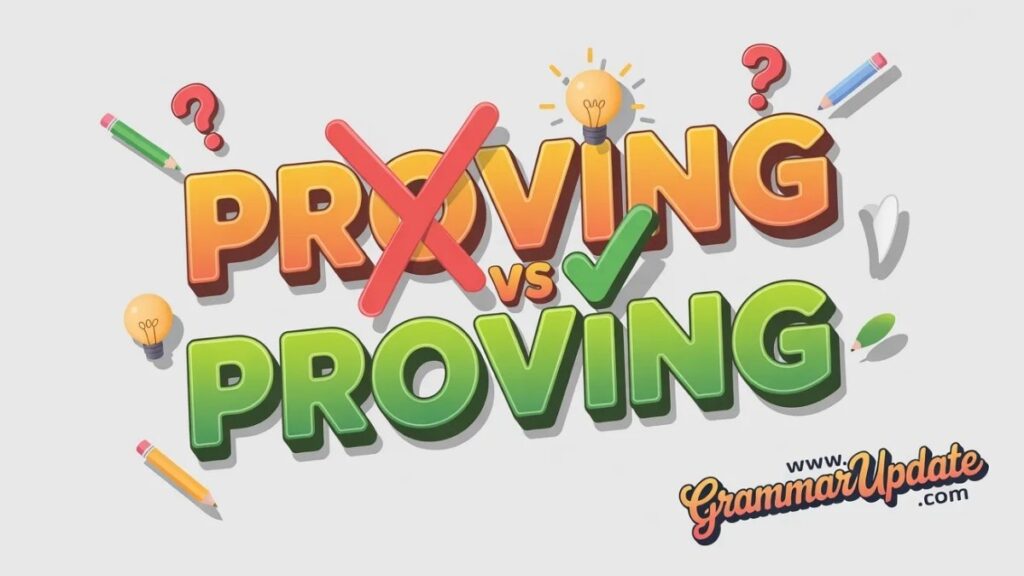
Understanding the proving meaning helps eliminate hesitation in usage.
Proving definition
Proving is the present participle of prove, meaning:
To demonstrate, confirm, or establish the truth, validity, or accuracy of something.
Key functions of “proving”
- Proving a point: demonstrating that an argument is correct
- Proving evidence: validating facts or claims
- Proving ability: showing competence or skill
Synonyms of proving
To improve writing variety, you can use:
- Demonstrating
- Confirming
- Verifying
- Validating
- Establishing
- Substantiating
Each carries a slightly different nuance, but all align with the idea of showing evidence.
How Do You Spell “Proving” Correctly?
If you’re asking “how do you spell proving?”, the answer lies in a simple and reliable grammar rule.
The rule: Drop the silent “e”
When a verb ends in -e, remove the “e” before adding -ing.
Examples
| Base Verb | Correct Form | Incorrect Form |
|---|---|---|
| Prove | Proving | ❌ Prooving |
| Make | Making | ❌ Makeing |
| Drive | Driving | ❌ Driveing |
| Write | Writing | ❌ Writeing |
Why this rule exists
Dropping the silent “e” maintains phonetic clarity and keeps English spelling consistent across verb forms. This rule is a cornerstone of verb forms in English.
Clearing Another Common Mistake
Another frequent error is prove or proove.
- Prove = correct
- Proove = incorrect
Why “proove” is wrong
English does not double the “o” in this verb. The correct spelling is always:
👉 P-R-O-V-E
This mistake often leads directly to prooving, so fixing one helps eliminate the other.
How to Use “Proving” in a Sentence
To master proving in a sentence, it helps to see how it functions across contexts.
Everyday usage
- She is proving her skills in a new role.
- He keeps proving everyone wrong.
- The results are proving the theory correct.
Academic writing
- The study is proving the hypothesis valid through controlled experiments.
- Statistical analysis is proving the correlation between variables.
Professional communication
- The system is proving reliable under high demand.
- This approach is proving effective in multiple markets.
Key observation
In every example, proving introduces evidence, validation, or demonstration.
Proof vs Prove Understanding the Difference
Confusion between these two words often leads to spelling errors.
Core distinction
| Word | Type | Meaning |
|---|---|---|
| Prove | Verb | To demonstrate truth |
| Proof | Noun | Evidence or confirmation |
Example
- You prove a claim using proof.
Related forms
- Proved = past tense of prove
- Proofed = used in editing or baking contexts
Understanding this distinction helps avoid mixing proof vs prove difference in writing.
More Confusing Words Made Simple
Vinal vs Vinyl Which Is the Correct One to Use?
Proofing vs Proving A Critical Distinction
The confusion between proofing or proving is not just about spelling it’s about meaning.
Proving
- Refers to demonstrating truth
- Used in academic, legal, and everyday contexts
Proofing
Has two distinct meanings:
Editing context
- Reviewing text for errors
- Also called proofreading
Baking context
- Allowing dough to rise through fermentation
Proofing vs Proving in Baking
This is where terminology becomes especially important.
What is proofing in baking?
Proofing bread means:
Allowing yeast to ferment, producing gas that causes dough to rise
Proving bread meaning
In British English, proving is sometimes used interchangeably with proofing.
Comparison
| Term | Meaning | Context |
|---|---|---|
| Proving | Demonstrating truth | General use |
| Proofing | Dough rising or editing | Baking/editing |
The Proving Dough Process Explained
Understanding the proving dough process adds practical depth.
Key stages
- Yeast activation
- Gas production (carbon dioxide)
- Dough expansion
- Texture development
Why it matters
Proper proofing ensures:
- Light, airy texture
- Better flavor
- Even baking
Without it, bread becomes dense and lacks structure.
Common Mistakes in Proving Usage
Writing “prooving”
❌ He is prooving his argument
✅ He is proving his argument
Confusing proof and prove
❌ I need to proof my theory
✅ I need to prove my theory
Mixing proofing and proving
- Use proofing for baking/editing
- Use proving for demonstrating truth
More Confusing Words Made Simple
Enable vs Inable Difference and Correct Usage
Context Matters Where “Proving” Is Used
Legal writing
- Proving liability
- Proving innocence
- Proving contractual obligations
Academic writing
- Proving hypotheses
- Supporting claims with evidence
Everyday communication
- Proving a point
- Proving reliability
The Impact of a Spelling Error
Consider two sentences in a job application:
“I am prooving my leadership abilities.”
“I am proving my leadership abilities.”
Outcome
- The second sentence reflects professionalism and attention to detail
- The first introduces doubt about language competence
In competitive environments, even small errors influence perception.
Practice Exercises
Fill in the Blanks Prooving vs Proving
Complete the sentences with the correct form (proving):
- The scientist is ______ the effectiveness of the new vaccine.
- She spent months ______ her skills in data analysis.
- By consistently meeting deadlines, he is ______ his reliability to the team.
- The experiment is ______ the initial hypothesis to be accurate.
- Even under pressure, the lawyer is ______ her client’s innocence.
Answers and Explanations:
- proving – Demonstrates confirmation of effectiveness.
- proving – Showing her skills in action.
- proving – Establishing reliability through evidence.
- proving – Validating the hypothesis scientifically.
- proving – Demonstrating truth in a legal context.
Tip: Remember, never use prooving. The correct spelling drops the silent “e.”
Multiple Choice
Choose the correct option in each sentence:
- The engineer is (prooving / proving) the design will work under extreme conditions.
- By presenting solid evidence, the student is (prooving / proving) her thesis.
- The athlete is (prooving / proving) that hard work pays off.
- The results of the trial are (prooving / proving) the defendant’s innocence.
- He keeps (prooving / proving) that his strategy is effective.
Answers:
- proving
- proving
- proving
- proving
- proving
Explanation: Each sentence requires the present participle of ‘prove’ the correct spelling is always proving.
More Confusing Words Made Simple
Triple Vs Tripple Which Is the Correct One to Use?
Contextual Sentences Exercise
Select the correct word to complete these real-life context scenarios:
- In baking, the chef is ______ the dough to ensure it rises correctly.
- A) prooving
- B) proving
- C) proofing
- During the meeting, she is ______ that her proposal will improve productivity.
- A) prooving
- B) proving
- C) proofing
- The jury is convinced by the lawyer’s argument, effectively ______ the client’s innocence.
- A) prooving
- B) proving
- C) proofing
- The student continues ______ that her theory is correct with data and experiments.
- A) prooving
- B) proving
- C) proofing
Answers & Explanations:
- C) proofing – In baking, “proofing” is correct, not “proving.”
- B) proving – Demonstrating evidence for productivity improvement.
- B) proving – Establishing the truth legally.
- B) proving – Confirming the hypothesis scientifically.
Pro Tip: “Proofing” is context-specific: editing or baking. Otherwise, use proving.
True or False Exercise
Decide if the following statements are correct:
- “Prooving” is a correct spelling of the present participle of “prove.”
- “Proofing” can refer to letting bread rise.
- “Proving” is used when demonstrating the truth of a statement.
- You can use “prooving” in formal academic writing.
- The difference between “proof” and “prove” is that “proof” is a noun, while “prove” is a verb.
Answers & Explanations:
- ❌ False – “Prooving” is incorrect.
- ✅ True – Baking or editing context.
- ✅ True – Showing evidence or establishing truth.
- ❌ False – “Prooving” is never correct in professional writing.
- ✅ True – Correct distinction between noun and verb.
Advanced Exercise: Rewrite the Sentences
Correct the errors in these sentences:
- He is prooving his argument with solid evidence.
- The student is prooving the theory through experiments.
- The chef is prooving the dough before baking.
Corrected Version:
- He is proving his argument with solid evidence.
- The student is proving the theory through experiments.
- The chef is proofing the dough before baking.
Note: This exercise reinforces context awareness: baking = proofing, grammar = proving.
Why Practice Matters
Repeated practice helps:
- Stop prooving spelling mistakes.
- Differentiate proofing vs proving contexts.
- Write with professional clarity in emails, academic papers, or legal documents.
- Avoid embarrassment in everyday communication.
More Confusing Words Made Simple
Descision vs Decision Which Spelling Is Correct?
Key Takeaways
- Proving is the correct spelling
- Prooving is always incorrect
- Drop the silent “e” when adding “-ing”
- Understand the difference between:
- prove vs proof
- proving vs proofing
- Correct spelling improves clarity and credibility
Here’s a trusted source for clear word meanings:
FAQs
Is it prooving vs proving?
Correct answer: prove
Is it proofing or proving?
- Proving = demonstrating truth
- Proofing = editing or baking
How do you spell proving correctly?
P-R-O-V-I-N-G
Is prooving a real word?
No, it is a spelling mistake
What is the difference between proofing and proving?
Proofing relates to editing or baking, while proving relates to demonstrating truth
When should I use proving in a sentence?
When you are showing evidence or confirming something
Final Insight
When it comes to prooving vs proving, one tiny extra “o” can cause big confusion but thankfully, the fix is simple. Stick with proving, and you instantly sound sharper, more professional, and confident in your writing. Think of it as your secret superpower: every time you use proving correctly, you’re not just spelling a word right you’re proving your mastery of English. So ditch the “o,” embrace clarity, and watch your sentences shine. After all, in the battle of prooving vs proving, winning is just one letter away.

Jhon AJS, the creative mind behind Grammar Update, is an experienced blogger passionate about simplifying English grammar. He focuses on explaining confusing word vs word differences, grammar rules, punctuation, and sentence structure in a clear and practical way. Through easy to understand guides and examples, Jhon helps readers improve their writing and communicate with confidence. With years of blogging experience, he continues to share helpful insights that make learning grammar simple, useful, and accessible for everyone.